





























The Kenyan shilling is enjoying a period of unusual calm.
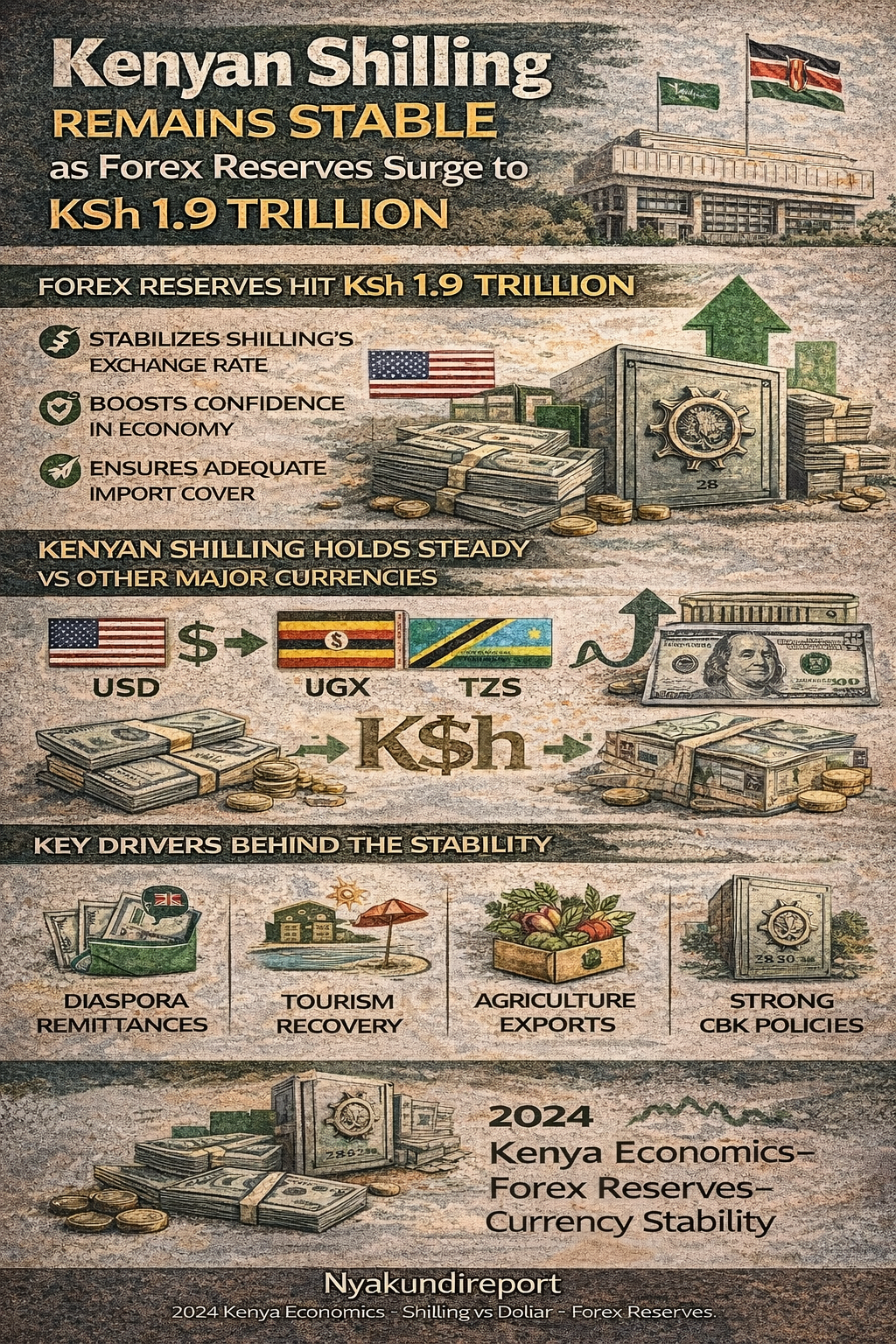
Therefore, holding steady against the US dollar and regional currencies, just as the country’s foreign exchange reserves hit a record KSh 1.9 trillion.
Shilling holds firm against US and EAC currencies
CBK’s latest weekly bulletin shows the shilling trading at around KSh 129.30 to the US dollar, almost unchanged from the previous week.
The regulator notes that the currency has remained “relatively stable against major international and regional currencies,” including the Ugandan and Tanzanian shillings.
This is a sharp contrast to 2023–2024, when the unit slid past 160 to the dollar, and volatility became a daily concern for importers and consumers.
Forex reserves hit a record of KSh 1.9 trillion
At the same time, usable foreign exchange reserves have climbed to about US$14.6 billion, equivalent to roughly KSh 1.9 trillion, up from around US$12.5 billion (KSh 1.6 trillion) just weeks earlier.
This gives Kenya about 6.2 months of import cover, comfortably above the legal minimum of four months and higher than the 4.6–5.3 months seen in late 2024 and early 2025.
CBK and Treasury officials attribute the jump mainly to proceeds from the recent US$2.25 billion Eurobond issue, which has replenished buffers and eased near‑term external payment pressures.
What this means for inflation and business
A stable shilling supported by stronger reserves helps cushion Kenyans from sudden price spikes on fuel, food, and imported inputs, because exchange‑rate shocks are less likely to feed quickly into inflation.
For businesses, especially importers and manufacturers, it provides more predictable conditions for pricing, contracting, and servicing external obligations.
The higher reserve cover also sends a reassuring signal to foreign investors, lenders,, and rating agencies that Kenya has room to meet upcoming external debt and import needs without immediate crisis.
The sustainability question
Economists, however, warn that rising reserves funded by Eurobond inflows are not a free lunch.
The borrowed dollars will have to be serviced and eventually repaid, meaning today’s comfort must be matched by tomorrow’s export earnings, remittances, and disciplined fiscal policy.
Analysis by Kenyan think tanks has repeatedly argued that the real goal should be a stable, not artificially strong, shilling, supported by higher productivity and a narrower current account deficit rather than continuous reliance on external commercial borrowing.
In that sense, the current stability and record‑high reserves buy Kenya time and credibility to fix underlying structural issues, but they do not remove the need for reforms.
ALSO READ:Kenya Airways Names Kiprono Kittony as New Board Chair