




































Christina Koch is not just another astronaut. She is a record-breaker, a trailblazer, and a living proof that determination conquers every frontier. From the freezing isolation of Antarctica to the vast darkness of deep space, Koch has consistently pushed beyond the boundaries of human achievement.
In April 2026, she etched her name permanently into history as the first woman to travel beyond low Earth orbit and journey around the Moon on NASA’s Artemis II mission—a moment that belongs not just to America, but to every woman who has ever dared to look up at the sky and dream.
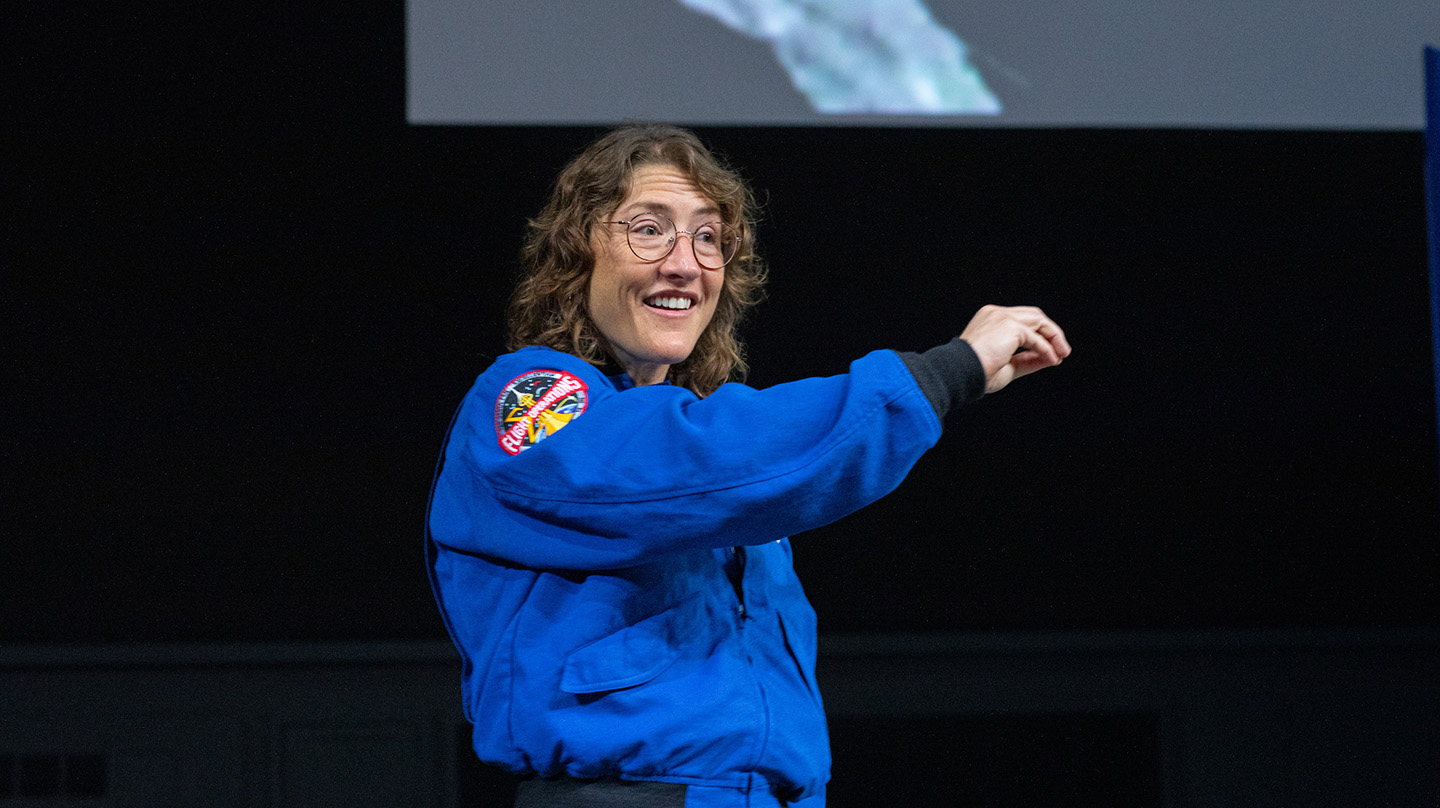
Who is Christina Koch? — Roots, Rise, and Record-Setting Career That Redefined Space Exploration
Christina Hammock Koch was born on January 29, 1979, in Grand Rapids, Michigan, and grew up in Jacksonville, North Carolina. Her parents, Barbara Johnsen of Frederick, Maryland, and Ronald Hammock of Jacksonville, raised a daughter who dreamed of space from a very early age. That childhood dream never faded — it grew into one of the most decorated careers in NASA’s history.
Koch attended the North Carolina School of Science and Mathematics in Durham, graduating in 1997. She then enrolled at North Carolina State University in Raleigh, where she earned two Bachelor of Science degrees—one in electrical engineering and another in physics—in 2001.
She followed that with a Master of Science degree in electrical engineering in 2002. In 1999, she also participated in an exchange program at the University of Ghana, Legon, where she studied astrophysics, broadening her scientific perspective across continents.
Her academic journey laid the foundation for a career that would take her from Earth’s most hostile environments straight to the Moon.
A Career Built in the World’s Most Extreme Environments
Before Koch ever launched into space, she tested herself in conditions that would break most people. She worked as an electrical engineer at NASA’s Goddard Space Flight Center, contributing to scientific instruments for multiple NASA missions studying astrophysics and cosmology. She also served as adjunct faculty at Montgomery College in Maryland, teaching physics laboratory courses.
From 2004 to 2007, Koch worked as a research associate in the United States Antarctic Program, spending three and a half years across Arctic and Antarctic regions. She completed a winter-over season at the Amundsen-Scott South Pole Station, where temperatures plunged to -111°F (-79.4°C).
She served on firefighting teams and ocean and glacier search-and-rescue teams—experiences that forged her mental resilience and physical toughness.
Between 2007 and 2009, she worked at the Johns Hopkins University Applied Physics Laboratory, contributing to instruments studying radiation particles for NASA missions, including Juno and Van Allen Probes.
She later joined the National Oceanic and Atmospheric Administration, eventually rising to station chief of the American Samoa Observatory. NASA selected Koch as part of Astronaut Group 21 in June 2013, and she completed her training in July 2015.
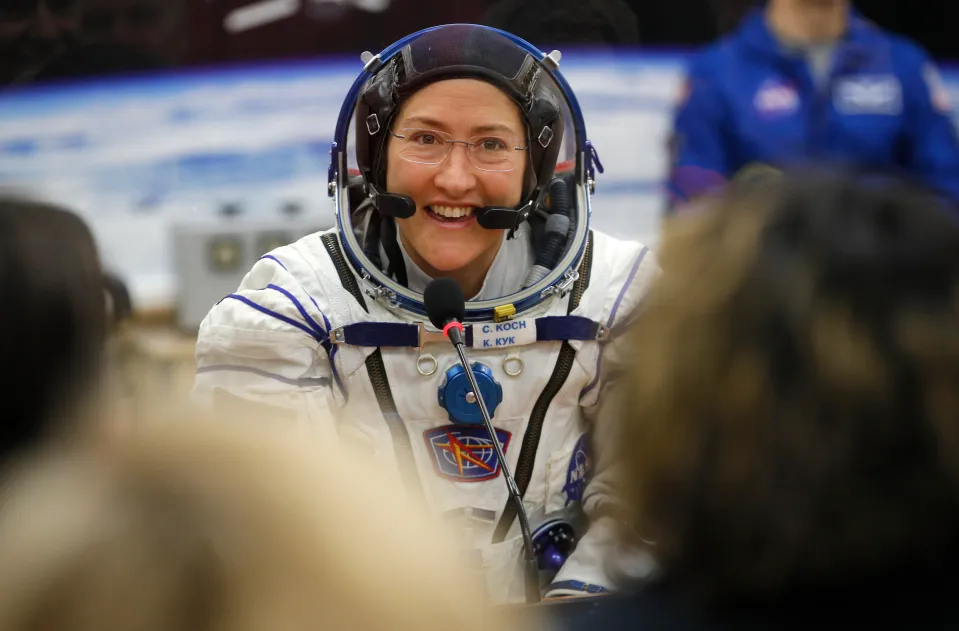
Spacewalks, Records and the Historic Artemis II Moon Mission
Koch’s spaceflight achievements stack up in a way few astronauts can match. Here is a summary of her landmark accomplishments:
| Achievement | Details |
|---|---|
| First all-female spacewalk | Conducted with Jessica Meir on October 18, 2019 |
| Longest single spaceflight by a woman | 328 days aboard the ISS, surpassing Peggy Whitson’s 289-day record |
| First woman beyond low Earth orbit | Artemis II mission, April 2026 |
| First woman to journey around the Moon | Artemis II flew 6,400 miles beyond the Moon’s far side |
| First Wikipedia edit from space | Made during her 2019-2020 ISS mission |
On April 1, 2026, Koch launched on the Artemis II mission alongside NASA astronauts Reid Wiseman and Victor Glover and Canadian Space Agency astronaut Jeremy Hansen. The crew flew by the Moon on April 6, 2026, travelling 6,400 miles beyond its far side before returning to Earth—setting a new record for human distance from Earth.
Her awards and honours reflect the full breadth of her career:
- NASA Group Achievement Award — Juno Mission Jupiter Energetic Particle Detector Instrument (2012)
- Johns Hopkins University Applied Physics Laboratory Invention of the Year nominee (2009)
- United States Congress Antarctic Service Medal with Winter-Over distinction (2005)
- NASA Group Achievement Award — Suzaku Mission X-ray Spectrometer Instrument (2005)
- Astronaut Scholar, Astronaut Scholarship Foundation (2000–2001)
- Honorary Doctor of Sciences — North Carolina State University (December 2020)
- Time 100 Most Influential People (2020)
Personal Life and Salary
Christina lives in Texas with her husband Robert Koch, a geospatial engineer she met in American Samoa in 2013. The couple has no publicly confirmed children. Outside of work, Koch surfs, rock climbs, ice climbs, does triathlons, practices yoga, and enjoys woodworking, photography, and backpacking. She is also a passionate Philadelphia sports fan who has watched the Phillies and Eagles from the ISS.
As a senior NASA astronaut, Koch earns an annual salary of approximately $183,500, consistent with senior-level government pay scales. While some sources speculate about her net worth, no official or independently verified figure exists.
What is beyond dispute is this—Christina Koch’s value to science, to space exploration, and to every girl who dreams of reaching the stars is simply priceless.


