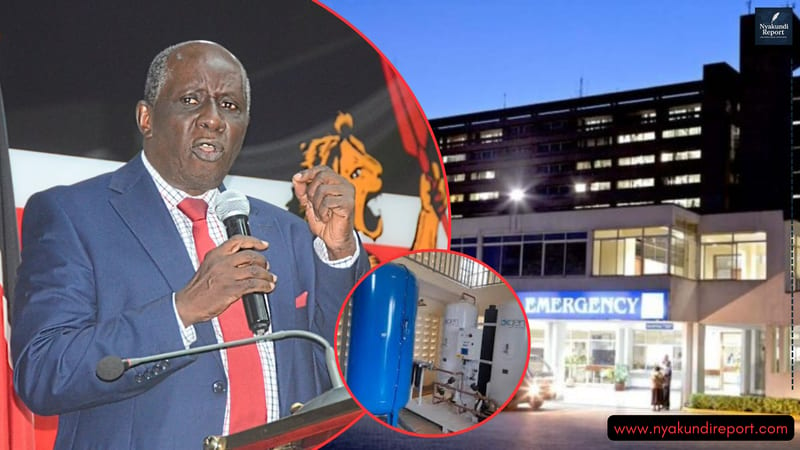
For years, taxpayers funded a Ksh 453 million oxygen plant meant to secure a lifesaving supply at Kenya’s biggest referral hospital. Today, that plant stands idle. As of March 2026, KNH's Non-Functional Oxygen Plant produces no oxygen, while patients rely on costly private suppliers. Lawmakers now question how procurement failures, weak supervision, and questionable payments crippled such a critical project. At the same time, cancer patients miss treatment, mothers queue in congested wards, and the hospital struggles to keep up with demand. Investigations by the Ethics and Anti-Corruption Commission have already flagged irregularities in the tender awarded to Biomax Africa, raising serious accountability questions. KNH's Non-Functional Oxygen Plant is not just a stalled project; it reflects leadership failure that demands accountability, urgent reform, and decisive action to protect patients and restore public trust. KNH's Non-Functional Oxygen Plant Raises Procurement Red Flags and Patient Safety Fears The National Assembly’s Committee on Health recently toured the hospital to assess service delivery. What they found alarmed them. Committee chair and Seme MP James Nyikal did not mince his words. He confirmed that the oxygen plant is not operational and does not produce even a single litre of oxygen per day.
He stated plainly that, as of now, KNH does not have a functioning oxygen plant. Yet the government paid hundreds of millions for it.
Nyikal pointed to problems across the entire chain. He cited flaws in procurement, design, tendering, supervision, and payment processes. He signaled that the committee will summon the Ministry of Health and other agencies to explain what went wrong and who bears responsibility.
Investigations by the Ethics and Anti-Corruption Commission have already revealed irregularities in the tender awarded to Biomax Africa. These findings reinforce fears that mismanagement and possible procurement manipulation derailed the project from the start.
Meanwhile, the consequences hit patients directly. Parliament Flags Oxygen Dependence Despite Sh453 Million Investment KNH’s Acting Chief Executive Officer, Richard Leyisampe, told MPs that the hospital serves about 700 patients daily who require oxygen support.
Without its own plant, the hospital purchases oxygen from private vendors. It also borrows from sister institutions such as Kenyatta University Teaching and Referral Hospital and Mama Lucy Kibaki Hospital.
Leyisampe insisted that patients are not currently experiencing shortages. However, he admitted that the hospital urgently needs a reliable in-house supply system.
The numbers tell a troubling story. Instead of generating oxygen internally, KNH spends hundreds of millions of shillings each year buying from private suppliers. This dependence drains public funds that could strengthen other critical services.
Nyikal stressed that a functional plant would not only serve KNH but could also supply surrounding health facilities. Instead, taxpayers now fund both the failed project and ongoing external purchases.
This double cost exposes a system that pays twice while patients remain vulnerable. Cancer Patients Pay the Price as LINAC Breaks Down The oxygen crisis does not stand alone. The committee also found major disruptions in cancer care. The hospital’s Linear Accelerator machine, commonly known as LINAC, has broken down. This machine delivers advanced radiotherapy treatment. Without it, the hospital relies on an older cobalt machine.
Nyikal confirmed that while doctors improvise with cobalt treatment, some patients miss the services they deserve.
Leyisampe revealed that KNH normally treats about 100 cancer patients daily. With the LINAC out of service, the hospital now treats only 50 patients using the cobalt machine. That means half of the patients who need radiotherapy do not receive treatment at KNH.
The hospital refers many of them to Kenyatta University Teaching and Referral Hospital. However, referrals increase waiting times and transport costs for already vulnerable patients.
Management assured MPs that repairs would be completed within a week. The committee is also considering allocating funds to procure an additional LINAC machine during the current budget process.
Still, the breakdown exposes how fragile critical services remain. When one machine fails, the system cannot absorb the shock. Maternity Congestion and Blood Shortages Expose Systemic Gaps Dr. James Nyikal and the National Assembly Health Committee directed the Health Ministry and relevant agencies to explain procurement failures and urgently restore KNH’s oxygen plant and critical services.
The committee also flagged severe congestion in maternity wards. Nyikal linked the overcrowding to dysfunction in lower-level facilities across Nairobi. Many expectant mothers arrive late at KNH because primary and secondary hospitals fail to handle complications early.
By the time they reach the referral hospital, they overwhelm the system. Nyikal warned that delays contribute to avoidable maternal and neonatal deaths. Mothers and babies wait longer because beds and staff cannot match the volume.
He indicated that the committee will call upon the Nairobi County Government to strengthen primary and secondary facilities. Without that support, KNH will continue to shoulder a burden it cannot safely manage alone.
At the blood donation unit, MPs found another gap. Demand for blood far exceeds supply. The hospital relies heavily on relatives of patients to donate.
Nyikal said the hospital needs more blood than it currently receives. The committee resolved to support the unit financially and help it conduct aggressive public blood donation drives.
The Accident and Emergency Department, now known as the Trauma Unit, also faces heavy congestion. Many walk-in patients from within Nairobi seek treatment there, even for conditions that primary facilities could handle.
This influx strains staff and resources. It also creates financial pressure because patients not registered under the Social Health Insurance Fund cannot be reimbursed. Nyikal advised the hospital to establish a dedicated unit to manage such cases under the Primary Care Fund and strengthen access to the Emergency and Critical Care Fund.
Despite the mounting challenges, the committee acknowledged improvements in infrastructure. The hospital received Sh1.1 billion for renovations. Works on Level Eight are complete, and Level Seven renovations are ongoing.
Nyikal commended management for prudent use of those funds. However, bricks and paint cannot mask deeper systemic failures.
KNH's Non-Functional Oxygen Plant remains the most glaring symbol of those failures. It represents wasted investment, flawed oversight, and misplaced priorities in a hospital that carries the nation’s highest referral burden.
Until authorities fix procurement loopholes, enforce accountability, and secure reliable supply systems, the hospital will continue to firefight avoidable crises. Patients deserve more than assurances. They deserve a health system that works.