Reported story
·
Updated 1 hr ago
Inside the Shadow Network Controlling Kenya’s Immigration System and Access to Visas and Passports
Investigation reveals a layered network around Kenya’s immigration system, linking middlemen, approval desks, clearance points and senior oversight to a fixed visa and passport pricing model driven by cash payments and controlled file movement.

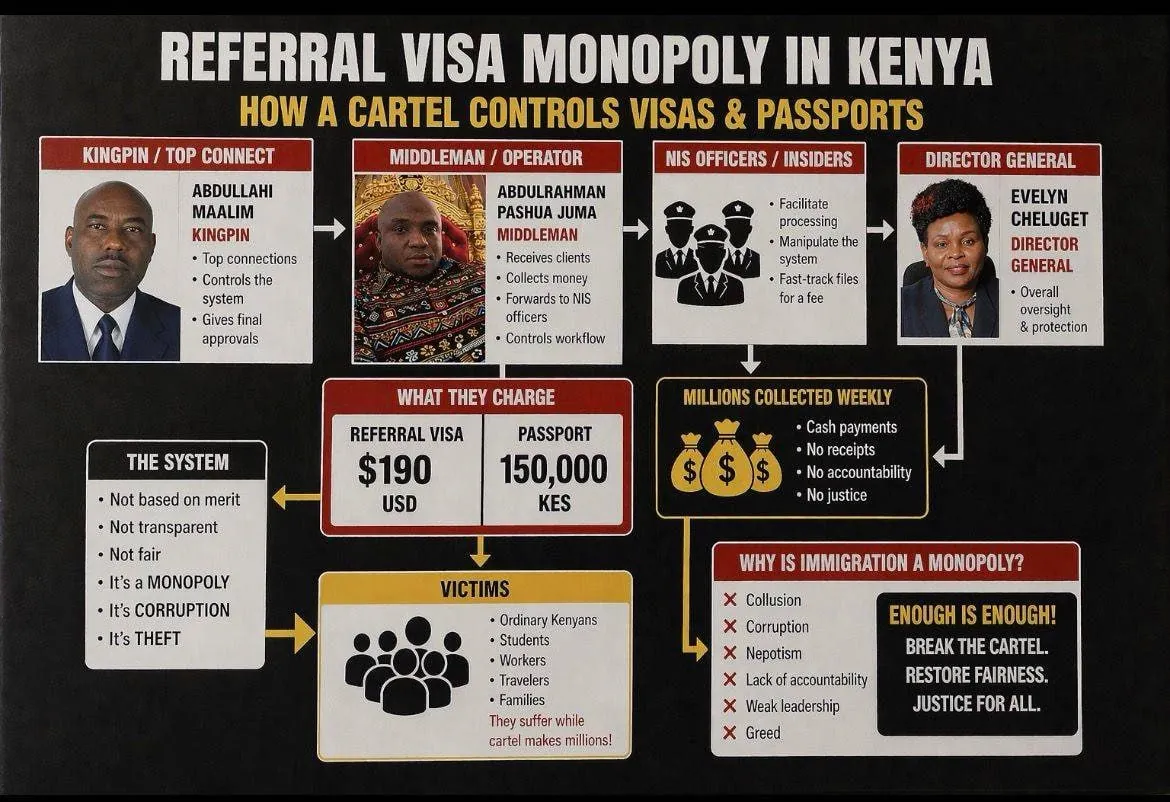
A carefully coordinated network operating around Kenya’s visa and passport processing system has emerged, exposing a structured chain through which applications are routed outside standard procedures, with payments, approvals and clearances moving through a tightly controlled set of actors embedded within and around the Directorate of Immigration Services, and with the result that access to critical travel documents is treated less as a public service and more as a managed commercial pipeline.
What the material describes is not a loose web of opportunistic middlemen drifting around the edges of the immigration system, but an organised machine with named handlers, fixed pricing, internal decision points and a hierarchy that appears designed to convert public documentation into a private market, where movement through the process depends not on merit, order or fairness, but on who sits at the right point in the chain and who is willing to pay.
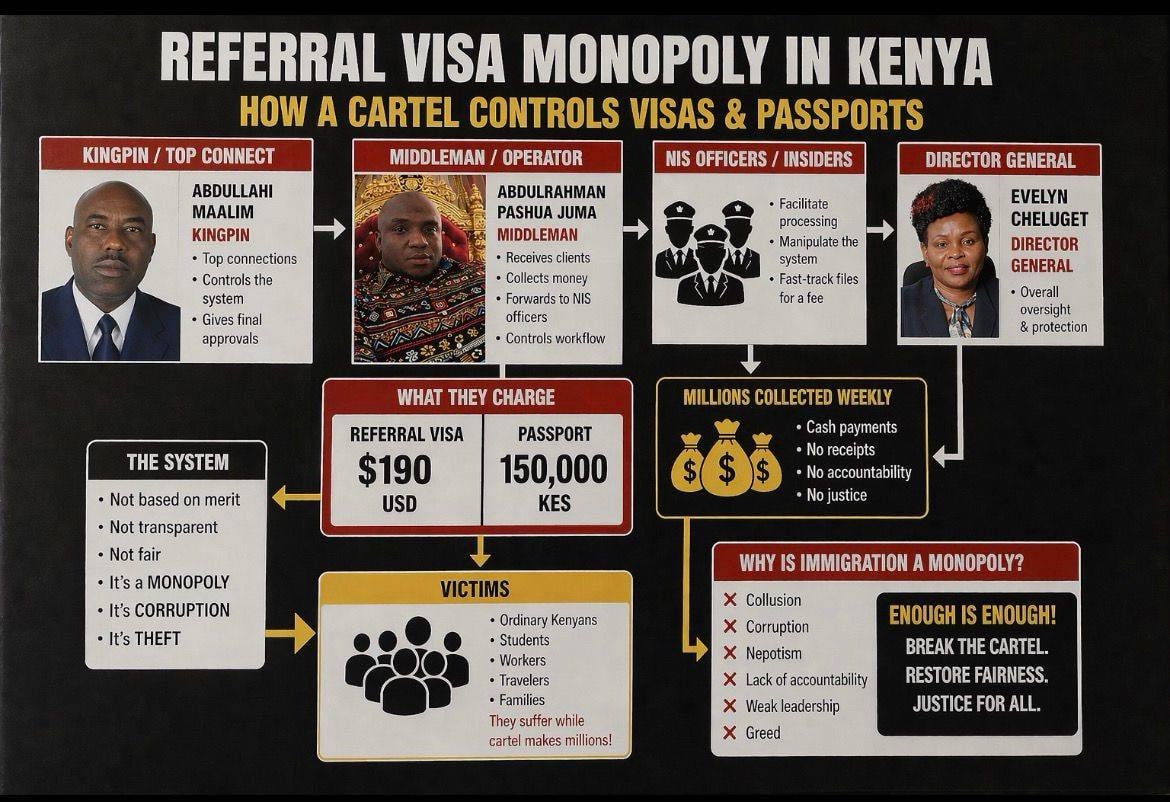
What gives this structure its force is not just the presence of actors at different levels, but the precision with which each role feeds into the next, creating a continuous loop in which applications are captured, redirected and processed through a closed system that mirrors official procedure while quietly displacing it.
The top layer: power, cover and final authority
At the apex of the structure sits the layer that gives the entire arrangement its durability, because no such network can survive without protection, internal alignment and administrative reach that stretches to the top of the institution, where final authorisation and operational cover are said to converge.
This layer is not defined by visibility but by control, operating less through open interaction and more through the ability to stabilise the system, maintain continuity and ensure that disruptions do not fracture the chain below.
Evelyn Cheluget: director general and the office of oversight
Evelyn Cheluget, as Director General, occupies the highest administrative post within the Directorate of Immigration Services, and in the structure mapped out in the material, her office is positioned as the point of overall oversight and protection, the place from which the system draws its institutional shield and where the final architecture of control is anchored.
In practical terms, that means the office at the top is not presented as a distant ceremonial perch, but as the command layer through which the wider processing environment is understood to operate, with the authority to shape how the directorate functions, how discipline is enforced, how files move, and how the internal order is maintained across the visa and passport chain.
Within such a configuration, stability at the top translates directly into continuity below, making this level central not only to administration but to the persistence of the entire structure.
Abdullahi Maalim: the central kingpin
At the core of the network is Abdullahi Maalim, identified in the material as the kingpin and the top connect, the central figure through whom the operation is said to be coordinated, aligned and sustained.
His role is depicted as the point where influence, access and workflow meet, making him the connective tissue between the outer brokerage layer and the internal machinery that turns applications into outcomes, while also embodying the command presence that keeps the chain intact, protects its rhythm and ensures that the commercial logic of the arrangement remains uninterrupted.
In structural terms, this position functions as the axis of the entire system, translating demand into action while ensuring that every segment of the chain remains synchronised.
The brokerage layer: who receives, collects and channels files
Once the top layer is set, the next tier becomes the working engine of the arrangement, the section that receives clients, handles money and delivers files into the internal corridor where approvals and clearance are said to be managed.
This layer operates with direct exposure to demand, meaning it is the point where public need meets controlled access, and where the system’s commercial nature becomes most visible.
Abdulrahman Pashua Juma: middleman and gatekeeper
Abdulrahman Pashua Juma, also identified as Salim, appears in the material as both middleman and gatekeeper, a dual role that places him at the most sensitive point of contact between the outside client and the inside processor.
He is described as the one who receives applicants, collects money, filters files and forwards them to the next stage, a position that gives him direct power over access and timing, while also making him the visible face of a system that depends on controlled entry, selective movement and strict internal discipline.
By controlling entry, he effectively determines which applications enter the accelerated channel and which remain trapped within the ordinary queue, turning access itself into a controlled commodity.
Abubakar Dhaqane, Abdiaziz Abdullahi Ibrahim and Mubashir Omar: the operational brokers
Running alongside that gatekeeping function is a second operational layer made up of Abubakar Dhaqane, Abdiaziz Abdullahi Ibrahim and Mubashir Omar, who are profiled as part of the middleman wing that manages client movement and keeps the pipeline active.
Their role, as set out in the material, is to receive and manage applicants, convert demand into cash, forward files into the channel and maintain the rhythm of the operation, which means they are not peripheral names but active operators who help turn an official service into a monetised route controlled by entry, payment and internal access.
The efficiency of this layer is what allows the system to scale, because it ensures a constant inflow of clients and a steady circulation of files into the internal processing chain.
The internal corridor: where files are pushed through
The real weight of any such structure sits not only in the brokers who collect money at the edge, but in the officers positioned inside the institution, where files are approved, cleared and pushed toward issuance, because that is where discretion turns into power.
This is the stage where the informal pipeline intersects directly with formal authority, converting external coordination into official output.
John Ndegwa: approval head for visas
John Ndegwa is identified as the approval head for visa processing, the officer at the point where files receive the decisive internal green light that moves them from pending status into the next phase of completion.
In the logic of the structure laid out here, that role is not routine paperwork; it is the key control point through which the entire stream passes, because once a file reaches approval, the direction of travel is effectively set, and the hand that controls that stage controls the tempo, the queue and the result.
Control at this stage effectively determines throughput, making it central to both speed and outcome.
Shem Ateka: clearance office
Shem Ateka is placed in the clearance office, a role that sits just beyond approval and acts as the final internal channel before issuance or release, making it one of the last procedural gates in the chain.
The clearance desk in such a structure is not merely administrative housekeeping; it is the finishing line where files are finalised, paperwork is sealed into the system and the process is completed, which is why the position carries weight far beyond its ordinary title.
At this point, the process transitions from internal handling to outward delivery, completing the cycle.
NIS insiders: the hidden layer inside the institution
The material also points to NIS insiders, described as officers embedded within the internal environment who provide cover, relay information or help keep the machinery working quietly from within.
Their presence matters because no network of this kind runs purely on external brokers alone; it needs inside hands, inside signals and inside alignment, and the mention of intelligence-linked insiders points to a deeper operational reach that goes beyond casual interference and into the realm of controlled institutional penetration.
This hidden layer strengthens the system’s resilience by reducing exposure and ensuring continuity.
The price list: how access is monetized
A striking feature of the material is the clarity of the pricing structure, which is not framed as a one-off abuse or a random demand, but as a fixed tariff system with standard amounts attached to different outcomes.
Referral visa at $190
The referral visa is priced at $190 (Ksh 24,000), a figure that turns access into a commodity and makes the first point of entry into the system a cash transaction rather than an administrative procedure.
That price tells its own story: the application is not just moving through a desk, it is moving through a commercial route where the value lies in speed, priority and access to the right hands, and where payment appears to determine whether a file enters the fast lane or remains stranded in the normal queue.
Scaled across volume, even modest daily intake translates into substantial weekly collections.
Passport at Ksh 150,000
The passport line in the material is even more stark, with a price tag of Ksh150,000, a figure that places ordinary citizens, students, workers, travellers and families in direct collision with a system that appears built to exclude anyone not able to pay premium sums for a basic state document.
When a passport is turned into a six-figure transaction, the issue is no longer routine inefficiency, because the service is recast as a monopoly in which the document itself becomes the prize, the fee becomes the gate and the poor are left to wait while those with money move ahead.
At scale, this pricing structure points to a revenue stream that runs into millions on a recurring basis.
Cash only, no receipts
The material says the money moves in cash, with no receipts and no formal paper trail, which strips the process of traceability and leaves no visible path for ordinary accountability.
That detail matters because a cash-only route without documentary evidence does not merely conceal a transaction; it creates a parallel economy inside a public office, one that thrives on invisibility, denial and the absence of ordinary fiscal controls.
Such a system is designed to sustain itself without interruption.
The structure of control: monopoly, not service
What stands out across the entire arrangement is the way the names, prices and roles fit together like parts of one machine, each actor occupying a specific slot that keeps the system operational and profitable.
This is why the material describes the setup as a monopoly rather than a service, because the routes are controlled, the fees are fixed, the outcomes are managed and the client has little room to negotiate once entry into the chain has been surrendered to the gatekeepers.
It is also why the language of theft appears so forceful in the material: when a public document is made available only through a private chain of paywalls, internal protection and controlled release points, the office stops looking like a neutral state facility and starts looking like a revenue corridor run for private gain.
What replaces fairness is control, and what replaces service is access for a price.
Who pays the price
The victims in this arrangement are the ordinary Kenyans who need visas, passports and travel documents for work, study, family movement or routine cross-border life, yet find themselves trapped in an environment where the official route appears to have been overtaken by cash demands and hidden handlers.
Students, workers, travellers and families are the ones who bear the delay, the pressure and the humiliation of a system that is supposed to serve the public but instead, according to the material, rewards those who can pay the referral fee while locking out those who cannot.
The burden is not just financial, but social and psychological.
What the structure tells us
The deepest problem exposed by this arrangement is not only the money changing hands, but the way the entire chain appears to be organised with deliberate roles, top-end protection and internal coordination that allows the process to keep moving while staying out of public view.
A kingpin at the centre, a middleman at the gate, brokers in the corridor, approval at one desk, clearance at the next, insiders inside the walls and a top office sitting over the whole design; that is not the language of a broken queue, it is the anatomy of a commercial system built to channel public demand into private gain.
It is structure, not accident.
The public cost
If this structure holds, then the cost is not merely financial, because once a state office begins to operate like a controlled market, public trust erodes, equal access disappears and the legitimacy of the institution itself begins to fracture.
A visa or passport ceases to be a right attached to a lawful process and becomes a product with a price tag, a layer of influence and a chain of intermediaries, and that is what makes the story so explosive: it is not just about money, but about the capture of a public function that should serve every Kenyan on equal terms.