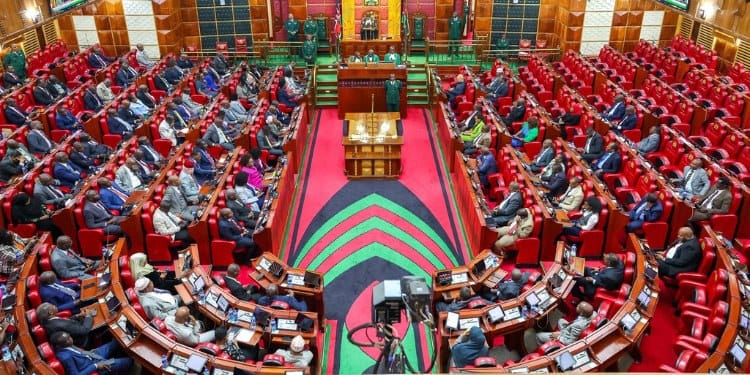
The National Assembly on Thursday evening passed the Finance Bill, 2026 through an electronic vote, clearing the final parliamentary hurdle and sending the legislation to President William Ruto for assent.
The Bill was approved at the Third Reading with 122 Members of Parliament voting in support and 40 voting against, with no abstentions recorded. The electronic voting process marked the formal conclusion of weeks of debate, committee scrutiny, and public participation on one of the most closely watched pieces of legislation in the current parliamentary calendar.
The outcome reflected the numerical strength of President Ruto’s broad-based coalition, which rallied behind the Bill, while a consolidated opposition bloc largely aligned to impeached Deputy President Rigathi Gachagua voted against it.
During earlier political mobilization, Gachagua had directed allied MPs to reject the Bill and demand a recorded division vote to publicly capture each legislator’s position.
The Finance Bill, 2026 is a key instrument in the government’s plan to finance the Sh4.8 trillion national budget for the 2026–27 financial year. It provides the legal framework for tax measures and revenue-raising policies that the Treasury says are necessary to support government operations, fund development projects, and service public debt obligations.
The Bill sailed through Parliament after lawmakers adopted a series of amendments proposed by the National Assembly Finance and National Planning Committee.
These amendments were developed following nationwide public participation exercises, during which stakeholders including businesses, civil society organisations, and members of the public raised concerns over several proposed tax measures.
Among the most significant changes made during the legislative process was the removal of a controversial proposal that would have required taxpayers to pay disputed taxes before they could file appeals.
The clause had drawn strong criticism from legal experts, taxpayers’ associations, and business groups, who argued it would undermine access to justice and make it difficult for taxpayers to challenge tax assessments.
Other amendments modified or dropped additional proposals that had attracted public concern, as MPs sought to strike a balance between the government’s revenue needs and the economic pressures facing households and businesses.
Treasury officials had defended the original proposals contained in the Bill, maintaining that the reforms were intended to improve tax compliance, broaden the tax base, and reduce reliance on borrowing.
They argued that the measures were also aimed at strengthening tax administration systems and ensuring more efficient collection of existing revenues rather than introducing excessively punitive taxation.
However, critics of the Bill maintained that several provisions risked increasing the cost of living at a time when many Kenyans are already grappling with high prices of basic goods and services. They warned that some of the measures could place additional pressure on households and small businesses, potentially slowing economic activity.
The vote followed an extended period of debate both inside Parliament and in the public arena, with the Finance Bill emerging as a key test of the government’s economic policy direction. Lawmakers on both sides framed the legislation not only as a fiscal instrument but also as a political statement on the government’s approach to taxation and economic management.
Inside the House, Speaker Moses Wetang’ula announced the final results after the electronic voting process confirmed the passage of the Bill. The sitting proceeded in accordance with parliamentary procedure after the Finance and National Planning Committee tabled its report recommending adoption of the Bill with amendments.
Following its approval by the National Assembly, the Finance Bill, 2026 will now be transmitted to President William Ruto for assent. Once signed, it will become law and provide the legal framework for revenue collection under the 2026–27 national budget.
Its passage represents a significant legislative victory for the Kenya Kwanza administration, which has been working to secure revenue streams needed to finance government programmes, support infrastructure development, and manage public debt obligations in a tightening fiscal environment.
The approval also sets the stage for implementation of the wider budget framework, with Treasury expected to move swiftly to align tax administration systems and enforcement mechanisms ahead of the new financial year.