
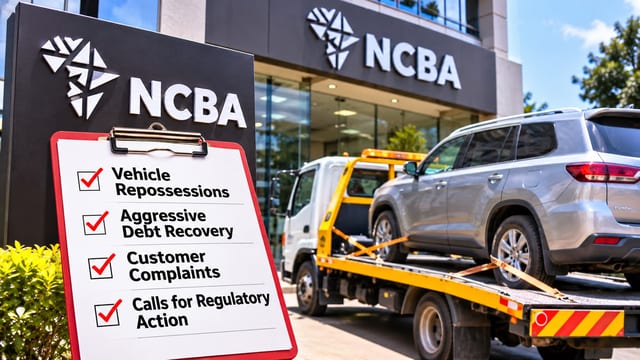
NCBA Bank is facing growing criticism over its vehicle repossession practices after Kenyans took to social media to question how vehicles financed through the lender are being seized, with some accusing the bank and its contracted recovery agents of employing aggressive tactics that leave borrowers financially devastated.
The latest complaints have raised concerns about the treatment of customers who fall behind on loan repayments, the procedures followed before vehicles are repossessed and whether borrowers are given a reasonable opportunity to resolve outstanding debts before losing assets they have spent years paying for.
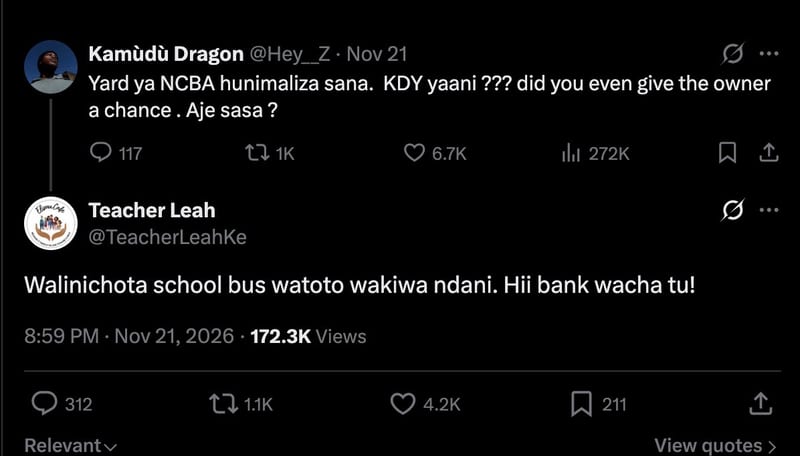
The controversy gained attention following a post on X by a user identified as Kamûdù Dragon, who questioned the number of vehicles being held at an NCBA-associated repossession yard. The user expressed disbelief at the sight of vehicles bearing relatively recent registration series, including KDY, and questioned whether their owners had been given sufficient opportunities to address their repayment difficulties before repossession.
"Yard ya NCBA hunimaliza sana. KDY yaani ??? did you even give the owner a chance. Aje sasa?" the user wrote, questioning how a relatively recently registered vehicle could already have ended up in a repossession yard
The post attracted considerable attention, recording approximately 272,000 views and thousands of reactions in the screenshot shared with Nyakundi Report. The engagement demonstrates the level of public interest surrounding vehicle repossessions, particularly among Kenyans who rely on financed vehicles for transport, business operations and income generation.
Another X user, Teacher Leah, made an even more troubling claim involving a school bus. According to her account, a vehicle was repossessed while children were still inside, raising questions about the conduct of recovery agents and the safety precautions taken during such operations.
"Walinichota school bus watoto wakiwa ndani. Hii bank wacha tu!" she wrote.
The statement suggests that a school bus was taken while pupils were on board. Nevertheless, the account raises a serious issue that deserves investigation because any recovery operation involving a vehicle transporting children must place their safety above the urgency of recovering a debt.
For many borrowers, vehicle financing represents a substantial financial commitment extending over several years. Customers are required to make regular repayments while meeting insurance, maintenance, fuel and other operating expenses. When a borrower experiences financial difficulties, whether through job loss, reduced business income or unexpected emergencies, missed instalments can quickly accumulate alongside interest, penalties and recovery-related charges. The consequences become particularly severe where the financed vehicle is also the borrower's principal source of income.
This is where concerns about aggressive repossession practices become important. A vehicle purchased to support a transport business, deliver goods or generate income through commercial operations may be the very asset a borrower needs to continue servicing the loan. Once the vehicle is repossessed, the customer can lose the means of earning money while remaining responsible for any outstanding balance under the financing agreement. If the vehicle is eventually sold for less than the amount owed, the borrower may still face a shortfall, subject to the applicable contract and law.
Under Kenya's Movable Property Security Rights Act, 2017, secured creditors have enforcement rights when borrowers default, but the exercise of those rights is subject to statutory requirements and the terms of the security agreement. The law provides procedures governing enforcement, possession and disposal of collateral, including requirements relevant to notification and commercially reasonable conduct. The precise obligations in an individual repossession depend on the financing arrangement, the applicable legal framework and the circumstances of the default.
Borrowers are therefore entitled to question whether the notices required in their particular circumstances were issued, whether the amounts demanded were correctly calculated and whether recovery agents acted lawfully.
The role of auctioneers and repossession agents also deserves attention. Where repossession activities fall within the Auctioneers Act and applicable rules, agents must comply with the legal requirements governing their conduct. Borrowers should be able to identify the individuals recovering their vehicles, understand the authority under which they are acting and obtain information about the outstanding debt and the process for recovering or redeeming the asset.
One of the most troubling aspects of the public discussion is the possibility of recovery operations being conducted without sufficient regard for the circumstances in which vehicles are being used. A commercial vehicle may be carrying passengers, transporting schoolchildren or operating on a busy road when recovery agents attempt to take possession. Such situations require careful handling to avoid exposing innocent third parties to unnecessary danger. If Teacher Leah's account is accurate, the reported school bus incident should be investigated to establish whether children were endangered and who authorised the operation.
There are also questions about the treatment of borrowers after their vehicles have been taken. Customers need clear information about the outstanding loan balance, repossession expenses, storage charges, redemption options and any intended sale of the vehicle. Without transparent communication, a borrower can find themselves facing an increasing financial obligation while struggling to understand how to recover the asset or challenge disputed charges.
The concerns extend to the valuation and sale of repossessed vehicles. A borrower who has already made substantial repayments has a legitimate interest in ensuring that the asset is disposed of through a lawful and commercially reasonable process. Where a vehicle is sold, the proceeds should be properly accounted for against the debt, with the borrower receiving a clear statement showing the sale amount, relevant expenses and any remaining balance or surplus.
NCBA should explain the safeguards it applies when appointing recovery agents, how it ensures that customers receive the required notices and what procedures exist to prevent repossession operations from endangering passengers or members of the public.
The bank should also clarify how borrowers experiencing temporary financial difficulties can seek restructuring or other repayment arrangements before recovery becomes unavoidable.
The Central Bank of Kenya, which regulates commercial banks, has an important role in ensuring that lenders maintain appropriate consumer protection and complaints-handling practices. Borrowers who believe their accounts have been mishandled should have access to clear procedures for raising disputes, obtaining account statements and seeking explanations about the actions taken against them.
For Kenyans who depend on financed vehicles to support their families, that distinction matters. A bank's right to recover a debt must operate alongside its responsibility to treat customers fairly and ensure that the people acting on its behalf remain within the law.