
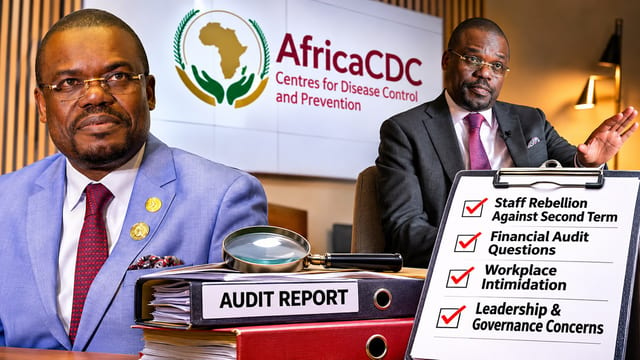
Africa Centres for Disease Control and Prevention (Africa CDC) Director-General Dr Jean Kaseya is facing mounting scrutiny over his leadership, financial management, staff treatment and recruitment practices as he campaigns for another four-year term at the helm of the African Union's leading public health institution.
His push for reappointment comes amid a petition from senior employees, complaints involving high-ranking African Union diplomats, disputes before the AU Administrative Tribunal and an external audit that identified 49 weaknesses in the organisation's financial management.
Kaseya, a national of the Democratic Republic of Congo, was appointed in 2023 following a diplomatic campaign backed by President Félix Tshisekedi. His current term expires in February 2027, and his reappointment will depend on a recommendation from the Africa CDC Governing Board and subsequent approval by the African Union Assembly. The board is scheduled to consider his continuation in office on November 22, 2026, just as questions about his management of the institution intensify.
Eight senior sources, most of them current or former Africa CDC employees, have raised concerns about Kaseya's leadership, including intimidation, threats directed at senior female diplomats, irregular staff appointments and the reassignment of employees who question management decisions. Four additional sources provided information through intermediaries or written documentation. The individuals requested anonymity because they feared professional retaliation.
The controversy has reached the institution's governing structures, with a petition from concerned senior employees calling on the Africa CDC Governing Board and the African Union Permanent Representatives Committee to reject Kaseya's reappointment.
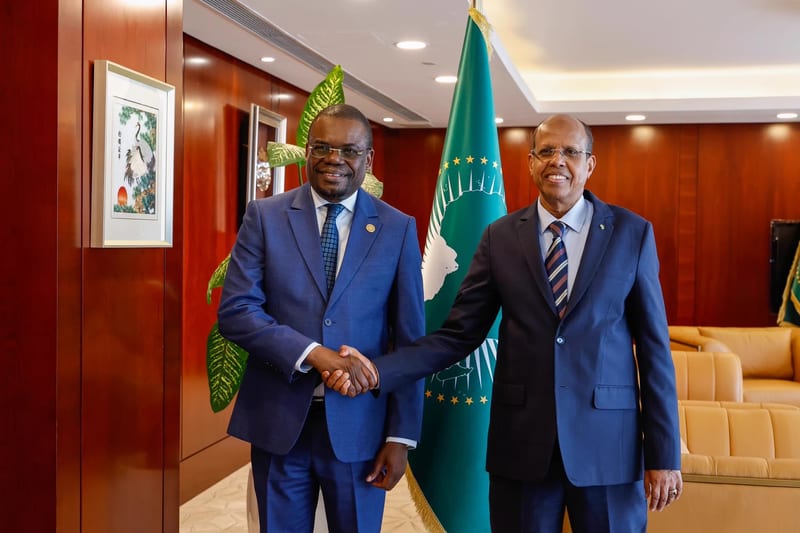
The petition challenges the validity of a performance appraisal completed in April 2026 and signed by African Union Commission Chairperson Mahmoud Ali Youssouf. The assessment covers Kaseya's entire period in office from 2023 to 2026, although Youssouf only assumed his position in March 2025. Employees have questioned whether the appraisal sufficiently covers the Director-General's performance and is procedurally sound.
The petition also notes that the appraisal was completed before the current Ebola outbreak, one of the major public health emergencies confronting the institution during Kaseya's tenure. The employees argue that a decision on his future should take account of the organisation's operational performance, financial management, institutional governance and treatment of staff.
The governing board has recently undergone a membership change, with eight African Union member states joining as part of the regular rotation. Health ministers representing Cameroon, Gabon, Gambia, Kenya, Namibia, Sierra Leone, Uganda and Zimbabwe attended an orientation meeting on November 10. North Africa has yet to nominate its two representatives.
The newly constituted board will therefore be responsible for considering one of the institution's most consequential leadership decisions while complaints about its current administration remain unresolved.
Kaseya's initial appointment has also returned to public discussion. During the 2023 selection process, former Guinea-Bissau Health Minister Dr Magda Robalo was the highest-ranked candidate but was not appointed. Robalo subsequently questioned the decision.
Rwandan President Paul Kagame also raised concerns about the appointment process in a March 2023 letter to the African Union Commission Chairperson, stating that discussion of Kaseya's appointment had not been permitted.
Africa CDC has defended the process, explaining that its statute provides for the selection and appointment of a Director-General rather than an election.
Dr Jean Kaseya's Threats Against Senior Female African Union Diplomats 

Among the most serious complaints are accounts from three senior sources who said Kaseya threatened two high-ranking female African Union Commission diplomats in incidents witnessed by other officials.
According to the sources, security personnel intervened during at least one confrontation. The incidents have raised questions about professional conduct and accountability within the African Union's administrative structures.
Sources also reported that Kaseya was instructed to take leave following the second confrontation. The staff petition presents a different account, stating that he was suspended for ten days over inappropriate conduct involving an African Union Commission official.
The petition questions why the reported disciplinary incident was not reflected in the performance appraisal used to assess his suitability for reappointment.
Employees Describe Intimidation, Uncertainty and a Difficult Working Environment 
Concerns about staff welfare have become another major issue surrounding Kaseya's leadership.
Ten current and former employees described the Africa CDC working environment as toxic, with staff reportedly fearing reassignment, removal or non-renewal of contracts if they challenge management decisions.
Employees have pointed to frequent changes in senior leadership as evidence of institutional instability. Africa CDC has had five Chiefs of Staff in less than four years, while 14 employees, including the Deputy Director-General and five directors, resigned in 2024.
Several former employees attributed their departures to difficult working conditions and management pressure.
One employee explained that many staff members operate under annual contracts whose renewal requires approval from the Director-General, creating uncertainty among employees concerned about job security.
The concerns have also attracted attention outside the institution. In August 2026, the Nigerian-based African Health Initiative Advocacy wrote to the African Union Permanent Representatives Committee requesting an independent examination of recruitment practices, staff appointments, organisational restructuring and employee management.
The organisation expressed concern that employees lacked sufficient protection when raising legitimate questions about institutional practices.
Its communication described a workplace in which some employees felt pressured and intimidated, with the working environment contributing to resignations.
The organisation also questioned the increasing use of appointments of limited duration, particularly where such appointments were made without open competitive recruitment. It raised concerns about employees with satisfactory performance records losing their positions while others were appointed to similar functions.
Additional questions were raised about advisers performing responsibilities normally assigned to directors and departmental heads.
Africa CDC disputes the suggestion that the institution is experiencing widespread staff departures.
The organisation maintains that only two directors have left since Kaseya took office, while seven directors have been recruited during the same period.
It also points to substantial growth in its workforce, from 262 employees in 2023 to 620 in 2026, which it attributes to an expanded mandate, additional programmes and increased recruitment across Africa.
According to Africa CDC, only 37 positions are financed directly through member-state contributions, while the majority of employees work on donor-funded projects.
The organisation explained that employment contracts linked to specific grants naturally end when the corresponding programmes conclude.
One example is the five-year, $1.1 billion Mastercard Foundation-supported Saving Lives and Livelihoods initiative, which ended in June 2026 and resulted in significant job losses.
Africa CDC has also defended its use of short-term appointments during public health emergencies, arguing that outbreaks require the rapid deployment of qualified personnel.
Tribunal Orders Spark Dispute Over Removal of Three Regional Directors 
A separate governance dispute has developed between Africa CDC and the African Union Administrative Tribunal following the reassignment of three regional directors in February 2026.
The directors, responsible for regional operations, challenged their transfer to the institution's headquarters in Addis Ababa.
On May 12, the tribunal issued an order suspending the reassignments and directing that the affected officials remain in their positions.
By that time, however, Kaseya had already appointed replacements who were subsequently designated Special Regional Representatives of the Director-General.
These officials assumed responsibilities previously carried out by the regional directors in West, Central and East Africa. The replacement positions had not been publicly advertised.
The dispute intensified on July 20 when African Union Commission Chairperson Mahmoud Ali Youssouf directed the three directors to accept redeployment to Africa CDC headquarters.
On October 26, the tribunal suspended that decision as well.
Two contempt proceedings have since been brought before the tribunal over the failure to implement its earlier directions. The proceedings concern the African Union Commission Chairperson and, by extension, Africa CDC.
The tribunal had not ruled on the contempt applications at the time of the original report.
Sources familiar with the dispute said the three directors were working from home and had faced pressure to abandon their cases.
Africa CDC has maintained that the African Union Commission Chairperson exercises administrative and financial oversight over the institution and is responsible for handling the dispute.
The confrontation has raised questions about compliance with tribunal decisions, the authority of senior management to restructure regional leadership and the protections available to employees challenging administrative actions.
External Auditors Identify 49 Financial Management Weaknesses 
Beyond the staff complaints, Africa CDC is facing scrutiny over its financial management following an external audit that identified 49 weaknesses in its accounting and administrative processes.
The financial management letter, issued by the African Union Board of External Auditors on May 27, 2026, covers the financial year ending December 31, 2025.
Of the 49 findings, 12 were classified as Grade 1, representing the most serious category of weaknesses.
Among the major findings were $23.5 million in outstanding bank reconciliation items spread across 2,013 transactions, expenditure incurred against activities without approved budgets and the absence of an internal audit during 2025.
The auditors also identified approximately $2.3 million in African Development Bank-financed expenditure that had not been recorded in Africa CDC's accounts because the bank paid suppliers directly.
Other findings concerned delays in spending funds provided by major development partners.
The audit identified $5.3 million remaining in a World Bank COVID-19 account that had been inactive since September 2025, without a final decision on whether the money should be spent, redirected or returned.
The auditors also raised concerns about the pace of expenditure under World Bank and Gavi-funded programmes.
The findings have intensified questions about financial oversight at an institution responsible for coordinating major disease surveillance, outbreak preparedness and emergency response programmes across Africa.
Africa CDC's 2025 annual report indicated that its directly managed grant portfolio had expanded from $52 million in 2022 to $463 million in 2025, covering 66 active grants.
The organisation's funding comes from several major partners, with philanthropic institutions accounting for 52 percent of its revenue.
The World Bank contributes 21 percent, governments eight percent, the African Development Bank six percent, the European Union four percent, Gavi three percent, the Global Fund one percent and other partners five percent.
Despite the size of the grant portfolio, the external auditors' letter did not provide a consolidated annual budget figure.
Instead, it recorded a cash balance of $52.9 million at the end of 2025.
Africa CDC Chief of Staff Dr Claudes Kamenga explained that the institution does not operate under one consolidated audit covering its entire budget, saying that seven separate audits had been conducted during the year.
Internal financial documents have also presented differing figures for the institution's 2026 finances.
One presentation to employees placed the annual budget at $74.4 million, with $55.4 million spent by September 9.
Another internal document placed total revenue, including grants, Ebola funding and the Africa Epidemics Fund, at $147.7 million.
The absence of a publicly available consolidated budget has made it difficult to establish a complete picture of the institution's financial position.
Questions Over International Travel and Spending 
The financial concerns extend to international travel expenditure and the management of donor-funded activities.
An anonymous policy brief circulated to African Union member states and Africa CDC donors in October raised complaints about spending priorities, including expensive travel arrangements, benefits for close associates and the use of emergency resources.
Six current and former employees separately raised concerns about the Director-General's international travel expenses, describing accommodation arrangements involving expensive suites normally reserved for senior government leaders.
The external auditors' findings identified weaknesses in travel expenditure controls across Africa CDC, although the audit did not attribute the identified problems directly to Kaseya.
According to the audit, the institution spent $8.8 million on airline tickets in 2025.
Of that amount, $1.78 million covered 1,608 tickets booked late, while 298 tickets were irregularly requested after their recorded departure dates.
The auditors also identified discrepancies between Africa CDC's travel accounting records and those maintained by airlines.
For Ethiopian Airlines alone, the difference amounted to $1.56 million.
Earlier reporting by Devex had raised concerns about substantial expenditure on travel and meetings under a five-year, $100 million World Bank grant.
An internal communication questioned the scale of those expenses, although the relevant spending was subsequently deemed justified by the institution's auditor.
Separate concerns reported by Devex indicated that World Bank officials feared the spending could create the impression of excessive expenditure on travel rather than public health activities.
The audit findings and staff complaints have renewed attention on how Africa CDC balances administrative expenditure with its responsibility to finance disease prevention, surveillance and emergency health responses.
Public Health Conference Faces Funding Questions Ahead of Leadership Decision 
Kaseya's reappointment discussions are scheduled to take place immediately before the International Conference on Public Health in Africa, Africa CDC's flagship annual gathering.
The 2026 conference is expected to take place in Addis Ababa, Ethiopia, with Kaseya publicly indicating that approximately 30,000 delegates could attend.
The projected attendance has raised logistical questions because the Ethiopian capital has approximately 25,000 hospitality beds.
The event has also attracted scrutiny over its funding arrangements.
Africa CDC has explained that Ethiopia is providing significant support, including non-cash contributions, while exhibition fees, registration payments and side events are expected to cover additional costs.
The institution said it did not maintain a single consolidated budget specifically for the conference.
However, an internal third-quarter review presented to staff on October 15 indicated that $36.5 million in funding requests remained pending.
At that point, approximately $400,000 in cash and $75,000 in non-cash contributions had been secured.
Sources also reported that international non-governmental organisations had been approached to sponsor participants, with some asked to contribute more than $1 million each.
Questions have additionally emerged over the allocation of youth fellowships for the conference.
Some young applicants complained that fellowships previously awarded to them had been withdrawn.
Africa CDC responded that approximately 12,000 young people had applied for participation opportunities, while the programme could accommodate only 4,000.
The conference's financial arrangements have drawn further attention because of problems identified during an earlier edition.
A special audit following the 2023 conference in Zambia found that a company initially contracted to organise the event for $618,638 ultimately received nearly $2.4 million.
The audit also found that only four companies had been invited to submit bids for the contract.
Earlier Leadership Controversies Resurface 
The current complaints are not the first to emerge during Kaseya's leadership.
Following his appointment in 2023, the Democratic Republic of Congo presidency celebrated the decision as a major diplomatic achievement for President Félix Tshisekedi.
The presidency described the appointment as the culmination of a six-month diplomatic campaign.
Months later, a group identifying itself as the African Union Leadership Focus Group raised concerns about Kaseya's leadership style, including staff treatment and management practices.
Africa CDC rejected those complaints at the time, describing them as baseless and unsupported.
Previous reporting also documented disagreements between Kaseya and his former employer, the Clinton Health Access Initiative, which did not renew his contract after two years as country director in the Democratic Republic of Congo.
The renewed scrutiny comes as Africa CDC continues expanding its responsibilities in disease surveillance, emergency preparedness, outbreak response and coordination of health programmes across African Union member states.
The institution has defended its operational growth, recruitment practices and leadership structures, maintaining that its expansion reflects increased responsibilities rather than organisational instability.
Nevertheless, the staff petition, outstanding tribunal proceedings, external audit findings and questions surrounding senior management have placed the Director-General's reappointment under close examination.
The November 22 governing board meeting will determine whether Kaseya receives a recommendation for another four-year term, subject to the African Union's final approval process.
For the employees seeking changes in leadership, the decision represents an opportunity for the governing board to examine unresolved institutional concerns before endorsing another term.
For Africa CDC, the wider issue concerns maintaining confidence in the governance, financial accountability and operational independence of an institution entrusted with protecting public health across the continent.
Article credit: Adapted and rewritten from an investigation by Kerry Cullinan, Health Policy Watch, published November 16, 2026.