
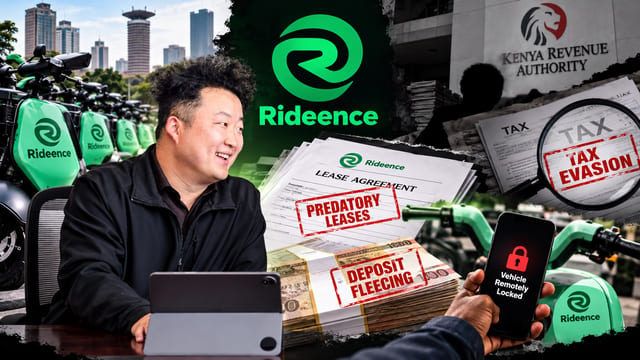
Serious complaints have emerged against Rideence Africa Limited, an electric mobility company operating in Kenya, with transport operators accusing the firm of imposing excessive leasing charges, deducting unexplained fees from security deposits and remotely disabling vehicles when drivers fall behind on payments.
According to a complaint circulating among transport stakeholders, operators are required to pay deposits ranging from KSh 100,000 to more than KSh 300,000, only to face additional deductions before their vehicles begin generating income.
The complainants further claim that daily leasing demands can reach KSh 5,000, placing drivers under considerable financial pressure in a sector already struggling with charging infrastructure limitations, electricity interruptions and unpredictable passenger demand. These accusations have not been independently verified, and Rideence Africa Limited's response has not been provided.
The complaint raises further questions about the use of remote vehicle immobilisation technology, the circumstances under which leased vehicles are repossessed and whether affected operators receive proper accounts of their deposits and payments.
It also calls for an examination of the company's tax compliance, although no independent evidence establishing tax evasion has been presented. The concerns come as Kenya encourages investment in electric transport, making it important that the transition protects drivers and small businesses alongside investors.
The Competition Authority of Kenya, Kenya Revenue Authority, National Transport and Safety Authority and Directorate of Criminal Investigations are among the agencies being urged to examine the accusations. Below is the complaint as submitted, reproduced without substantive alteration.

As Kenya positions itself as a regional hub for green energy and electric mobility (E-mobility), a growing financial scandal threatens to derail the sector. An in-depth investigation reveals that Rideence Africa Limited, an electric vehicle (EV) enterprise operating in Kenya, is running a systemic predatory leasing scheme designed to fleece local transport operators, SACCOs, and small-business drivers out of millions of shillings while systematically evading statutory tax obligations to the Kenya Revenue Authority (KRA). Under the guise of providing eco-friendly, low-cost transport solutions, Rideence targets small-and-medium public service vehicle (PSV) operators and independent drivers with promises of affordable EV leasing. However, transport stakeholders and affected operators report a calculated cycle of financial exploitation: Pre-Deployment Deposit Erosion: To secure a vehicle, operators are required to pay heavy upfront security deposits ranging from KSh 100,000 to over KSh 300,000 per unit. Before the vehicles are placed on the road or earn a single shilling, Rideence reportedly begins deducting undocumented administrative fees, system charges, and pre-maintenance costs directly from the operators' deposits. Exorbitant and Unviable Daily Targets: Operators of small commercial vans and 14–33 seater electric buses are subjected to daily lease demands as high as KSh 5,000 per day. In Kenya's current transport landscape—hampered by charging infrastructure constraints, power grid downtime, and route traffic—these targets are mathematically unviable. Remote Telematics Disablement: The moment a driver experiences a minor payment delay or dispute regarding daily targets, Rideence utilizes integrated vehicle telematics and Engine Control Unit (ECU) kill-switches to remotely lock engines mid-route, disabling vehicles on public roads without prior notice. Arbitrary Repossession & Asset Cycling: Following remote lockouts, Rideence forcibly repossesses the vehicle, unilaterally declares the entire security deposit forfeit, and absorbs all prior lease payments. The same vehicle is then polished and leased to another unsuspecting Kenyan operator, restarting the lucrative extraction cycle.Legal experts and consumer advocacy groups note that Rideence’s operational model breaches several fundamental provisions of Kenyan law designed to protect citizens, ensure fair competition, and safeguard public revenue. Article 46 (Consumer Rights): Guarantees consumers the right to goods and services of reasonable quality, full disclosure of financial and contractual terms, and protection of their economic interests. Article 47 (Fair Administrative Action): Protects citizens from arbitrary, unilateral administrative or contractual decisions without prompt, reasonable, and lawful procedural fairness. Article 201 (Principles of Public Finance): Demands openness, accountability, and fair sharing of the tax burden across all corporate entities operating within the Republic. Consumer Protection Act (No. 46 of 2012): Sections 12 and 13 prohibit unconscionable representations and predatory consumer practices, specifically targeting contracts where the burden on the consumer is grossly disproportionate to the benefit received. Competition Act (Cap 504), Section 56: Strictly outlaws unconscionable conduct in commercial transactions, prohibiting dominant parties from exploiting bargaining power imbalances or enforcing terms not reasonably necessary for legitimate business protection. Movable Property Security Rights Act (No. 13 of 2017): Regulates the enforcement of security rights in movable property. Self-help repossession via remote electronic lockouts—without formal default notices, statutory cure periods, or judicial enforcement orders—violates statutory debt recovery procedures and endangers public safety on roads. Tax Procedures Act (No. 29 of 2015), VAT Act (No. 35 of 2013), and Income Tax Act (Cap 470): Commercial lease arrangements attract mandatory Value Added Tax (VAT), Withholding Tax (WHT) on lease charges, and Corporate Income Tax. By structuring operations around forfeited off-the-books deposits and untracked cash/digital transfers, Rideence allegedly conceals revenue streams, defrauding the KRA of statutory duties owed to the Kenyan public. We call upon key national regulatory, enforcement, and investigative bodies to intervene immediately to protect Kenyan transport operators and preserve the integrity of the country’s green energy transition.We demand the following immediate actions: Competition Authority of Kenya (CAK): Initiate an immediate administrative audit into all Rideence Africa Limited lease contracts under Section 31 of the Competition Act; issue interim cease-and-desist orders against remote vehicle disablement; and mandate full restitution of unlawfully confiscated deposits. Kenya Revenue Authority (KRA): Launch a comprehensive forensic tax audit into Rideence Africa Limited’s financial accounts, deposit forfeiture registers, VAT remittances, and corporate income declarations under the Tax Procedures Act. National Transport and Safety Authority (NTSA): Audit and suspend Rideence’s fleet operational licenses pending safety reviews on the remote kill-switch technology used to disable moving or active PSV units on public highways. Directorate of Criminal Investigations (DCI - Economic & Banking Fraud Unit): Open criminal investigations into the executive management of Rideence Africa Limited for obtaining money by false pretenses (Penal Code Sec. 313), fraudulent contract execution, and economic sabotage against Kenyan transport entrepreneurs.