
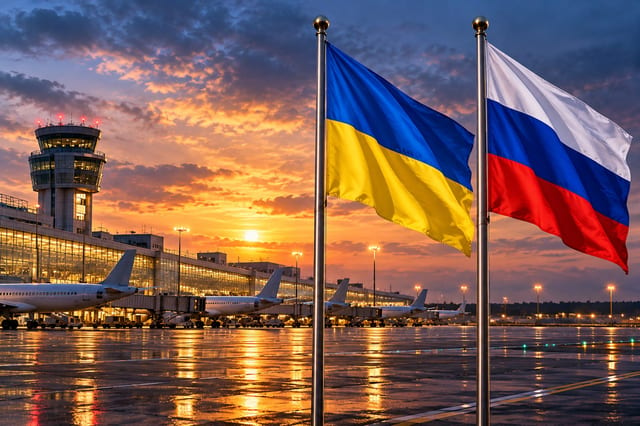
Moscow has been forced to temporarily shut down its four major airports following reported Ukrainian drone activity, raising fresh security concerns just days before African leaders are expected to arrive in the Russian capital for the third Russia–Africa Summit.
The disruptions on Friday, October 23, affected Sheremetyevo, Vnukovo, Domodedovo and Zhukovsky airports, with reports of widespread flight delays and cancellations as Russian authorities responded to the aerial threat.
Passengers at Sheremetyevo Airport were reportedly evacuated following an air raid alert and reports of drone debris within the airport complex. A separate evacuation was also reported at Moscow City's IQ-Quarter complex, which houses several Russian government ministries.
The developments come just five days before the Russia–Africa Summit, scheduled for October 28–29, raising questions about the safety of visiting delegations and Moscow's preparedness to host African heads of state and other senior officials.
Repeated airport closures in recent weeks have highlighted the extent to which the war in Ukraine continues to affect the Russian capital, potentially complicating travel arrangements for African delegations expected to arrive in the coming days.
Beyond the immediate security concerns, Russia is also facing growing questions over its treatment of African nationals recruited into its war in Ukraine, with revelations that Moscow has declined to help trace or repatriate the remains of dead Kenyan fighters casting another shadow over the summit.
The gathering comes amid disturbing reports of African job seekers from countries including Kenya, Ghana, Uganda, Zimbabwe and South Africa being lured into Russia's military through promises of lucrative employment, only to find themselves fighting on the frontlines in Ukraine.
The controversy has raised questions about Russia's commitment to African countries it routinely describes as strategic partners, particularly as families struggle to establish the whereabouts of relatives who travelled to Russia seeking better economic opportunities.
Prime Cabinet Secretary and Foreign Affairs Cabinet Secretary Musalia Mudavadi recently told Parliament that 84 Kenyans involved in the conflict had either been killed or were missing, while government records identified 354 Kenyans linked to the war.
More troubling was his disclosure that Russia's Defence Ministry had declined to assist Kenyan authorities in locating and repatriating the remains of those killed.
"The Russian Ministry of Defense says it cannot help in tracing or repatriating the remains of the deceased," Mudavadi told lawmakers.
The revelation presents an uncomfortable diplomatic contradiction for Moscow, which has spent years portraying itself as a dependable African ally while expanding its political and security influence across the continent.
For affected families, the consequences extend beyond the loss of loved ones. Without official confirmation of death, burial information or access to remains, relatives face difficulties securing compensation and giving their loved ones dignified burials.
Investigations suggest the scale of African recruitment could be substantially higher than official government records indicate.
A February investigation by The Washington Post, citing Kenyan intelligence findings, reported that more than 1,000 Kenyans had been lured into Russia's military through recruitment networks promising civilian employment and attractive salaries.
Separately, Swiss-based investigative group INPACT, through its All Eyes on Wagner project, identified 1,417 African nationals from 35 countries who signed contracts with the Russian military between January 2023 and September 2025.
Its investigation documented 316 deaths among the identified recruits, representing more than 22 per cent of those recorded.
Another investigation by iLAB, Code for Africa's technical investigations team, identified 289 digital assets, including websites, social media accounts and messaging channels, allegedly used to attract recruits through misleading employment opportunities.
The findings have intensified scrutiny of Moscow's recruitment practices and the vulnerability of unemployed African youth to networks promising financial opportunities abroad.
Ukrainian President Volodymyr Zelensky had earlier warned African governments about their citizens being drawn into the conflict.
"We know that Russia uses citizens of 47 countries in its war," Zelensky told the United Nations General Assembly on September 24, naming Kenya, Ghana, Zimbabwe and South Africa among affected countries.
The controversy has also exposed contradictions in Russia's diplomatic position.
During a March visit to Moscow, Mudavadi said Russia had agreed to stop deploying Kenyan nationals to fight in Ukraine. However, Russian authorities have repeatedly denied organising recruitment operations in Kenya.
Questions therefore remain over how Moscow intends to prevent further recruitment while distancing itself from responsibility for the existing networks.
The revelations come as Russia seeks to deepen its economic and diplomatic relationships with Africa despite maintaining a comparatively modest commercial presence.
Kenya exported goods worth just $48.48 million to Russia in 2024 against imports valued at $589.78 million, according to United Nations COMTRADE data, leaving a trade deficit exceeding $541 million.
Although Russia remains an important supplier of wheat and fertiliser, its economic footprint remains considerably smaller than those of China, Europe and the United States.
The recruitment controversy now presents a more immediate challenge to Moscow's diplomatic credibility than the trade imbalance.
International humanitarian law requires parties to armed conflicts to take measures to account for missing persons and facilitate the return of human remains to families.
International law scholar Dominic Mundia has called on Kenya to demand verified lists of recruits, military service records, death certificates and burial information from Moscow.
As African leaders prepare to gather in Russia, the fate of citizens recruited into the Ukraine war presents a difficult question for the summit's organisers.
For a government seeking to strengthen its image as Africa's trusted friend, Moscow faces growing pressure to explain why African families are struggling to obtain even basic information about relatives who died fighting in its war.