
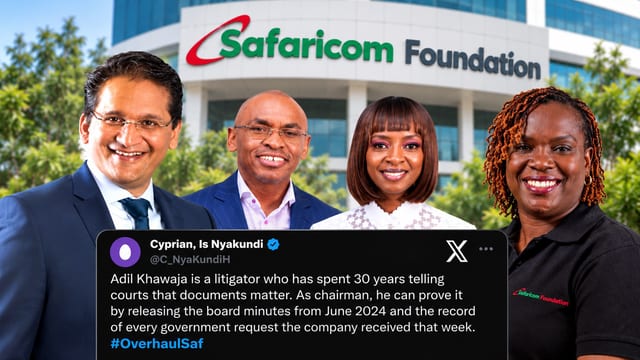
Investigative blogger Cyprian Nyakundi has opened a fresh debate about accountability at Safaricom, questioning how it selects beneficiaries of its charitable projects, awards procurement contracts and handles complaints against senior executives. His latest campaign has placed Karen Basiye, the company’s Director of Sustainable Business and Social Impact, at the centre of questions concerning the Safaricom Foundation, while extending scrutiny to CEO Peter Ndegwa, board chairman Adil Khawaja and the company's management of sensitive telecommunications infrastructure ahead of Kenya’s 2027 General Election.
The controversy began with Nyakundi questioning why serious issues concerning the foundation's procurement practices and leadership have not resulted in a publicly disclosed independent investigation. He wants Safaricom to explain how projects are selected, who approves funding, whether politically connected individuals receive preferential treatment and what mechanisms exist to prevent conflicts of interest involving trustees, managers and suppliers. His concerns have since expanded into a wider examination of corporate governance, employee treatment, data protection and the company's relationship with the government.
In one of his posts on X, Nyakundi directly challenged the foundation's leadership:
"What exactly is happening inside the Safaricom Foundation, and why are serious corruption allegations against its senior leadership Karen Basiye not being subjected to a publicly disclosed independent investigation? Why do the foundation projects only go to politicians that are pro-government? #OverhaulSaf"
The questions concern an organisation whose programmes reach schools, hospitals and communities across Kenya. Under its 2023–2026 strategy, the Safaricom Foundation has focused on education, health and economic empowerment, areas where access to funding can significantly influence the lives of vulnerable households. The foundation's public profile makes the transparency of its expenditure particularly important, especially when projects are unveiled alongside elected politicians who may receive political recognition for developments financed through corporate philanthropy.
At the centre of Nyakundi's criticism are that some foundation resources may have been improperly allocated, that procurement decisions may have favoured particular interests and that certain projects may not have delivered the benefits originally promised. Claims have also circulated about projects existing primarily in documentation and funds being channelled through private investment structures or foreign currency accounts.
The concern over political favouritism has attracted particular attention because several foundation projects have been publicly associated with influential political figures.
In Vihiga County, Senator Godfrey Osotsi has been cited as acknowledging that he lobbied for a KSh40 million facility at Emusenjeli Primary School.
In Machakos, former State House Chief of Staff and gubernatorial aspirant Nzioka Waita has been quoted describing how an initial request for KSh2.5 million developed into support worth KSh50 million, which he linked to his previous service. In Tongaren, National Assembly Speaker Moses Wetang'ula appeared alongside Basiye during the launch of a school project valued at KSh35 million.
These examples have become part of the discussion about whether political access influences which communities receive foundation assistance.
The more substantial question is whether communities without politically influential intermediaries have an equal opportunity to obtain support. If projects are selected through transparent assessments of public need, the foundation should be able to demonstrate that through its records. If political recommendations are considered, the organisation should explain how they are evaluated and what safeguards prevent politicians from turning charitable projects into instruments of personal influence.
The Safaricom Foundation Board of Trustees consequently has questions to answer about the complaints raised against its management.
Were any formal whistleblower reports received concerning Basiye or the foundation's procurement decisions? Were those complaints investigated, and by whom? Did any trustee declare a conflict of interest involving suppliers, contractors or beneficiary organisations? Were any executives considered for administrative leave or negotiated departures in connection with the concerns?
The material supplied does not establish that such steps occurred, but disclosure of the relevant governance procedures would help address the uncertainty.
Nyakundi has also called for a wider examination of procurement across Safaricom, arguing that the company's role in Kenya's economy demands greater openness about how commercial relationships are managed.
"The next major Safaricom investigation should examine its procurement contracts, supplier selection, related party dealings and conflicts of interest, because a company handling critical national infrastructure should be open to rigorous scrutiny. #OverhaulSaf"
The demand extends beyond the foundation's charitable spending. Safaricom purchases technology, infrastructure, professional services, advertising, branding and other supplies through relationships that may involve substantial financial commitments. Questions about procurement therefore concern not only whether suppliers deliver value for money but also whether executives or their relatives have interests in businesses benefiting from company contracts.
One of Nyakundi's most pointed concerns CEO Peter Ndegwa's wife, Jemimah, whom he has linked to claims about the company's branding operations.
"Safaricom CEO @PeterNdegwa_ Is free to deny that his wife handles Safaricom Branding etc .... from London, and that he personally handpicked her #OverhaulSaf"
Nyakundi has also questioned the quality of the company's branding, suggesting that its current output reflects problems in how the function is managed. His posts have included the remark

Are you aware that Peter Ndegwa pushed out Safaricom Executive Committee members who opposed the leaking of Kenyans' personal data, reportedly angered by their objections, leaving him with a free hand to run the company without internal resistance?
His wife, Jemimah, operates from London and handles Safaricom's branding work, including design and printing.
Who approved these arrangements, which companies received the contracts, and why hasn't Safaricom publicly addressed these serious allegations of possible conflicts of interest and retaliation against senior managers?
Nyakundi has separately raised issues about the removal of Safaricom Executive Committee members, questioning whether some executives were pushed out after objecting to the handling of customers' personal information. He has suggested that Ndegwa became dissatisfied with internal resistance to practices involving the disclosure of personal data, eventually leaving the CEO with fewer obstacles to his decisions.
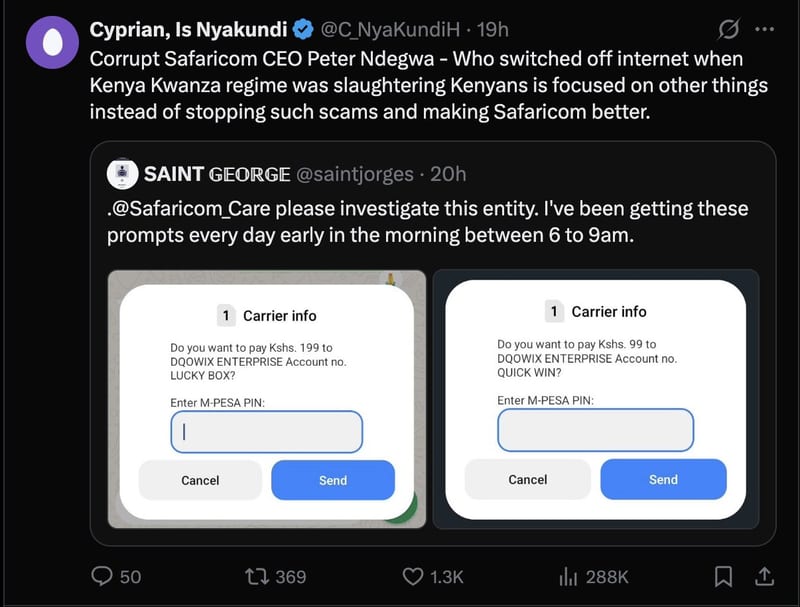
For customers, the underlying issue is whether personal information is accessed, processed and disclosed only through lawful and properly authorised procedures. Safaricom's responsibilities under Kenya's Data Protection Act make the security of subscriber information a matter of public interest, regardless of whether the particular allegations against its executives are ultimately substantiated.
The campaign has also brought attention to complaints about Safaricom's internal working environment. An X user identifying as Dev Kimani Ojwang Rop shared claims attributed to a former employee concerning ethnicity, promotions, gender and the treatment of graduate management trainees and interns.
The post stated:
"Things going on at Saf from a former employee (via DM) 1. Tribalism. Mostly only Kips get promotions. 2. Feminism. Women rule even in getting promotions & perks. 3. GMTs & Interns. wanachukua kama 200 GMTs, pay ni 17k, kazi ni ya punda. Let go, then repeat yearly."
The message states that promotions favour particular ethnic groups and women, while graduate trainees and interns are subjected to demanding work for relatively low pay before being released and replaced.
Nevertheless, the concerns raise questions that could be examined through workforce data, recruitment procedures, promotion records, employee grievance reports and the contractual terms offered to trainees.
Beyond employment and procurement, Nyakundi's most consequential questions concern Safaricom's handling of the internet disruption experienced during the June 2024 anti-Finance Bill protests. The events of June 25, when protesters faced deadly police violence, remain central to public debate about the conduct of State institutions and the reliability of communications during moments of national crisis.
Nyakundi has challenged the company to explain what happened, when its management became aware of the disruption and whether external instructions influenced its response.
"Peter Ndegwa should publish a detailed account of what Safaricom knew during the June 2024 internet disruption, when management became aware of the problem and what actions were taken before connectivity returned. #OverhaulSaf"
He has also directly accused the company's leadership of deliberately interrupting internet services during the protests, arguing that it could happen again under similar political circumstances.
"There can be never a free and fair election in Kenya, with the current Safaricom leadership. This is a leadership, that switched off internet when Kenyans were being slaughtered and will do it again, with no shame and claim some shark bit the undersea cables. #OverhaulSaf"
Nyakundi's argument is that the absence of publicly available evidence resolving these questions leaves uncertainty about the safeguards protecting communications infrastructure from political interference.
"Who has the authority to switch off Safaricom's internet infrastructure, who approves such an instruction, and who keeps the records? After June 25, 2024, Kenyans deserve an independent investigation before the 2027 elections. #OverhaulSaf"
The questions become particularly important when considered alongside Kenya's increasing reliance on telecommunications networks for financial transactions, public communication and the transmission of election-related information. A major network disruption during a disputed election could interfere with access to information and public confidence, even where there is no evidence that the interruption was politically motivated.
Nyakundi has therefore challenged the tendency to scrutinise electoral officials without giving comparable attention to the private infrastructure on which parts of the electoral process depend.
"We investigate IEBC, question its commissioners and demand access to election records, yet barely discuss who controls the telecommunications infrastructure carrying results, or what safeguards prevent political interference when an election becomes disputed. #OverhaulSaf"
He has gone further by raising a hypothetical scenario in which an incumbent president refuses to concede defeat, asking what would prevent political pressure from being exerted on telecommunications companies.
"If a defeated president refused to concede in 2027, what protections would stop government officials from pressuring telecommunications operators to interfere with communications, restrict public information or compromise the security of election systems? #OverhaulSaf"
The concern is not proof that Safaricom intends to interfere with the 2027 election. Rather, it highlights the importance of having documented procedures governing network operations, lawful government requests, emergency decisions, cybersecurity and the protection of election-related communications.
Safaricom chairman Adil Khawaja has also been drawn into the controversy, with Nyakundi questioning why the board has not publicly commissioned an independent inquiry into the company's handling of the June 2024 events.
"Adil Khawaja is a litigator who has spent 30 years telling courts that documents matter. As chairman, he can prove it by releasing the board minutes from June 2024 and the record of every government request the company received that week. #OverhaulSaf"
In another post, Nyakundi criticised what he sees as the company's reliance on internal oversight rather than independent examination.
"Safaricom’s board approves its own investigations, reviews its own findings and writes its own press statements. Adil Khawaja has not commissioned a single public, independent inquiry since June 2024. That is a choice, and it is his. #OverhaulSaf"
The posts put the responsibility for governance squarely before the board, which is expected to oversee executive management and the company's risk controls. Although board minutes and some government communications may contain confidential or legally protected information, an independent review could potentially establish what happened and disclose appropriate findings without compromising legitimate security or commercial interests.
Nyakundi has also accused Ndegwa of misleading shareholders in South Africa, referring to a communication he considers inaccurate.
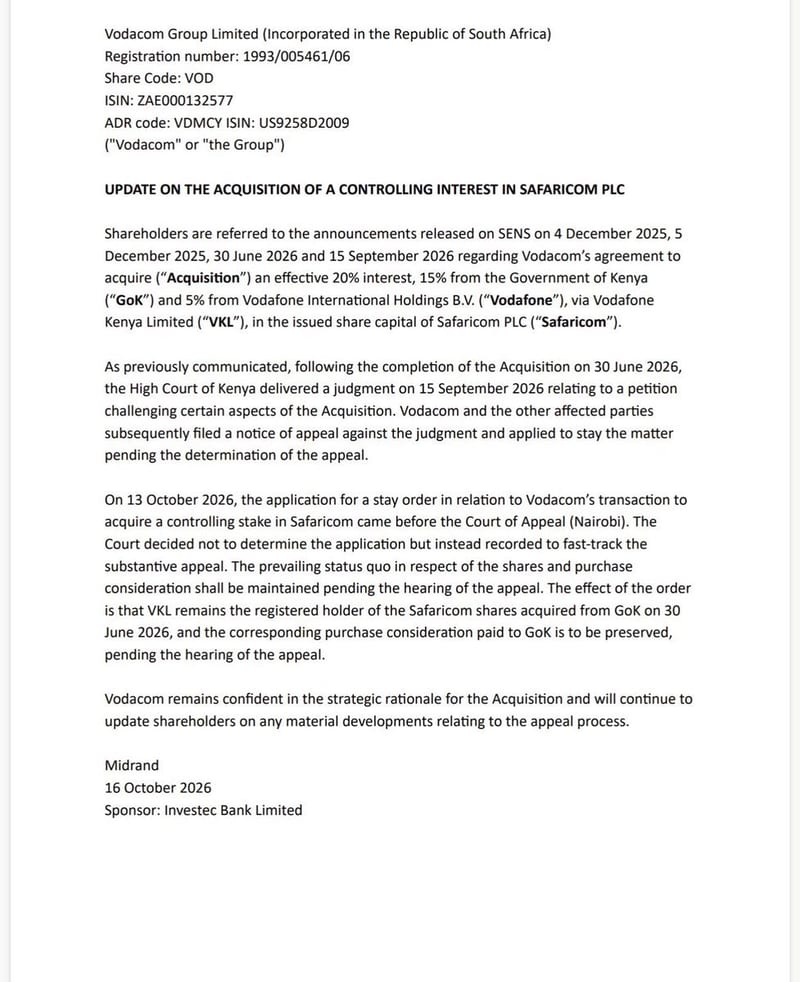
Here @PeterNdegwa_ is misinforming shareholders in South Africa. Look at this misleading communication #OverhaulSaf"
Meanwhile, complaints about ordinary service delivery have become part of the discussion. Media personality Eric Latiff publicly expressed frustration after experiencing a prolonged internet outage and receiving no communication from Safaricom's customer support team.
"Hakuna! These @Safaricom_Care people are 'watapeli wa hali ha juu'….wanakunywa zile za majina mbili mbili. I haven’t had internet connection since 8am on Friday. Not even an SMS, or call to explain or inform. Nothing. Ng’ooo!"
Nyakundi circulated the complaint as another example of what he considers deteriorating accountability within the company, adding:
"See… It is time heads roll at Safaricom #OverhaulSaf"
Across the various posts, Nyakundi's campaign has developed around one central demand: Safaricom should respond to serious governance concerns through verifiable information rather than leaving customers, employees, shareholders and the wider public to speculate.
For the Safaricom Foundation, that would mean explaining the criteria used to select projects, how contractors are appointed, how conflicts of interest are managed and whether complaints concerning Karen Basiye or other officials have been investigated. The examples involving Godfrey Osotsi, Nzioka Waita and Moses Wetang'ula provide a basis for examining the foundation's relationship with political figures, but a finding of favouritism would require evidence showing that the selection process was improperly influenced.
For the wider company, the questions concern procurement transparency, related-party dealings, employee grievances, personal data protection and the independence of internal oversight.
For Kenya's communications infrastructure, the most pressing issue is whether Safaricom can provide a credible explanation of the June 2024 disruption and demonstrate that operational decisions are protected from unlawful political interference. With the 2027 elections approaching, the public interest in understanding these safeguards extends beyond any single company or political administration.
Safaricom occupies an influential position in Kenya's telecommunications and financial services sectors, while its foundation distributes resources to communities that may have limited access to alternative support. Decisions affecting those services deserve transparent oversight, particularly where questions arise about the use of charitable funds or the independence of critical infrastructure.
Nyakundi's #OverhaulSafcampaign has brought those questions together, challenging the foundation's trustees, Safaricom's board and executive management to demonstrate that their governance arrangements can withstand independent scrutiny.
How are foundation projects approved, who benefits from its procurement contracts, what happened to internet connectivity during the June 2024 protests, and what protections exist to ensure that the company's operations remain lawful and independent when political pressure is greatest?
Those are questions that cannot be settled by corporate assurances alone. They require records, explanations and, where credible evidence warrants it, independent investigation.