
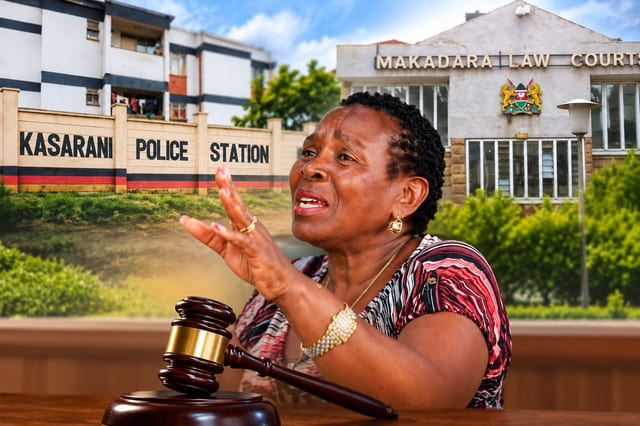
After nearly eight years of criminal proceedings, repeated court summonses and orders to DCI Kasarani Police Station who fabricated the case against her, attempts to obtain police accountability and the continued retention of her motor vehicle, Lydia Mukami Nyambura says she is now living in fear for her safety and that of her family.
Mukami's case raises questions about the treatment of accused persons, police accountability, compliance with judicial processes and the protection available to people who seek to challenge alleged abuses by law-enforcement officers.
According to documents relating to her case, Mukami was charged before the Makadara Law Courts in Criminal Case No. 1056 of 2019, with the charges subsequently altered and consolidated into Criminal Case No. 1211 of 2019. The allegation against her concerned KSh 2,980,000 deposited into her Family Bank account with DCI prying into her bank account without a court order. Mukami has consistently maintained that the money was a debt repayment and says she presented documentation to the courts supporting that position. She further states that the complainant herself had described the payment as a debt repayment.
The criminal proceedings continued for close to 8 years. Her past attempts to DCI headquarters, DCI Nairobi Region, Office of the Director of Public Prosecutions head office and Makadara, The Office of the Inspector General, the Internal Affairs of Police Department and other bodies to intervene and withdraw the malicious prosecution were met with animosity and she was consistently told follow the court.
According to Mukami's account, the prosecution ultimately withdrew the charges under Section 87(a) of the Criminal Procedure Code, and she was discharged on 24 June 2026 after the prosecution failed to produce witnesses over the prolonged proceedings, DCI Kasarani failing to attend court and produce the police file for over 4 years despite court orders and summons to do so with only the complainant and her personal assistant having testified in a period of 8 years.
But the end of the criminal proceedings did not, according to Mukami, bring an end to her ordeal.
The vehicle that remains at the centre of the dispute Mukami's motor vehicle, KCM 536P, was retained during the investigation on the stated basis that it might have been acquired from proceeds of the alleged offence because it had been purchased from the bank account into which the disputed payment had been deposited.
She says that even after the court proceedings ended, the vehicle still remains in police custody to date and court orders and summons to release it to her have been met with retaliatory actions by DCI Kasarani police station.
Her account raises a straightforward question:
What is the current lawful basis for continuing to retain the vehicle after the criminal proceedings against her were withdrawn? According to her records, she repeatedly sought intervention through the relevant institutions. She says she approached the DCI, the Inspector-General of Police, the Office of the Director of Public Prosecutions and Internal Affairs in the past to withdraw the malicious prosecution, but was repeatedly directed back to the courts.
She followed that direction.
The court subsequently issued directions and summonses requiring relevant police and DCI officers to attend court concerning matters including the continued retention and release of her vehicle. Mukami says the officers nevertheless has failed to attend on repeated occasions to show cause why they should continue holding her vehicle for more than 8 years despite the summonses. Such conduct would raise serious questions about respect for judicial authority, police accountability, access to justice. neglect of duty, negligence, court contempt, abuse of office and power and if the DCI Kasarani Police are above the law.
A citizen says she was punished for seeking accountability Mukami's most serious concern is what she describes as retaliation after she attempted to enforce the court process.
She says that on 12 August 2026, she attended court in connection with the matter concerning her vehicle where DCI was summoned by the courts and that the presiding magistrate expressed frustration concerning the failure of DCI/police officers from Kasarani police station to comply with the court process. According to her account, the magistrate advised her to report the officers to IPOA and gave her a physical court summons to take to Kasarani Police Station.
The following day, 13 August 2026, Mukami says she was rearrested.
She alleges that she was subjected to mistreatment while in police custody and subsequently required medical attention. She says another human-rights defender who had accompanied her to the police station demanded that she be allowed police bond so that she could obtain medical care which has occasioned her to continued bed rest due to her health condition.
Mukami says this sequence of events has left her fearful that her attempts to seek judicial protection and police accountability may themselves be exposing her to further retaliation. IPOA is already seized of the complaint This is not simply a matter being raised on social media without recourse to official institutions.
Mukami states that she reported the conduct to the Independent Policing Oversight Authority (IPOA) and that the matter is being followed under Reference Number IPOA/CMU/4019/2026. She says she remains willing to cooperate with IPOA and other legitimate investigative or judicial institutions.
Her request is for DCI Kasarani to leave her, release her car and stop abusing the court process for improper reasons. What other case does the DCI Kasarani want to start afresh after failing to support their case for 8 years? What does it mean that the DCI Kasarani cannot obey court orders and summons which are currently in force with the next date at 2nd November 2026 yet they want to start a fresh case before the same court whose authority they undermine?
A disturbing account of an alleged attack outside court Mukami's concerns about her personal safety intensified following an incident she says occurred on 12 August 2026.
According to her statement, after leaving court, a woman whom she says she had previously seen in court approached her from behind and allegedly attempted to attack her with a knife.
A human-rights defender accompanying Mukami intervened, according to the account.
Mukami further says that she observed two men nearby who moved away after the intervention and that the woman subsequently joined them. She believes the incident was coordinated. Her attempts to report the matter at Kasarani was met with refusal to grant her an occurrence book incident report. The human-rights defender who intervened, she says, can provide a witness statement concerning what he personally observed.
That allegation should be investigated independently rather than dismissed or treated as established fact without evidence.
Eight years of complaints.
Mukami's document sets out what she describes as a continuing pattern involving alleged harassment, intimidation, arrests and detention, seizure and retention of property, alteration of police documents, disregard of court processes and renewed criminal proceedings.
These are serious allegations.
She says that in March 2019, she was detained from 25 to 28 March without being produced in court and without a court order authorising the detention. She also alleges inappropriate treatment by male officers during that period.
She further records that in 2023, after seeking intervention regarding the matter, she was allegedly threatened with another case involving forgery. She says that after the threat was publicised through bloggers and social media, the threat did not proceed. She describes the subsequent years of litigation as being marked by what she regards as excessive delay and repeated failure by DCI/police officers to attend court despite summonses and orders. The central question: who is accountable when police officers allegedly refuse to answer to the court?
Mukami's complaint ultimately goes beyond the vehicle. It concerns what she describes as a breakdown in the normal mechanisms through which a citizen can challenge police conduct. She says that government institutions repeatedly directed her to follow the court process.
She did.
She says the courts then issued summonses and orders requiring police officers to appear.
She says they repeatedly did not.
And after the prosecution against her was withdrawn, she says the police still retained her vehicle to date and she was subsequently subjected to threat of renewed criminal proceedings.
Her document records that after her discharge on 24 June 2026, police officers were summoned several times to explain why the vehicle had not been returned. On the fourth occasion, she says she was given a physical summons to deliver to the police station — after which she says she was arrested.
Now her children are also part of her fears Mukami says her concerns have extended beyond herself. She reports that her children have allegedly been followed or monitored and that people have asked about their home and her whereabouts. She also reports receiving calls from unidentified numbers where the caller does not speak.
She further states that unknown people recently visited a medical facility where she had sought treatment after leaving police custody, prompting a doctor to warn her about the visitors' apparent intentions.
A call for independent investigation — not special treatment Mukami is not asking that the courts be bypassed.
She is asking that the institutions charged with protecting citizens and overseeing police conduct examine the evidence and protect her A plea to the public and human-rights community Mukami says she is now sick, traumatised and fearful for her life and the safety of her children.
Her written account concludes that the cumulative pattern is why she is seeking urgent intervention and protection. She is therefore appealing to local and international mechanisms to look into the police conduct and protect her and her family from harm.
Eight years is a long time for any citizen to remain trapped in a criminal-justice process.
And when a citizen alleges that the very officers whose conduct she is challenging are refusing to comply with court processes, the question of independent oversight becomes even more important. Lydia Mukami is asking for three things: accountability, due process and protection.
She says she is ready to place the documentary evidence before competent authorities and to cooperate with any independent investigation.
The institutions responsible for upholding the law now have an opportunity to demonstrate that the law applies equally to everyone — including those who challenge the conduct of the police.