
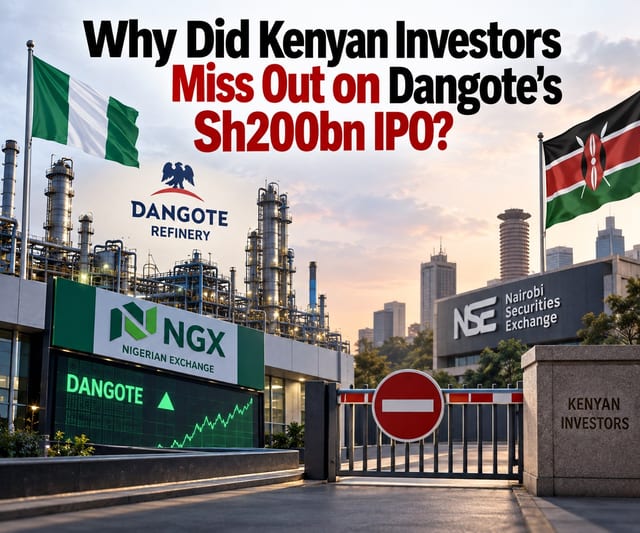
Africa's biggest ever initial public offering has landed, and Kenyan investors are largely watching it happen from the sidelines.
Nigeria's Dangote Petroleum Refinery and Petrochemicals FZE opened a public offer worth roughly Sh200.8 billion ($1.55 billion) on September 14, 2026, giving investors a chance to buy into a three percent stake in one of the largest refining operations on the continent.
It was originally billed as a pan-African moment, with plans for cross-listing on exchanges in Kenya, South Africa, Egypt, Ghana and Rwanda alongside the primary Nigerian listing. That cross-border ambition has, for now, not materialised the way many expected, and Kenyan investors are among those left without a straightforward path into the offer.
The core of the problem is structural. The IPO has been domiciled entirely in Nigeria, meaning the shares are being sold in naira through Nigerian regulatory channels rather than through the Nairobi Securities Exchange.
Local investors had originally been expected to contribute as much as Sh64.8 billion ($500 million) of the total raise, a sizeable chunk that reflected genuine appetite among Kenyan retail and institutional investors for a piece of Aliko Dangote's refining empire.
Instead, that expected cross-listing was frozen, and industry sources point to a combination of a tight subscription window and regulatory hurdles as the reasons behind the freeze. Bringing an offer of this scale to multiple African markets simultaneously would have required the issuer to secure separate regulatory approvals in each jurisdiction, a process that takes considerably more time than the compressed timeline this offer was run on allowed for.
That has left Kenyan investors reliant on indirect, privately arranged access rather than a clean, regulated route through their own market. Several Kenyan brokers have acknowledged that they were still working through structural challenges before they could bring the offer to their own clients in any organised way.
Why is Dangote forcing Kenyans to use subcontracted digital platforms?
Through outlets like this, Kenyan investors can, in principle, subscribe for as few as ten shares at 525 naira apiece, putting the minimum entry point at a modest sum before fees and currency conversion costs are added.
But this is a materially different experience from a straightforward NSE-listed offer that a Kenyan investor could simply walk into through their usual local brokerage relationship.
The missed opportunity carries a genuine financial dimension too. Dangote has publicly floated the idea that shareholders in the refinery would receive dividend payments in US dollars, drawn from the refinery's substantial projected annual export revenues from fuel and petrochemical products.
For African investors who typically have limited direct routes to dollar-denominated income from an African-listed equity, that structure would have been an unusually attractive proposition, particularly for Kenyan investors accustomed to shilling-denominated returns exposed to currency depreciation risk.
That dollar dividend mechanism, it is worth noting, still requires final sign-off from Nigeria's securities regulator and central bank before it can be treated as fully locked in, but it has been consistently reiterated by the company and forms a central part of the offer's appeal.
There is also a regional dimension that makes the missed access particularly notable. Dangote's broader continental strategy includes plans for a second refinery in Lamu, Kenya, alongside ambitious cross-border pipeline projects intended to stretch product distribution from Namibia through Botswana and onward toward South Africa and Zimbabwe.
Given that Kenya is set to be a direct beneficiary of Dangote's expansion plans on the ground, the inability of ordinary Kenyan investors to participate cleanly in the IPO that is financing this expansion stands out as something of a missed alignment between where the money is being raised and where some of it will ultimately be invested.
For now, Dangote's own public framing of the offer has emphasised inclusion rather than exclusivity, with Aliko Dangote himself telling investors at the Lagos opening ceremony that the IPO was designed to give ordinary people, from drivers to cooks, the chance to hold a stake in the refinery. Company management has indicated there are no plans for a foreign listing for at least three years, citing the need for a longer audited public track record before expanding beyond the Nigerian Exchange.
That timeline suggests Kenyan investors hoping for a straightforward, locally accessible route into Dangote's refining business may need to wait, relying in the meantime on cross-border platforms and indirect channels if they want in on Africa's biggest IPO before then.