
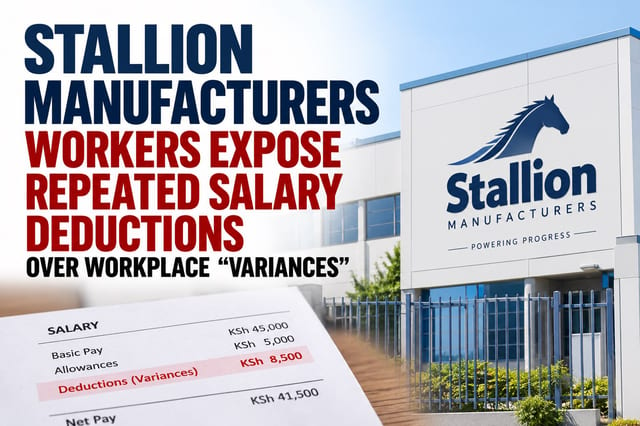
Workers at Stallion Manufacturers Limited in Nairobi's Industrial Area have raised concerns over repeated and unfair deductions from their salaries, stating that employees are routinely issued with “variance” or “recovery” charges for workplace mistakes, including instances where they claim they were not responsible for the loss or damage.
The complaint, sent to Nyakundi Report by an employee who requested anonymity, describes a workplace where workers face deductions almost every month, with employees being called at the end of the month and asked to sign documents authorising the deductions.
The complainant says the situation has recently taken another turn, with workers being deducted even when they decline to sign, leaving employees questioning what exactly the company considers a recoverable loss and whether the deductions are being made within the limits set by Kenyan labour law.
Hi Cyprian hide my identity want to raise an issue About a certain company call stallion manufacturer located at industrial area workers are discriminated, for example makosa kidogo ,ushakatwa pesa every month almost kila mtu unaandikiwa makosa hata kma sio Ile makaso mtu anafaa kukatwa ,each end month unaitwa ety usign ndio ukatwe pesa ,but for recent case either usign or usisign bdo unakatwa , sometime unakatwa ya all day need intervention pls watu wanaumia.
The worker further questions the meaning of the term “variance”, saying employees understand it to refer to something that has actually been lost or damaged and for which an employee can properly be held responsible. Even in circumstances where an item is genuinely damaged, the complainant argues that the employee should first be shown what was damaged and why they are personally responsible before money is recovered from their salary.
According to the complaint, the deductions are ordered by the owner of the company, with workers alleging that the practice has become so common that employees have little choice but to accept whatever amount appears on their payslips.
The complainant says some workers are now afraid to challenge the deductions because of the possibility of being targeted at work, creating a situation where employees continue working while quietly absorbing deductions they believe are unjustified.
Nyakudi am raising an issue about this company called stallion manufacturer located in Mogadishu road industrial area employee are complaining about illegal deduction of salary by the name of recovery ,for instate usahau usisafishe machine ,unakatwa pesa need intervation pls because the issues is escalating which laws in Kenya allowed salary deduction kwa kitu haujapoteza
Stallion Manufacturers Limited is listed in business directories as a Nairobi based manufacturer, with a location on Mogadishu Road in the Industrial Area, while industry records also list the company among manufacturers operating in Nairobi.
Section 19 of the Employment Act allows an employer to make a reasonable deduction for damage to or loss of property that was lawfully in the employer's possession or custody where the damage or loss was caused by the employee's wilful default.
The same section provides for other specific circumstances in which deductions may be made, including certain shortages of money caused by negligence or dishonesty, recovery of wages paid in error, deductions authorised by written law, a collective agreement, court order or arbitration award, and certain deductions requested by an employee in writing.
That provision is important to the complaint because an allegation that an employee made a mistake does not automatically answer the question of whether the employer can deduct the employee's wages.
Where the deduction relates to damage or loss of company property, the law specifically refers to a reasonable amount and to wilful default by the employee. The circumstances surrounding each deduction would consequently need to be examined, including what was lost or damaged, who was responsible, how the loss was established and how the amount deducted was calculated.
The law also places limits on the total amount that can be deducted from wages at any one time. Section 19 provides that deductions permitted under the Act generally cannot exceed two thirds of an employee's wages, subject to the statutory provisions governing deductions. This means that even where a deduction is legally permissible, an employer cannot simply decide to remove whatever amount it considers appropriate from an employee's monthly pay.
Employees are also entitled to know what has been taken from their salaries. Section 20 of the Employment Act requires an employer to provide a written pay statement showing the gross wage or salary and the amounts of variable and statutory deductions and the purposes for which they are made. This makes documentation particularly important in the Stallion case because the workers' central complaint is that deductions are being repeatedly imposed under labels such as “variance” and “recovery”.
The workers are now calling for intervention from the Ministry of Labour, asking labour officials to examine the company's payroll records and establish how the deductions are calculated and whether they comply with the Employment Act.
This is an area where labour officers have considerable powers. Under the Labour Institutions Act, a labour officer can require an employer to produce wage sheets and employment records, inspect and copy records relating to employment, question employers and employees and enter premises where employees are working for purposes of checking compliance with labour laws.
The Labour Institutions Act also provides that wages orders can specify the matters in which deductions may be made from employees' wages and the maximum amount that may be deducted. The law therefore does not leave salary deductions entirely to the discretion of individual employers.
For the workers at Stallion, the immediate concern is the effect of these deductions on people who depend on their monthly salaries to meet rent, food, transport, school fees and other basic expenses.
A deduction that may appear small from the perspective of a company can be significant to a worker whose entire household budget is built around a fixed monthly wage, particularly when the employee says similar deductions are happening repeatedly.