
A High Court has issued a conservatory order stopping the Directorate of Criminal Investigations from investigating or prosecuting an advocate while a constitutional petition challenging the criminal process is pending, in a decision that has once again brought into focus the delicate balance between the independence of investigative agencies and the power of courts to protect individuals who claim that their constitutional rights are at risk.
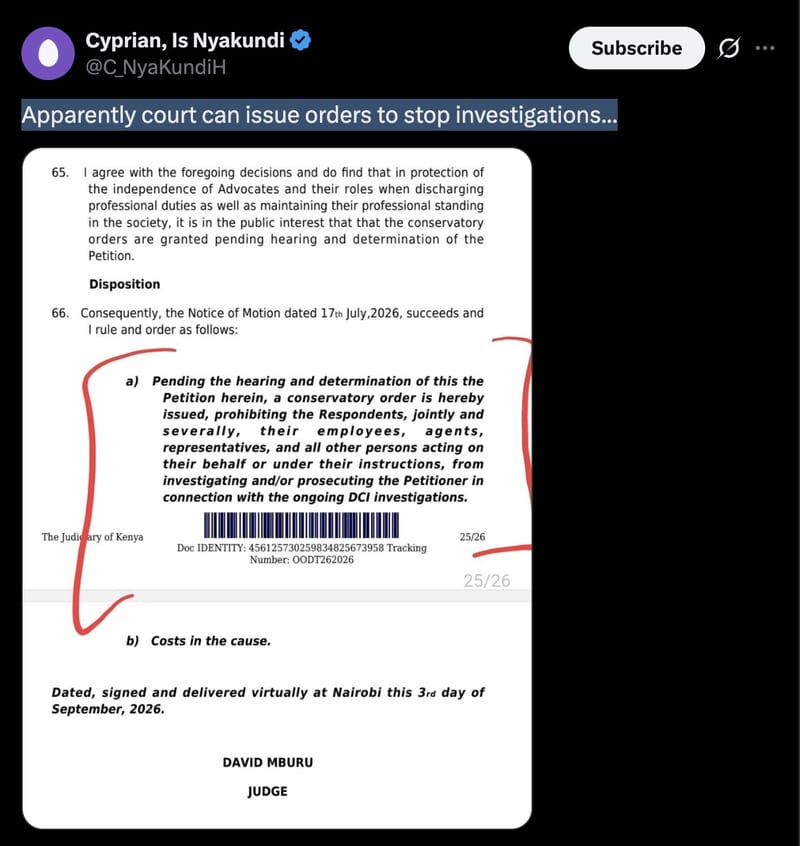
In an order dated September 3, 2026, Justice David Mburu directed that the respondents, together with their employees, agents, representatives and anyone acting on their behalf, should not investigate or prosecute the petitioner in connection with ongoing DCI investigations until the petition is heard and determined.
The order was issued after the judge considered an application seeking interim protection and found that it was in the public interest to protect the independence of advocates and their ability to discharge professional duties while maintaining their professional standing in society.
The wording of the order is significant because it does not merely tell the parties to slow down or preserve documents. It expressly prohibits the respondents from “investigating and/or prosecuting the Petitioner” in relation to the ongoing DCI investigations.
The development has attracted attention after Cyprian Nyakundi's post on X questioning whether courts can issue orders stopping investigations. The answer, in the context of the order now before the public, is yes, a court can issue such an order in appropriate constitutional proceedings, but that power is not an automatic licence to stop every police investigation simply because a suspect goes to court.
Kenya's Constitution gives the High Court authority to hear claims involving the violation or threatened violation of fundamental rights, while Article 23 specifically lists a conservatory order among the remedies a court can grant in proceedings brought to enforce the Bill of Rights.
A conservatory order is essentially a temporary judicial measure intended to preserve the position of the parties or prevent a threatened constitutional injury from occurring before the court has had an opportunity to hear the main case.
Kenyan courts have previously explained that such orders are not supposed to be issued casually. The applicant generally has to place before the court an arguable case, show the constitutional interests at stake and demonstrate why intervention is necessary before the main petition is determined, with the court also considering public interest and whether the subject of the petition could be defeated if no interim protection is granted.
This is where the latest ruling becomes important. Justice Mburu's order, as shown in the court document, specifically refers to the protection of the independence of advocates and their roles when discharging professional duties, as well as maintaining their professional standing in society. The judge consequently found that the circumstances justified preserving that position until the substantive petition is determined.
The order does not, by itself, change the constitutional mandate of the DCI or the Director of Public Prosecutions. Article 157 gives the DPP power to direct the Inspector-General to investigate allegations of criminal conduct, while the Constitution also gives the DPP authority to institute criminal proceedings. At the same time, Article 157 requires the DPP to consider the public interest, the interests of the administration of justice and the need to prevent abuse of the legal process.
Article 245 also protects the operational independence of the National Police Service, including the Inspector-General's mandate over investigations, meaning that courts generally approach attempts to interfere with criminal investigations with considerable caution.
In previous cases, the High Court has held that the mere existence of an investigation is not enough to justify stopping it and that there must be a proper constitutional or legal basis for judicial intervention.
That distinction is important because there is a major difference between saying “the court has stopped an investigation” and saying “the court has found the investigation illegal.” The document released on September 3 does the former. It is an interim order pending the determination of the petition. The court has not, at this stage, made the final determination on the allegations behind the DCI inquiry.
There are already Kenyan cases showing both sides of this legal argument. In Kalya & 2 Others v Director of Public Prosecutions & 3 Others, the High Court granted a conservatory order preventing criminal investigations and prosecution of three advocates over their professional involvement in the preparation and certification of a disputed will. The court considered arguments that the advocates were being subjected to criminal investigations because of work performed in their professional capacity and held, at the interlocutory stage, that the circumstances justified temporary protection.
But courts have also declined requests to stop investigations where applicants failed to demonstrate abuse of power, malice or a violation of constitutional rights. In Leverage Company Limited v Director of Criminal Investigations, for example, the High Court stressed that criminal investigations fall within the mandate of investigative agencies and should not ordinarily be halted merely because a person facing an investigation considers the allegations weak or expects that no charges will eventually be brought.
The latest order therefore raises a larger question about where the line should be drawn. Investigative agencies must be allowed to investigate allegations of crime without fear that every summons will immediately end up before a judge, but citizens, including advocates, are equally entitled to approach the courts where they believe state power is being exercised unlawfully, maliciously or in a manner that threatens constitutional rights.
For now, the court has chosen to preserve the position of the petitioner while the larger dispute is argued. The DCI investigation is not being declared false or abandoned, and the petitioner has not been declared innocent of whatever allegations prompted the inquiry. What has happened is that the court has temporarily placed the investigation on hold within the scope of the order until the constitutional petition is determined.