

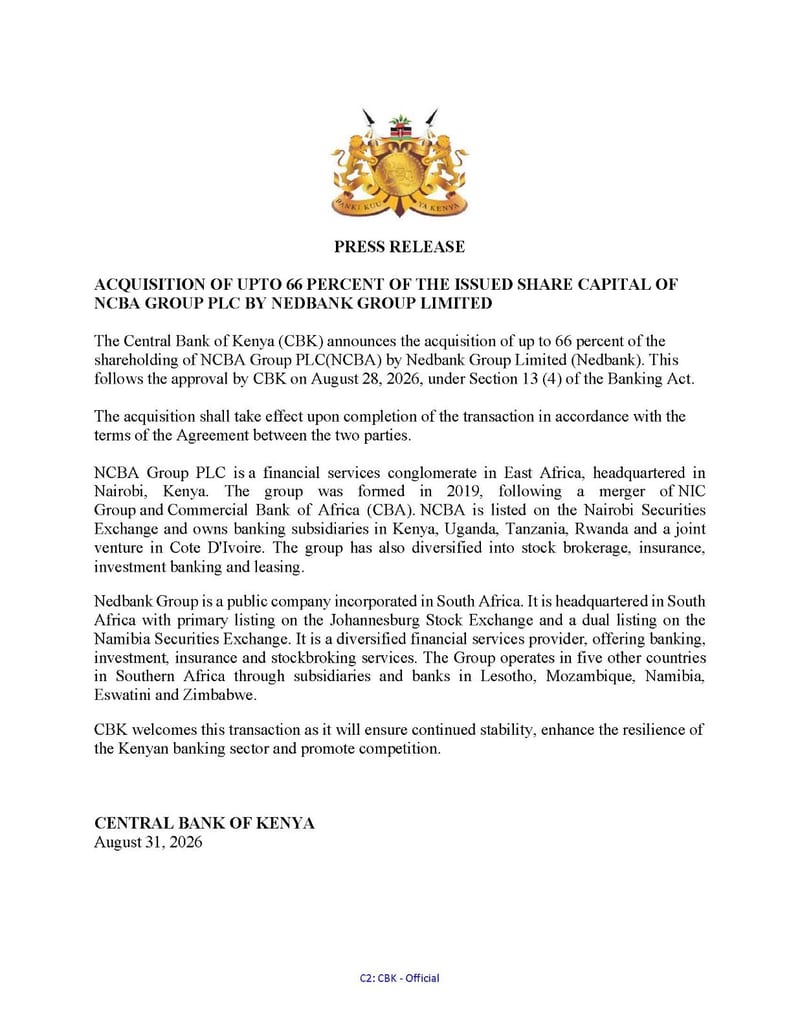
The ownership of one of East Africa’s biggest financial services groups is set for a major change after the Central Bank of Kenya approved Nedbank Group Limited’s acquisition of up to 66 percent of the issued share capital of NCBA Group PLC, clearing a major regulatory hurdle for the South African financial services company to take control of the Kenyan banking group.
In a press release dated August 31, 2026, the Central Bank of Kenya said its approval was granted on August 28 under Section 13(4) of the Banking Act, allowing the proposed acquisition to move closer to completion.
CBK was careful to state that the transaction will only take effect once the agreement between the two parties has been completed in accordance with its terms, meaning the regulator has approved the acquisition but the change in ownership has not yet been completed.
The transaction will see Nedbank acquire a controlling stake of up to 66 percent in NCBA, leaving about 34 percent of the shares in public hands and continuing to trade on the Nairobi Securities Exchange once the deal is completed. Nedbank announced its intention to acquire the stake in January 2026, putting forward an offer worth about R13.9 billion at the time, with the consideration structured through a combination of cash and new Nedbank shares.
The latest CBK decision comes after years in which NCBA built itself into one of Kenya’s most recognisable financial institutions following the merger of NIC Group and Commercial Bank of Africa in 2019. The merger brought together NIC’s corporate and asset finance business with CBA’s retail banking and digital lending operations and created a regional group with operations in Kenya, Uganda, Tanzania and Rwanda, alongside other financial services businesses.
The bank remained profitable and continued to report billions of shillings in earnings, but the public record surrounding NCBA has increasingly contained a different set of questions about how the institution treats customers and borrowers when things go wrong.
One of the more recent complaints came from a customer who said she had decided to close her NCBA account after ten years, arguing that the service she received under the current bank was far worse than what she experienced when the institution was still operating as CBA.
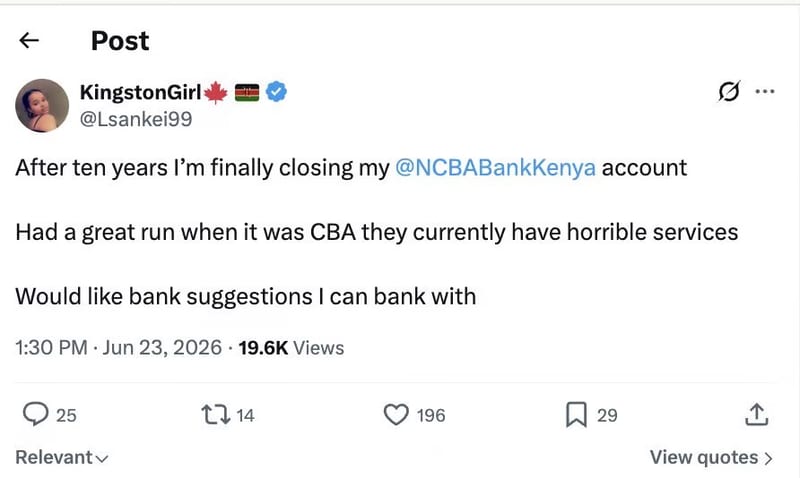
In a post published on June 23, 2026, the customer said she had "finally" decided to close her account after a decade and asked Kenyans to recommend alternative banks, adding that she had enjoyed better service during the CBA years.
That customer complaint sits alongside a much larger body of disputes involving NCBA's asset finance business, which has become one of the bank's most important operations. NCBA has built a major vehicle financing business, offering customers loans to purchase cars and other assets, but complaints have repeatedly emerged when borrowers fall behind on repayments and their vehicles are repossessed. Borrowers have questioned recovery charges, auction procedures, vehicle valuations, the amounts demanded after repossession and whether a customer who clears arrears can actually recover a vehicle before additional costs continue accumulating.
One such complaint involved a borrower who said he had serviced an NCBA vehicle loan for about four years before falling behind with approximately KSh530,000 remaining. The vehicle was repossessed and taken to a yard, and the borrower claimed that after clearing the arrears he expected the vehicle to be released but was instead confronted with demands connected to the wider outstanding loan and recovery costs.
The issue becomes bigger because vehicle recovery creates a chain of costs involving auctioneers, towing companies, storage yards and valuers, meaning that a borrower who initially missed a manageable number of instalments can find the amount required to recover the vehicle increasing after repossession.
Where the vehicle is eventually sold, the borrower can lose the asset and still be left with a balance if the sale proceeds do not cover the outstanding loan and associated costs. NCBA has its CarDuka platform for the sale of repossessed vehicles and presents the platform as a way of giving customers access to recovered assets, but former borrowers still need to know how the vehicle was valued, what price it achieved, what costs were deducted and how the final amount was credited to their loan.
These questions are not confined to individual customers. NCBA has also found itself in a major legal confrontation with Multiple Hauliers East Africa Limited, with the transport company accusing the bank of illegally appointing two PwC officials as joint administrators.
Multiple Hauliers argues that NCBA did not possess the qualifying floating charge required under Section 534 of the Insolvency Act to appoint administrators without first obtaining a court order. The company has challenged the appointments before the High Court and has warned that it considers decisions made by the disputed administrators unlawful. Multiple Hauliers dispute with NCBA reported by Nyakundi Report
The dispute is particularly significant because NCBA is pursuing approximately KSh7.2 billion from Multiple Hauliers, whose wider financial problems have been reported to involve debts exceeding KSh31.4 billion against assets valued at about KSh17 billion. The bank had previously placed the transport company under administration in 2021, meaning the latest disagreement is part of a much longer fight over debt recovery, control of the company and the legal powers available to the lender. The High Court has been asked to determine whether NCBA had the legal authority to make the latest appointments and whether the individuals appointed by the bank can lawfully exercise control over the company's affairs.
The bank has faced another set of questions around the handling of customer information. The Office of the Data Protection Commissioner has previously issued determinations against NCBA involving the disclosure of personal and financial information. In one case, the regulator ordered the bank to pay KSh250,000 to Rose Wambui Muigai after her personal details were disclosed to third parties. In another case, NCBA was ordered to pay KSh250,000 after transaction information belonging to a business customer was repeatedly sent to the wrong email address.
Then there are the internal fraud cases. One of the cases involved a former NCBA assistant operations manager at the Kisii branch who was accused of stealing more than KSh52 million from customer accounts. Prosecutors said that money was moved into accounts at NCBA and KCB through transactions that included mobile banking platforms and further said that some transactions continued after the employee had been suspended.
A separate case involved dormant customer accounts from which more than KSh3.2 million was withdrawn, while another case involved eight people accused of stealing approximately KSh449.6 million through the Fuliza platform operated by NCBA and Safaricom. A separate case in Rwanda involved a contractor accused of abusing authorised access to NCBA's mobile banking systems.
The existence of those cases raise questions that the bank must answer through its internal controls. How are staff access rights terminated after suspension? How quickly are unusual transactions detected? How are dormant accounts protected? What controls prevent employees or contractors with legitimate access from using that access for fraudulent purposes?
These questions become even more relevant for a bank whose business has become increasingly dependent on digital lending and mobile financial services. NCBA has reported enormous volumes of digital lending through products such as Fuliza and M Shwari, with more than KSh1 trillion in digital loans reportedly disbursed during 2025. The scale of the business is impressive, but it also means that millions of Kenyans are interacting with the bank through systems that hold their personal information, credit histories and financial records.
The bank has previously been required to write off KSh11.25 billion in bad Fuliza and M Shwari loans under a Central Bank of Kenya credit repair programme that affected more than four million Kenyans whose small digital loans had remained unpaid. The figures demonstrate both the size of NCBA's digital lending operation and the financial pressure facing borrowers who depend on short term credit. For a customer who repeatedly uses digital loans to pay rent, buy food or deal with emergencies, the convenience of instant credit can quickly become a cycle of borrowing and repayment charges.
Yet NCBA's difficulties are not only about customers and borrowers. The bank's history also includes questions surrounding the 2019 merger that created it, particularly the tax exemptions granted during the transaction involving NIC Group and Commercial Bank of Africa.
A High Court ruling later quashed a stamp duty exemption worth approximately KSh384.5 million, while subsequent proceedings allowed the Kenya Revenue Authority to pursue the matter. The controversy attracted attention partly because Commercial Bank of Africa was closely associated with the Kenyatta family, one of the country's most powerful business families.
That history is relevant to the current takeover because NCBA was created as a major Kenyan banking success story backed by powerful shareholders, yet the institution is now preparing to come under the control of a South African financial group. The proposed transaction values the bank at a substantial figure and will significantly reduce the direct control previously exercised by the founding shareholder groups. Nedbank has offered to acquire up to 66 percent of NCBA, leaving a minority stake with other shareholders and maintaining NCBA as a listed company after completion.
The Central Bank of Kenya says it welcomes the transaction because it expects the acquisition to support stability, resilience and competition in the Kenyan banking sector. That is the regulator's position, and the approval means Nedbank has cleared a major hurdle. But the regulator's approval should not end scrutiny of the institution being acquired. If anything, the change in ownership gives NCBA an opportunity to address the complaints and controversies that have accumulated around the bank before the takeover is completed.
Nedbank is not buying an empty shell. It is acquiring a bank with a large customer base, a major digital lending operation, a significant asset finance business and a regional footprint, but it is equally inheriting the disputes and public concerns attached to that institution. The South African group will therefore have to decide whether it wants simply to take over NCBA's balance sheet and continue operating largely as before or use the change in ownership to examine how the bank handles customers, borrowers, employees, internal controls and regulatory complaints.
The takeover also gives CBK Governor Kamau Thugge and the Central Bank of Kenya a continuing responsibility beyond the approval itself. CBK will remain the primary banking regulator and will have to monitor the new ownership structure, capital position, governance and conduct of the bank.
The Capital Markets Authority remains relevant because NCBA is listed on the Nairobi Securities Exchange and the transaction involves public shareholders, while the Office of the Data Protection Commissioner will continue to oversee the bank's handling of personal information. The Competition Authority of Kenya and other regulators have their own roles in matters relating to competition and the wider transaction.
For customers, the question is much more straightforward. Will a bank under South African ownership provide better service than the one some customers have spent years complaining about? Will borrowers receive clearer explanations before and after vehicle repossessions? Will disputed recovery charges be easier to understand?
Will customer information be better protected? Will internal controls become strong enough to prevent employees and contractors from abusing access? And will the new owner address the complaints that have already damaged confidence in the institution?
Will the new owner simply inherit NCBA's business model, or will it confront the complaints, court battles, regulatory findings and customer frustrations that have followed the bank in recent years?
Because the real test of the Nedbank deal will not be the announcement of the acquisition. It will be whether the new owners can give Kenyans a reason to trust NCBA again