
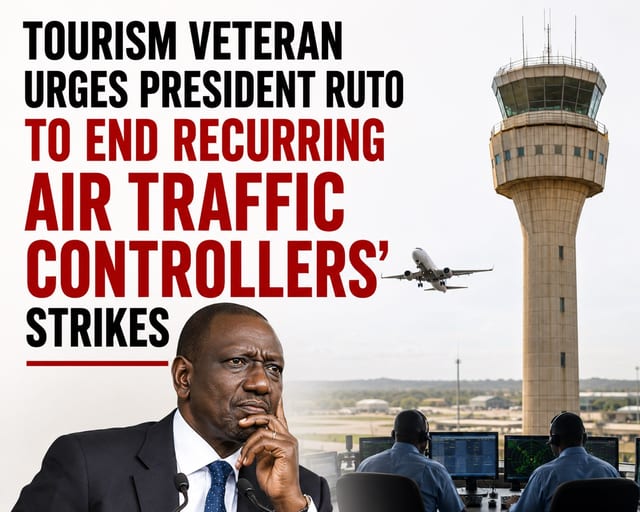
Tourism industry veteran Mohamed Hersi has called on President William Ruto to personally intervene in the recurring air traffic controllers’ strike, warning that repeated disruptions at JKIA are damaging Kenya’s tourism reputation.
Hersi says the dispute between the government and aviation workers should be permanently resolved rather than repeatedly addressed through temporary return to work agreements.
He warns that continued flight disruptions could see tourists and international clients choose competing destinations such as Zanzibar, Mauritius and Cape Town, while local tour operators bear the financial and reputational consequences.
I write this letter as a tourism industry player of over thirty years and, frankly, as a frustrated Kenyan. This morning, August 30, 2026, Jomo Kenyatta International Airport ground to a halt again. Aircraft sat on tarmacs, passengers stood at gates with no answers. Kenya Airways, Jambojet, and international carriers scrambled to manage delays running into hours. This is not a new story. It is the same story we lived through in February 2026.
It is the same story the Transport Cabinet Secretary said was resolved after his return-to-work deal. It is the same story that a strike notice in July threatened to reopen, and here we are again, at the end of August, watching it happen for what feels like the third act of a play we should never have had to sit through twice, let alone three times.
Your Excellency, how is this still happening?
I ask this not as a rhetorical flourish but as a genuine, exhausted question from someone who has spent decades convincing tour operators in Europe, Asia, and North America that Kenya is a destination they can trust with their clients' money and their reputations. Every one of us in this industry has, at some point in the last year, had to sit across from an agent and explain why their client's flight was delayed four hours, why a connecting safari group missed its bush flight, why a conference delegation arrived a day late. We absorb the reputational cost. We absorb the financial cost. We smile and say Kenya is still worth it, and then the same dispute resurfaces months later because it was never actually settled, only paused.
We are told we are chasing five million visitor arrivals. That target requires unbroken confidence in Kenya's air connectivity, because tourism is built entirely on the promise that a booking made today will still be honoured on the day of travel. A tourist who cannot trust that their flight will depart on schedule does not simply tolerate the inconvenience. They quietly choose Zanzibar, Mauritius, or Cape Town next time, and they tell their friends to do the same. Nobody sends out a press release when a booking is redirected. It just happens, silently, one cancelled reservation at a time, and by the time the numbers show up in our arrival statistics, it is too late to reverse the damage.
What troubles me most is that this is not a natural disaster or a global shock outside our control. This is a labour dispute between a government agency and its own workforce, over a collective bargaining agreement, pay, and working conditions that, by the union's own account, had not been reviewed in fifteen years. That is not a controllers' failure. That is a governance failure. If the grievances are legitimate, they should have been resolved permanently in February, not managed with a temporary return-to-work formula that bought a few months of calm before the same fault line cracked open again in July and again now in August.
Your Excellency, I ask you directly why has this been allowed to become a recurring event rather than a resolved chapter? Who within your government is accountable for the fact that a "return-to-work deal" earlier this year clearly did not include a durable settlement of the underlying issues? Tourism, horticulture, and cargo cannot keep absorbing the cost of a dispute that should have been closed permanently after its first occurrence.
I am not writing to score political points. I am writing because I, and thousands like me in this sector, have skin in this game every single day. We do not get to strike when things go wrong for us. We simply lose the booking, lose the client, and start over.
I would humbly ask that Your Excellency personally intervene to ensure a final, binding settlement is reached with KCAA and KAA staff, one that resolves the collective bargaining agreement and compensation questions in full, not a stopgap that buys three months of quiet before the cycle resumes.
Kenya's tourism sector has fought hard to rebuild since the pandemic. We have Ebola threats and the ongoing Iran-US conflict hanging over our heads. We do not need another obstacle imposed on us from within our own house. We need our own airspace to be a source of pride, not a recurring cause of apology.
My own flight out of Zanzibar was delayed by close to two hours because it could not take off out of Nairobi. Tonight we are handling many visitors who have been forced to miss their flights, many of them on transcontinental connections. What a way to end their stay in Kenya and spare a thought for others who are starting their holiday on the back foot, delayed before their trip has even begun. What a welcome to Magical Kenya.
I remain, as always, a proud son of this industry and an eternal optimist, hoping that this letter lands with the urgency with which it is written. Reads the Letter by Mohamed Hersi