
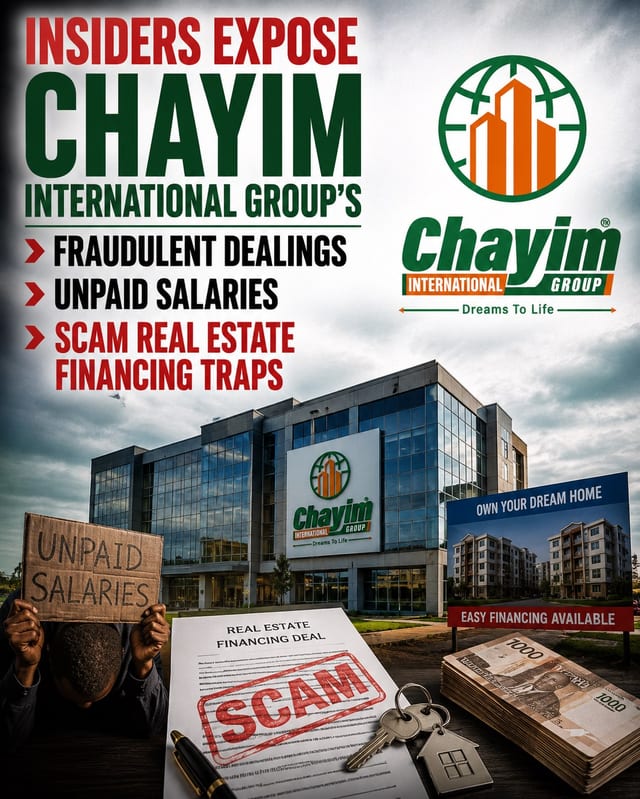
Employees at Chayim International Group, a Kenyan real estate company that markets housing and financing solutions have gone three months without pay.
An Insider has shared with us information that call centres direct unsuspecting clients who are lured with promises of financing that are not honoured after payments are made.
The employee, whose identity has been withheld for obvious reasons, says they work at a call centre where their main responsibility is receiving calls from potential clients and directing them to the company's Nairobi office.
According to the complaint, some clients are promised financing of up to 105 percent of their project costs before being asked to commit money towards the process.
Chayim International Group publicly presents itself as a real estate development and housing investment company, with its website currently describing the business as an institutional rental housing investment platform operating in Kenya and listing products including Jenga Kwako, Buy and Build, CIG Faida and Kuwa Landlord.
The insider says that callers are told they can access financing of up to 105 percent of the project value, after which they are asked to pay 10 percent of the project cost together with a Sh150,000 service fee for feasibility.
After the customer makes the payment, the process changes and the client begins being taken from one explanation to another without receiving the financing they were initially led to expect.
The employee says the concerns are particularly troubling because the people being approached are ordinary Kenyans looking for ways to finance homes and property projects, with some potentially committing significant amounts of money after being told that the company can provide financing beyond the value of the project.
The original complaint received by our desk 
The employee asked that their identity be kept anonymous and shared the following complaint:
"Hello Cyprian.I thank you for the great work you are doing to fight for our rights.Am writing this to address the challenges we are facing In Chayim international Group a real estate company. We work at a call center where our work is receiving calls and directing clients to the Nairobi office. They are luring innocent Kenyans in the name of Giving them financing up to 105% but it's a lie. They tell you to commit a certain money which is 10% of the project money and service fee for feasibility which is 150,000, na after umelipa wanaanza kukuzungusha. Ukiendelea kuongea they show you a fake project yenye wamefanya but si yao.Please warn our parents to be careful of the so called joint ventures.They have not paid our salaries for 3 months now, na ukiongea wanakutishia.Hide my identity please."
Under the Employment Act, wages due to an employee should be paid in accordance with the employment relationship and applicable law, while disputes over employment rights and contractual obligations can be taken through the labour dispute resolution system. The State Department for Labour and Skills Development, through the relevant labour officer, is therefore one of the first authorities that should be approached if the workers' salary claims remain unresolved.
The workers who have not been paid for three months are planning to take the matter to the relevant labour office and, where necessary, pursue the dispute through the Employment and Labour Relations Court.
If customers are being asked to pay a 10 percent commitment and Sh150,000 feasibility fee before accessing financing, the company should make the terms of that arrangement clear, including whether the money is refundable, what the feasibility process covers, who provides the financing and under what conditions a client can actually receive the promised funds.
A potential customer should be able to verify ownership, development rights and the identity of the actual developer before committing substantial funds.
There is a growing public interest in companies that promise Kenyans access to property financing because the demand for affordable housing and alternative financing remains high.
What exactly is a customer paying for before the promised financing arrives, and where does the money go when that financing does not materialise?