
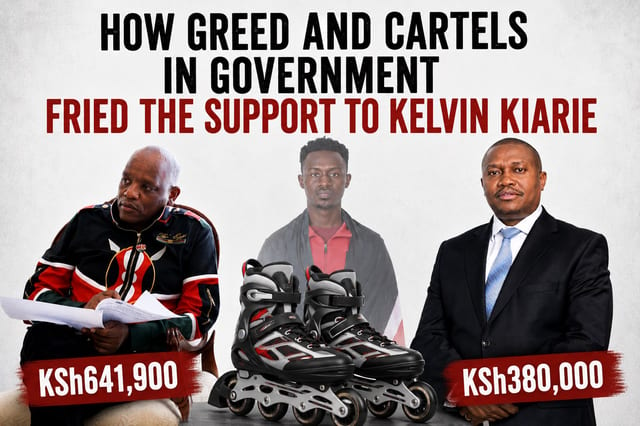
What was supposed to be a story about Kenya supporting one of its most promising athletes in an emerging sport has now turned into a public dispute over government funding, federation payments and whether a skater who has repeatedly raised the Kenyan flag internationally actually received the support he was promised.
Kenyan skater Kevin Kiarie Ruhiu has publicly challenged officials over what he says are delays and inconsistencies in funding for his international competitions, days after Head of Presidential Special Projects and Creative Economy Coordination Dennis Itumbi published what he described as a factual brief from Sports Principal Secretary Elijah Mwangi responding to questions surrounding the athlete's support.
The exchange has now placed specific figures in the public domain, including KSh641,900 approved for the Africa Skating Championships in Egypt, KSh380,000 said to remain due to Kiarie from the federation and a separate KSh870,000 payment that Itumbi says was transferred to an account held by the skater.
The dispute is particularly striking because only a few months ago, the Government was publicly celebrating Kiarie's achievements and promising to support his international career.
On May 9, 2026, Sports Principal Secretary Elijah Mwangi met Kiarie at Talanta Plaza and reaffirmed government support for athletes in emerging sports. The ministry said Kiarie had won gold and silver medals at an international competition in Benin before adding two gold medals at the Africa Skate Games in Egypt, performances that earned him qualification for the World Skate Games in Paraguay. Mwangi said the Government would support his preparations, including a planned training camp in China.
That public commitment now sits at the centre of Kiarie's complaint. The skater says he had attempted to reach Itumbi privately on April 10 and June 12 through Facebook, Instagram and WhatsApp seeking assistance, but received no response. He says he later looked for help privately before the matter became public, and is now questioning why PS Elijah Mwangi was not being addressed in the public conversation despite being the official who had previously spoken about supporting skating and his international career.
OleItumbi on April 10th and June 12th 2026 I texted you on fb, ig & WhatsApp trying to seek your help and got no response. I looked for you privately, but you decided to go for me publicly. Why is PS Elijah Mwangi missing on this issue. What was the point of him announcing on national Television that they were going to support skating sports knowing very well they were lying. Despite assurance of support, I've missed 3 International skating competitions as attached. Let the PS say what was not submitted. That frustration is what is leading me to this point. They asked me to provide receipts for Singapore, Benin & Egypt for reimbursement only to tell me that they lost the receipts on following up.
Kiarie says the frustration did not begin with the current social media exchange. According to his account, he was asked to provide receipts for expenses incurred during competitions in Singapore, Benin and Egypt for reimbursement, only to later be told that the receipts had been lost during the follow up process.
He further says that KSh641,900 was approved for reimbursement connected to Egypt, but that only KSh380,000 was transferred to the federation, leaving him questioning where the remaining KSh261,900 went.
Of approved Ksh.641,900 Egypt Reimbursement, which I'm yet to receive, why did they send Ksh. 380,000 to the Federation instead of total Ksh. 641,900. Where's is the balance Ksh. 261,900. On Ksh.870,000 disbursement, Director sports Caroline said to me 'sasa si utapata pesa ya kwenda China' where I ended up sponsoring myself while that was not the purpose of those funds, I made a post about it on May 23rd.
The numbers have now become central to the disagreement because the Government's version of events is different in important respects. In the advisory shared by Itumbi, the State Department for Sports said KSh641,900 for the Egypt Africa Skating Championships had been approved and fully disbursed to the federation, but acknowledged that KSh380,000 remained due to Kiarie from the federation. The department further stated that Kiarie had received KSh800,000 in cash awards arising from his performances in Benin and Egypt.
That immediately raises the question that Kiarie is now asking publicly. If the full KSh641,900 was sent to the federation, where is the KSh380,000 that the Government itself says remains due to the athlete, and why had the federation not transferred the money to him several months later?
Itumbi said he had directed that the KSh380,000 be released immediately, effectively confirming that there was an amount the department believed was still sitting with the federation rather than in the athlete's hands.
Please Stop the bias and celebrate Sports Diversity in Kenya. There are many upcoming young skaters in Kenyan homes and school clubs and this is not a good Image for them. Skaters have tried everything to get support. True intention is making sure that right now my only focus is purely the World Skate Games and that I have full access to everything I need to raise the Kenyan flag and not all this!
Kiarie has since disputed parts of the Government's account, saying the issue is not simply about whether money was approved somewhere within the Government system but whether the money actually reached him and whether the commitments made to him were honoured.
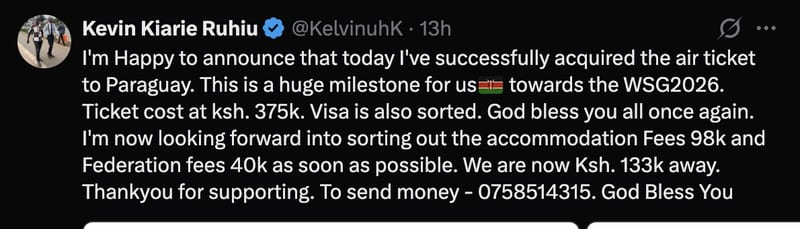
In another response, he said PS Mwangi had committed to reimburse expenses for his self sponsored appearances in Singapore, Benin and Egypt, but that none of those reimbursements had been completed despite formal follow up. He further said the federation had not channelled funds to him four months later and that he had missed three international competitions despite being assured of support.
The disagreement over the KSh870,000 payment has made the matter even more complicated. Itumbi publicly asked Kiarie whether he held an Equity Bank account beginning with 77 and ending with 078 in May 2026 and challenged him to confirm whether KSh870,000 had been transferred into that account.
Itumbi said he was prepared to publish evidence of the successful transfer if Kiarie consented, while maintaining that he would not publish personal banking information without the athlete's permission. He separately said he had evidence showing a KSh380,000 transfer from Government accounts to the federation.
This creates two separate questions that should not be mixed together. The first is whether Government money was approved and transferred to a federation or an athlete. The second is whether the intended beneficiary actually received the money and when.
A payment leaving a Government account does not, by itself, prove that an athlete received the funds meant for him. Equally, an athlete's claim that he did not receive money cannot by itself prove that the Government failed to pay it. The bank records, payment instructions, federation records and acknowledgement of receipt are what should settle the dispute.
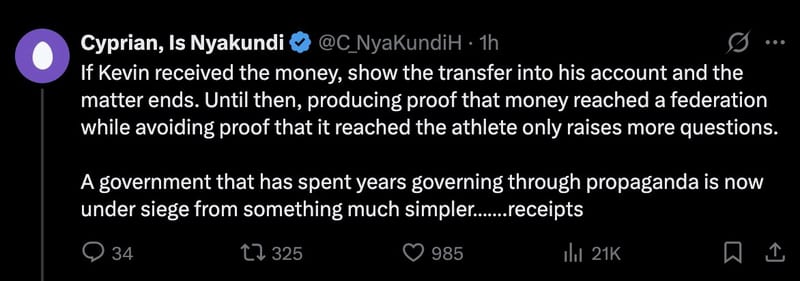
That is why the call for receipts and transfer records is important. If KSh641,900 was fully disbursed to the federation, the payment voucher and bank transfer should establish when the money left the Government account, which account received it and what purpose was stated for the payment. The federation should then be able to show when and how much was transferred to Kiarie. If KSh380,000 remained due to him, there should be a clear record explaining why it had not reached him and what happened after the PS directed that it be released.
The same applies to the KSh870,000. If the Government has evidence that the money reached Kiarie's account, the transaction should be independently verifiable through the appropriate financial records, subject to the protection of the athlete's private banking information. If Kiarie disputes receiving the money, the matter should not be settled through social media arguments. The relevant transaction records should settle it.
The controversy is unfolding against a background in which Kiarie's achievements have already received considerable public recognition.
In April, he returned from Benin after winning gold and silver at the International Challenge Skating Championships, having publicly spoken about the difficulty he faced in raising money to travel for the competition. Capital FM reported that Kiarie had struggled to secure transport to Benin and described getting to the competition itself as a major challenge.
His performances in Egypt later strengthened his position as one of Kenya's leading skaters, with reports showing that he won gold medals at the Africa Skate Games. Citizen Digital reported that Kiarie had returned from Cairo after his African success, while other Kenyan media reported that his success had come after significant personal financial sacrifice and limited support.
The Government itself recognised his achievements. In May, PS Mwangi met Kiarie and publicly discussed support for emerging sports, while the State Department said the Government had recognised Kiarie's international performances through the National Awarding Scheme. The same meeting produced a public commitment to support his preparations for the World Skate Games in Paraguay.
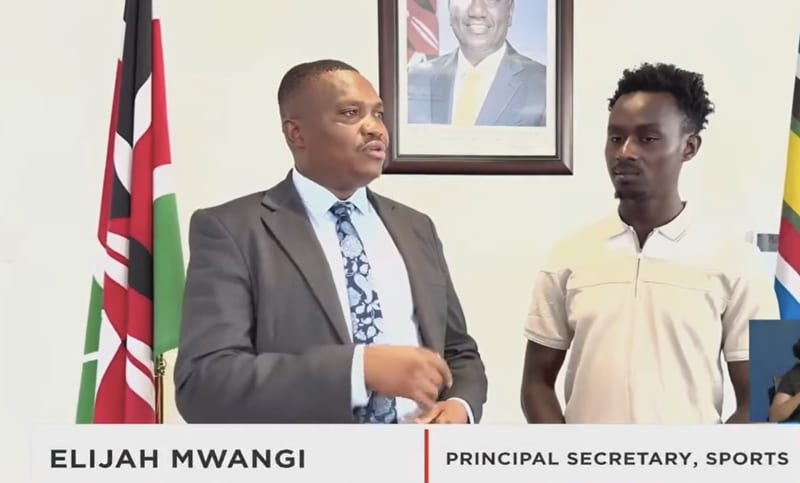
That makes the later dispute difficult to ignore. The Government was publicly telling the country that Kiarie had earned support, while the athlete says he was still struggling to secure the money required to compete.
The question now is whether the problem lies with the Government's approval processes, the federation's handling of funds, communication between the athlete and officials or some combination of all three.
The Government's advisory says the situation involving Benin and Singapore was different from Egypt. According to the State Department, funding for those competitions could not be approved or disbursed because of pending audit queries and the absence of formally approved event budgets before the competitions began. The department also said Kiarie was unable to attend the Sichuan High T Competition in China because his Chinese visa was issued after the competition had already ended.
Kiarie's account is that he was repeatedly assured of support and that the failure to receive the promised assistance contributed to him missing international competitions. He has also questioned why funds that were supposed to support his participation in China were not available for their intended purpose, saying he ended up sponsoring himself despite earlier discussions around government support.
The China issue is particularly important because the Government's own public statement in May had indicated that Kiarie was expected to attend a two week training camp in China before travelling to Paraguay for the World Skate Games.
If the training opportunity was part of the support discussed with the athlete, then the relevant records should show when the funding request was submitted, when approval was granted, when the money was released and whether the visa delay occurred before or after the funding arrangements were completed.
There is another issue that deserves attention, and that is the role of the skating federation. The State Department's own brief places the KSh380,000 outstanding payment with the federation, not with the athlete. If that position is correct, then the federation should be able to explain why money received for the athlete had not reached him and why it required a public dispute before the Sports Department directed that the amount be released.
This is where the Office of the Sports Registrar becomes relevant. The Sports Act established the Sports Registrar as the office responsible for registering sports organisations and dealing with matters relating to sports governance and compliance. The State Department itself has previously encouraged athletes in emerging sports to register with federations and with the Sports Registrar, with PS Mwangi saying formal registration could help athletes deal with disputes and problems involving non compliant federations.
The State Department for Sports, headed by PS Elijah Mwangi, must now provide clarity on the Government's side of the story. The department has already stated that KSh641,900 was fully disbursed to the federation, that KSh380,000 remains due to Kiarie and that it has directed the amount to be released immediately. It should therefore be possible to establish the date of the transfer, the recipient account, the purpose of the payment and whether the federation has since released the KSh380,000 to the athlete.
The Sports, Arts and Social Development Fund may equally be relevant to the wider financing questions where funding for international sporting activities passes through its structures or programmes. Parliament's relevant sports committees should also be able to demand records where public money is involved, particularly if there are discrepancies between amounts approved, amounts disbursed and amounts ultimately received by athletes.
If the disagreement involves public funds that cannot be accounted for, the Office of the Auditor General and, where evidence points to possible misuse or improper handling of public resources, the Ethics and Anti Corruption Commission can become relevant.
But the first step should be straightforward. Establish the paper trail and the bank trail, then determine whether the money reached the person or institution it was intended for.
The current dispute is bigger than Kevin Kiarie. It speaks to how Kenya treats athletes in sports that do not have the commercial visibility enjoyed by football, athletics and rugby.
Kiarie's rise has shown that a Kenyan can compete successfully on the international skating circuit even without the same infrastructure and sponsorship available to athletes in more established disciplines.
He trained in an apartment basement and began his journey with a second hand pair of skates bought from Gikomba, while later reports highlighted the financial difficulties he faced while trying to compete internationally.
When such an athlete wins medals, qualifies for a global competition and is publicly promised Government support, the system has a responsibility to make sure the promise translates into actual support. Otherwise, recognition becomes little more than a photograph after the victory while the athlete is left to solve the financial problems alone.
Kiarie says he has already missed three international competitions and is now focused on the World Skate Games. The Government says his new funding request for the World Inline Freestyle Championship has been received and is undergoing the approval process, while Itumbi has publicly assured him that the Government will support his participation because he has earned his place.
That commitment now needs to be followed by action and clear records.
If KSh870,000 reached Kiarie's account, the transaction should be shown to him and the matter should be settled. If KSh641,900 was sent to the federation, the federation should account for every shilling and explain why KSh380,000 remained unpaid to the athlete. If Kiarie's reimbursements for Singapore and Benin were never approved, the Ministry should show the relevant decisions and explain why he was led to believe reimbursement would be made. If funding was blocked because of audit queries or missing event budgets, those documents should be made available to explain the decision.
And if mistakes were made, they should be acknowledged and corrected rather than buried under competing social media statements.
For now, the most important thing is not who wins the online argument between Kiarie and Government officials. It is whether the records can answer the questions being raised.
Kenya has already seen what Kiarie can do when he gets onto the international stage. He has won medals, qualified for major competitions and continued representing the country despite the financial challenges surrounding his sport. The Government has publicly recognised those achievements and promised to support him. The public is now entitled to ask whether that support exists on paper only or whether it actually reaches the athlete who is expected to fly the Kenyan flag.
The answer should not require another social media battle.
It should be in the receipts.