
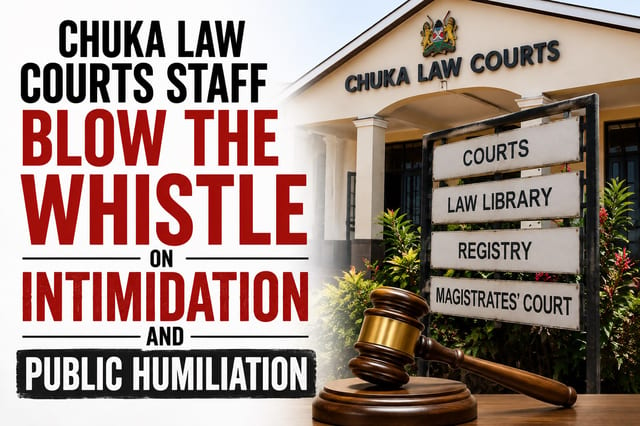
A staff member at Chuka Law Courts has raised serious concerns about the working environment at the station, stating that the management style of Chief Magistrate Hon. Joane Wambilyanga has contributed to declining staff morale and an atmosphere in which court employees, prosecutors, police orderlies and students on attachment reportedly feel intimidated, humiliated or unable to freely raise concerns.
The staff member, who has requested complete anonymity for fear of losing their job or facing retaliation, says the concerns are not about the Chief Magistrate's legitimate authority to supervise the station or ensure that court business is conducted properly, but about the manner in which that authority is exercised.
According to the complaint, Hon. Wambilyanga reported to Chuka Law Courts around February this year, after which some members of staff began experiencing what they describe as a more confrontational working environment.
The complainant states that court administrators and other employees have at times felt intimidated while carrying out their responsibilities, with staff feeling that decisions concerning the daily running of the station are largely expected to follow the Chief Magistrate's preferred approach, leaving limited room for alternative views or discussion.
The staff member further claims that some employees have become reluctant to raise concerns because of the manner in which disagreements are handled.
One statement attributed to the Chief Magistrate has particularly concerned some staff members, who say she has on various occasions made remarks to the effect that “yeye ni mtoto wa system.” The complainant says that, regardless of the intended meaning, some employees interpret such remarks as suggesting that her decisions should not be questioned, further contributing to an environment where workers are afraid to speak openly.
Court assistants reprimanded in front of litigants 
One of the most serious concerns is the treatment of court assistants during proceedings.
The complainant says that some court assistants have been rebuked in open court in the presence of litigants, accused persons and members of the public, a practice they say has left some employees feeling humiliated and undermined in front of the very people they are expected to serve.
The complaint acknowledges that supervision and correction are necessary within any institution, particularly in a court where accuracy and professionalism are essential, but argues that disciplinary or corrective concerns can be addressed privately rather than through public reprimands that could affect an employee's dignity and confidence.
The staff member says the incidents have contributed to growing apprehension among some employees, who reportedly fear making mistakes or expressing their views because they may be publicly called out.
Prosecutor humiliated during court proceedings 
The concerns also extend beyond Judiciary employees, with the complainant alleging that prosecutors appearing before the court have experienced similar treatment.
The complaint specifically cites the case of Ms. Grace Gichuru, a prosecutor who was humiliated in open court around February while prosecuting a matter.
According to the staff member, the incident arose after the prosecutor indicated that the police file had not been made available to her.
The complainant says the incident was sufficiently distressing that Ms. Gichuru subsequently sought to stop appearing in that particular court and was later deployed to another court.
The staff member argues that if there were concerns about the prosecutor's conduct or the manner in which she handled the matter, the issue could have been addressed privately rather than in the presence of litigants and accused persons.
“If there were concerns regarding the prosecutor's conduct or the manner in which she had handled the matter, it would have been more appropriate, in my respectful view, for the Chief Magistrate to summon her to chambers and address the issue privately and professionally.”
The complainant says public confrontation of a prosecutor risks not only affecting the individual officer but also undermining the professional relationship between the Judiciary and the Office of the Director of Public Prosecutions, whose officers must work together during court proceedings.
Police orderlies also reportedly affected 
The complaint further alleges that police officers attached to Chuka Law Courts as orderlies have also experienced intimidation and have sometimes been discouraged from expressing themselves or raising concerns.
The staff member says this has contributed to strained relations between police orderlies and court employees, creating tension among institutions that should instead be working together to ensure the smooth administration of justice.
A court station depends on cooperation between judicial officers, administrative staff, prosecutors, police officers and other personnel, particularly because each plays a different role in ensuring that cases proceed properly and that litigants and accused persons are assisted within the law.
The complainant therefore argues that an environment characterised by fear and tension can ultimately affect more than the employees involved because poor working relationships can interfere with communication and coordination during court proceedings.
Students on attachment afraid to attend court 
The complaint also raises concerns about students who attend Chuka Law Courts for attachment, including students from universities in Chuka and Embu.
According to the staff member, some students have found the environment intimidating and have become reluctant to appear in the Chief Magistrate's court because of fear of being singled out, rebuked or humiliated.
The complainant argues that students attend court specifically to learn and gain practical exposure, meaning mistakes should ordinarily provide opportunities for correction and mentorship rather than becoming occasions for public embarrassment.
“Students come to court to learn and gain practical experience. They should therefore be given an environment where they can ask questions, learn from proceedings and develop their professional skills without fear of humiliation.”
The concern is about management, not supervision 
The staff member is careful to distinguish the complaint from a demand that the Chief Magistrate's supervisory powers be removed or ignored.
Instead, the concern is that supervisory authority should be exercised in a manner that maintains professionalism and dignity while still ensuring that court operations remain efficient.
The complainant says the cumulative effect of the incidents has been a decline in morale, with some workers reportedly approaching their duties with apprehension rather than the confidence expected within a professional institution.
The staff member also believes that the working environment could eventually affect members of the public who depend on Chuka Law Courts for justice.
A court is not simply an office where employees report to work. It is an institution through which citizens seek justice, accused persons defend themselves, prosecutors present cases and police officers execute responsibilities connected to the criminal justice system.
For that reason, the complainant says disagreements and mistakes should be handled through established professional procedures rather than through conduct that could be perceived as intimidation or humiliation.
A call for the Judiciary to look into the concerns 
The complaint should now attract the attention of the Judicial Service Commission, the Judiciary's administration and human resource structures, and other relevant oversight mechanisms within the justice sector.
The concerns raised can be investigated without prejudging either the complainant or the Chief Magistrate, including by speaking to current and former employees, prosecutors, police officers and students who may have witnessed the alleged incidents.
This complaint is ultimately asking for a professional working environment where lawful supervision can continue without employees feeling that raising legitimate concerns will expose them to humiliation, intimidation or retaliation. Chuka Law Courts serves members of the public seeking justice, and maintaining dignity and professionalism among the people who operate the station is therefore not merely an internal human resource issue, but part of ensuring that the justice system functions effectively