
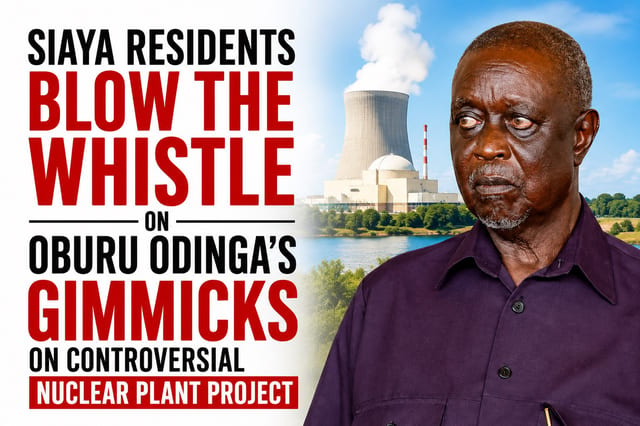
Residents of Lenya Village in Central Sakwa, Bondo Sub County, have raised fresh concerns over the proposed nuclear power plant in Siaya, saying the community that stands to be directly affected by the project must be given a genuine opportunity to express its views before decisions concerning the project are made.
The concerns come at a time when public participation and stakeholder engagement for the proposed nuclear power project have already become contentious in parts of Bondo, with residents in Lenya and neighbouring areas staging protests, questioning the proposed location and raising concerns about displacement, environmental safety and whether their views are being adequately captured.
The proposed facility, which the government has placed in Lenya Village as the preferred site for Kenya's first nuclear power plant, is expected to form part of the country's long term energy strategy. The Nuclear Power and Energy Agency has previously said the project will not proceed without the required approvals and community engagement, while President William Ruto has also called for the people of Siaya to be partners in the nuclear programme.
But for residents who live in the proposed host area, the central concern is whether participation is actually reaching the people whose homes, land and livelihoods could be directly affected.
A resident of Central Sakwa, Lenya Village, contacted Nyakundi Report saying the community has serious reservations about the project and wants its concerns heard without intimidation.
“There is growing concern in Lenya Village regarding the proposed nuclear power plant project in Siaya, particularly the plans affecting our area. As a community, we have raised serious concerns about the project and, like the communities in Kilifi, we have expressed our opposition and desire to have our concerns genuinely heard and addressed.”
The concerns raised are not occurring in isolation. Residents of Lenya have previously publicly opposed the project, with reports in May indicating that residents were worried about possible displacement from ancestral land, environmental risks and what they described as inadequate consultation before Lenya was identified as a possible site.
Public participation meetings held in the area have also experienced disruption. In July, a stakeholder engagement forum at Ka'John Trading Centre in Central Sakwa descended into chaos, with one person suffering a gunshot wound and several vehicles damaged. The meeting had been organised by NuPEA and KenGen as part of the government's efforts to explain the project and collect views from residents.
The situation subsequently escalated into arrests, with 17 people arrested following the disruption of a public participation forum and later released on bail as investigations continued. A Bondo court reportedly declined a prosecution request to hold the suspects longer over possible terrorism related investigations and instead granted them bail.
Residents now fear that the arrests and the events surrounding the protests could discourage people from openly expressing opposition to the project.
Guya says this is particularly worrying because people living in Lenya should be able to raise concerns about a project that could directly affect their land and livelihoods without feeling that speaking out could expose them to arrest or intimidation.
“In July, several residents of Lenya were arrested following protests concerning the project. They were taken to court and faced serious allegations. This has left many residents feeling intimidated and fearful of openly expressing their views. And Oburu Oginga is the one leading this menance”
According to the complainant, meetings concerning the nuclear project are currently being held in Bondo, but residents from Lenya, which has been identified as the preferred site, feel that they are not being adequately represented in the discussions.
This concern deserves attention because the government has itself stated that public participation is an important part of the nuclear programme. NuPEA has previously said that community consent is necessary before nuclear infrastructure can be constructed, while the July engagement exercise was presented as part of the process of collecting public views.
The Senate Standing Committee on Energy has also recently sought assurances from NuPEA regarding community participation, environmental protection, safety, financing and the social and economic benefits of the proposed project. Parliament reported that NuPEA told senators that Lenya had been identified as the preferred site, but that detailed site characterisation and other studies still have to be completed before licensing and construction approvals can be granted.
That means the concerns being raised by Lenya residents should not be treated as an inconvenience to the project. They form part of the information that should be considered before the government moves further with a development of this scale.
Three issues from other communities offer a warning 
The experience in Kilifi is already part of the story. The nuclear project was initially proposed for the Uyombo area of Kilifi before opposition from local communities contributed to the government shifting its attention to Siaya. Residents in Siaya therefore argue that moving the project from one community to another cannot replace the process of obtaining meaningful acceptance and addressing concerns from the new host community.
The second concern is the experience of residents in Sakwa itself, where protests in May showed that opposition was already building before the July engagement meetings. Residents carried banners rejecting the project and raised concerns about environmental safety, public health and consultation.
The third is what happened during the July 24 engagement meeting, when the consultation exercise ended in violence and arrests. Whether the disruption was caused by protesters, inadequate crowd control or a combination of factors is a matter for the relevant authorities to establish, but the outcome was the same. A process intended to gather public views ended with residents injured and others arrested.
That should be a warning to everyone involved that the remaining engagement process requires greater transparency, patience and direct involvement of the communities most affected.
Public participation should be more than attendance registers 
The residents' complaint raises a broader issue about how major government projects are presented to communities.
A public meeting cannot simply become a process where officials explain why a project is beneficial and then record attendance before declaring that consultation has taken place. For a project capable of affecting land ownership, livelihoods, the environment and the future of an entire community, residents need access to sufficient information to understand the proposal, ask questions, challenge assumptions and receive substantive responses to their concerns.
The government has said that the proposed nuclear programme will bring jobs, infrastructure and reliable electricity, while NuPEA has described stakeholder engagement as a continuing process.
Those benefits should therefore be placed before the affected communities alongside the potential risks, compensation arrangements, land acquisition plans, environmental safeguards, emergency preparedness measures and the legal protections available to residents.
Most importantly, residents who oppose the project should not have to support it simply because the government considers it important.
Authorities should address the concerns before the project moves forward 
The Nuclear Power and Energy Agency, KenGen, the Nuclear Regulatory Authority, NEMA, the Siaya County Government and the relevant parliamentary committees should ensure that residents of Lenya and the wider Central Sakwa area are directly and adequately represented in the consultation process.
The environmental and social assessment process should also be transparent enough for affected residents to understand what is being proposed on their land and what safeguards would apply if the project proceeds.
Where residents have concerns over displacement, compensation, environmental effects or public safety, those concerns should be formally recorded and answered rather than dismissed as opposition to development.
The arrests that followed the July protests should also be handled through due process, with the courts determining the cases against those charged and authorities avoiding the appearance that criminal proceedings are being used to discourage legitimate public participation.
Guya's message is ultimately about the right of a community to be heard before a decision that could fundamentally change its surroundings is made.
“Please help share this message and bring national attention to what is happening in Lenya. The people of Lenya deserve to be heard not intimidated into silence. Dr Oburu should stop this nonsense”
The proposed nuclear plant remains a major national project, but its importance to Kenya's energy future does not remove the obligation to listen to the people living at the proposed site.
If the government believes the project is safe, beneficial and capable of transforming Siaya, the strongest way to demonstrate that is not through pressure, but through complete disclosure, meaningful public participation, independent oversight and a process in which even those who oppose the project are allowed to speak freely