
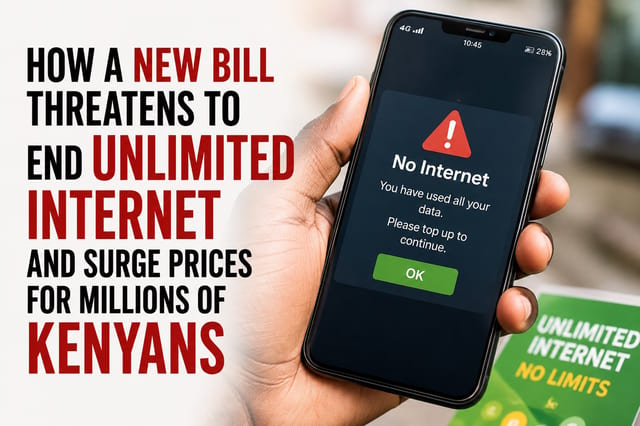
Kenyans may soon have to rethink the way they pay for internet if a proposed amendment to the Kenya Information and Communications Act becomes law.
At a time when mobile users are already complaining that their data bundles appear to disappear faster than before, the Kenya Information and Communications (Amendment) Bill, 2025, sponsored by Aldai MP Marianne Kitany, is proposing a major change to how internet consumption is measured and billed.
The Bill proposes that internet service providers operate a meter billing system that assigns every customer a unique and identifiable meter number, monitors usage, converts consumption into readable details, generates invoices based on consumption and allows customers to verify their bills.
ISPs would also be required to submit information about their billing systems, including internet meter numbers issued to subscribers, to the Communications Authority at least once every financial year.
The proposal is already moving through Parliament. The Bill was formally read for the first time on July 1, 2026, and was subsequently referred to the relevant parliamentary committee for consideration.
But the proposed changes are raising questions about what internet access could look like if metered billing becomes mandatory.
From bundles to metered internet 
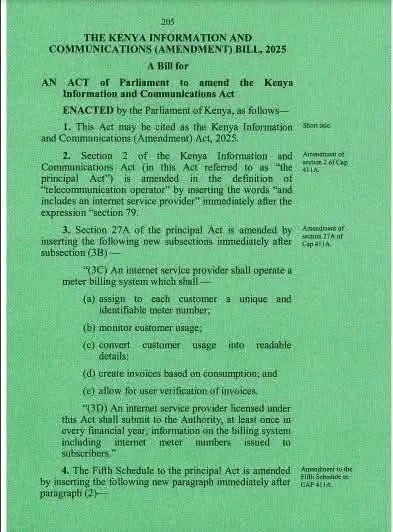
The most significant proposal is the requirement for ISPs to measure customers' actual internet consumption.
The Bill itself does not explicitly abolish unlimited internet packages or set new prices for data. However, its requirement for consumption based metering could change how some internet providers structure and price their services.
In practical terms, the proposal would move internet billing closer to the model used for other utilities, where consumption is measured and translated into a bill.
The Bill's sponsor says the objective is actually to protect consumers from exploitation and safeguard their economic interests by ensuring that customers can see and verify what they are being charged for.
That justification, however, has not stopped concerns from digital rights groups.
Amnesty International Kenya has warned that assigning internet users meter numbers and requiring providers to monitor usage could create privacy risks and give regulators access to detailed information about how people use the internet.
The bigger concern is affordability 
For millions of Kenyans, the internet is no longer a luxury.
Small businesses depend on WhatsApp, Facebook, TikTok, websites and online marketplaces to find customers. Students use the internet for classes and research. Freelancers work with international clients online. Content creators depend on affordable data to produce and distribute their work.
A significant increase in the cost of accessing the internet would therefore affect far more than social media users.
It could increase operating costs for businesses, make online learning more expensive and put additional pressure on young people whose livelihoods depend entirely on internet access.
The proposed law is particularly sensitive because Kenya's digital economy has grown around relatively affordable mobile and fixed internet access.
Could this affect social media access? 
Critics have raised concerns that the proposed metering system could eventually make internet access less affordable, particularly if providers pass the cost of implementing new billing and monitoring systems to consumers.
There are also concerns about the amount of information that could be generated through the system.
The Bill requires ISPs to monitor customer usage and submit information concerning their billing systems and meter numbers to the Communications Authority.
Digital rights advocates have consequently questioned whether a proposal presented as a consumer protection measure could also create a more intrusive system for monitoring internet users.
Why Kenyans should pay attention 
The debate is no longer simply about how many gigabytes are contained in a data bundle.
It is about who measures your internet consumption, how that information is recorded, how you are billed and what happens to the information generated about your online use.
The Bill's supporters argue that metering could protect consumers from unexplained or unfair billing. Its critics fear that the system could increase surveillance and eventually make internet access more expensive.
And with Kenya heading towards another election year, affordable and accessible internet has an even bigger public importance.
Social media has become one of the main channels through which Kenyans receive news, organise politically, scrutinise leaders and participate in public debate.
Any policy that changes the cost or conditions of accessing the internet therefore deserves serious public scrutiny.
Will metered internet give consumers greater control over what they pay for, or will it become another cost imposed on a population already struggling with the rising price of living?