
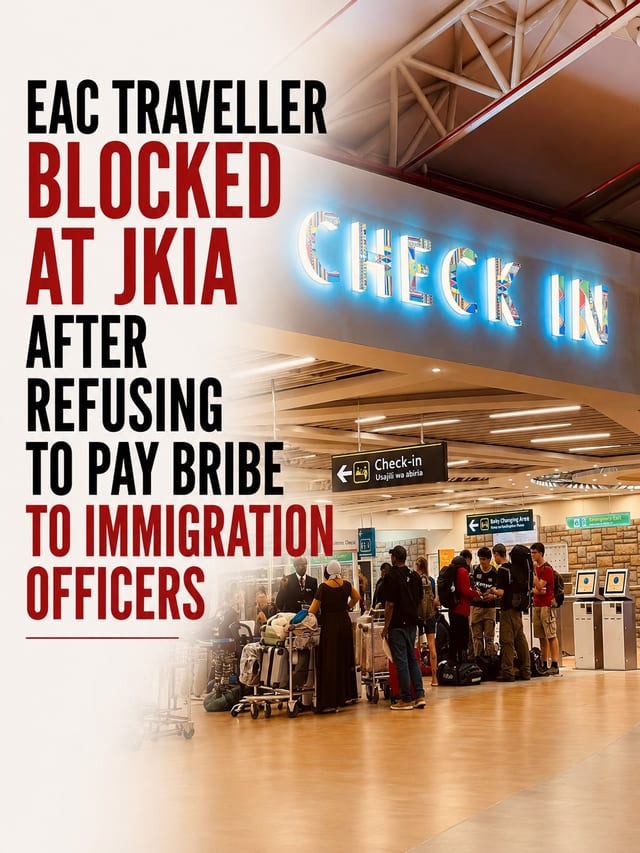
A traveller has accused immigration officers at Jomo Kenyatta International Airport of preventing him from boarding an international flight.
According to his odeal, the immigration officers were telling him to first travel back to Uganda and begin his journey from there, despite having entered Kenya legally and holding the necessary travel documents.
The traveller, identified on X as Henry, raised the complaint on August 18, 2026, questioning the purpose of East African integration if citizens of the region can allegedly be stopped from using airports in another EAC member state.
“What’s the role of the EAC if we can’t freely fly out using any airports within the EAC. Immigration officers at JKIA were telling me to go and start my journey from Ug. When I asked them why they had no reason,
He later said the officer justified the position by telling him that Kenyans are treated in a similar manner in other countries, an explanation that left him questioning whether reciprocal mistreatment should become an accepted immigration practice in East Africa.
The traveller also claimed that when he questioned the purpose of the EAC passport, an immigration officer dismissed it as “nonsense”, adding to his concerns about whether regional integration rights are being respected at points of entry and exit.
The complaint becomes more serious because Henry says his passport had already been stamped when he entered Kenya through the Busia border on July 20, 2026, meaning there was a documented record of his entry into the country.
According to his account, he was therefore not attempting to leave Kenya without an immigration record, and he believed he had complied with the requirements expected of an EAC traveller.
When I talked of giving them money to let me fly, they were very happy and even offered me a seat. This is very disturbing. When i engaged the immigration officer he simply told me this is how Kenyans are also treated in other countries so he was just reciprocated. This is sad..
What the EAC rules actually provide 
The EAC Common Market Protocol provides for the free movement of persons between Partner States, including the right of citizens of other Partner States to enter, stay and exit another Partner State without restrictions, subject to limited exceptions involving public policy, public security and public health. The EAC also says Partner States should apply non discrimination and equal treatment to citizens of other Partner States.
The regional framework does not, however, mean that every traveller can board any flight without meeting immigration requirements, because travellers must still comply with the immigration procedures of the country from which they depart and the requirements of their destination.
Kenya's Directorate of Immigration Services itself states that passengers departing by air must present their boarding pass and valid passport or acceptable travel document, undergo the required processing and, where travelling to a third destination, produce an onward ticket or boarding pass to their home country or country of domicile where applicable.
JKIA is also an officially designated Kenyan port of entry and exit operating around the clock, meaning there is nothing inherently unusual about an international traveller completing departure procedures from the airport.
That makes the allegation important to investigate, because if an immigration officer denied departure, there should have been a clear immigration reason that could be explained to the passenger rather than an unexplained instruction to travel back to Uganda.
Other travellers are now coming forward 
Henry's complaint has attracted responses from other travellers who say they have encountered similar situations in Kenya and Uganda.
One traveller claimed that an immigration officer at JKIA refused to stamp his passport and demanded KSh15,000, while another person claimed they were asked for KSh5,000 and eventually paid KSh2,000 before their passport was stamped.
Another traveller said they experienced a similar situation at Entebbe, where immigration officers told them to return to Nairobi before taking an onward flight to Dubai despite holding a valid visa for their destination.
There is also a separate allegation from another traveller who claimed that police officers in Nakuru detained them while travelling to Uganda and demanded KSh20,000 after disputing the validity of their documents.
This issue goes beyond one passenger being delayed at an airport and raises broader concerns about how East African citizens are treated while exercising their regional mobility rights.
Immigration authorities should establish what happened 
The Directorate of Immigration Services should establish exactly why Henry was stopped from boarding his flight, identify the immigration officers who handled the matter and state the specific legal or administrative provision relied upon to prevent his departure.
If there was a genuine immigration concern, the passenger should have been given the reason and the matter recorded through the proper procedure.
If there was no lawful basis for preventing his departure, the circumstances surrounding the incident should be investigated, particularly because allegations of officers asking for money in exchange for immigration services have also emerged from other travellers.
The Ethics and Anti Corruption Commission and other relevant oversight bodies should also take note where specific allegations of bribery are formally reported, while the EAC Secretariat has a responsibility to ensure that commitments under the Common Market Protocol are not merely written into regional agreements but are actually reflected at border posts, airports and other points of exit.
East African integration cannot mean citizens have freedom of movement on paper while facing unexplained barriers when they attempt to exercise that freedom.
The authorities should establish what happened at JKIA, explain the legal basis for the decision and ensure that any officer who acted outside the law is held accountable