
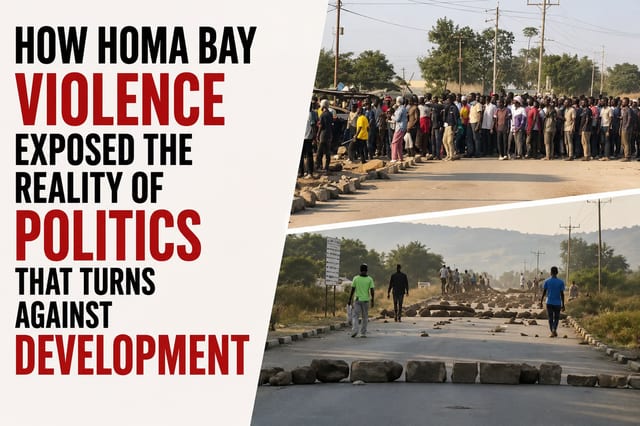
A growing public debate over events in Homa Bay has raised a disturbing question about the way politics can interfere with development, particularly after property worth millions of shillings was looted from Homa Bay Tourist Hotel amid rising political tensions ahead of the Linda Mwananchi rally.
This on top of separate accounts from residents have revived reality that community projects in parts of Nyanza have previously been destroyed, blocked or abandoned because they were perceived to threaten local political interests.
We saw youths armed with crude weapons raid Homa Bay Tourist Hotel on Saturday evening, with property worth millions of shillings looted as tensions increased ahead of the political rally.
The incident is serious on its own because private property and businesses should not become casualties of political competition, but the wider conversation that followed has exposed a deeper problem that residents themselves are now discussing, namely whether political power is sometimes used to determine which development projects survive, who receives credit for them and whether projects associated with individuals outside the political establishment are allowed to operate.
One of the most striking accounts came from a Homa Bay resident who said her late parents, including her mother who worked as a midwife, had personally invested in rural clinics serving communities in remote parts of the county, while she later continued supporting rural education projects after their deaths, only for a community library and a solar powered water tank she had helped establish to be brought down by an MCA and several men in 2019 because she had not sought their permission.
This is particularly disturbing because the projects described were not political offices or campaign structures, but facilities intended to provide water and a place for students to study, meaning that if the account is accurate, ordinary residents were ultimately the ones who lost access to services because of a dispute over who had authority or political ownership over a development initiative.
Another account from Ndhiwa, Homa Bay County, stated that a community water project funded privately at a cost of more than KSh3 million was stopped after a local councillor and his supporters complained that they had been excluded, with the complainant claiming that even animals were slaughtered at the project site to frighten villagers and prevent the work from continuing.
The most troubling question is why destroy what already exists?
This is the issue raised by journalist Ferdinand Omondi, who questioned the logic of destroying existing development before introducing another project.
“So some Luoland MPs are giving orders for the destruction of existing development so they can bring development. Make it make sense.”
The statement followed the report about the Homa Bay Tourist Hotel raid, but the reactions that followed revealed numerous Kenyans claiming to have witnessed similar disputes involving community development projects in different parts of the country.
Development should not have a political surname.
A borehole does not belong to the politician who commissioned it, a library does not belong to the MCA who launched it, a hospital does not belong to the MP who secured funding for it and a privately funded community project should not require political permission before residents can benefit from it.
The Seme water and library allegation 
One of the accounts circulating online came from a resident who said she had personally invested in community development after her parents, who had established rural clinics in Homa Bay, died.
She alleged that in 2019, an MCA and several men in her village brought down a water tank and a solar powered community library she had helped build for students to use in the evenings.
Her account was particularly revealing because she said she had not sought permission from the local political leadership before undertaking the project, suggesting that the disagreement was allegedly less about whether the community needed water and educational facilities and more about who had the authority to initiate and control development.
This raises an uncomfortable question about whether political leaders sometimes mistake public service for political ownership, where anything that does not originate from their office becomes competition rather than an additional benefit to residents.
The relevant county government, National Government Administration officers and police authorities should investigate any specific destruction of community facilities and establish who authorised such actions, whether the property had the necessary approvals and whether anyone was held responsible for the destruction.
The Ndhiwa water project allegation 
A separate account from Ndhiwa alleged that a community water project had already consumed more than KSh3 million in privately sourced funds when it was allegedly stopped by a former councillor and his supporters because they were said to have been left out of the project.
The complainant further alleged that the people involved went as far as slaughtering animals at the project site, which allegedly frightened villagers and disrupted the initiative.
Again, if public or privately raised funds were used to construct a water project and the facility was subsequently destroyed or stopped because of political disagreements, the matter would warrant investigation by the relevant county authorities, police and, where public resources are involved, the Ethics and Anti Corruption Commission.
A community that has spent millions trying to solve a water problem should not be forced to start again because political actors disagree over who should receive credit.
The sunflower industry allegation 
Another account circulating in the debate recalled claims involving the former Sikri sunflower industry, with journalist Ferdinand Omondi saying that the chairperson of the Luo Council of Elders, Riaga Omollo, had previously been associated by locals with the collapse of a sunflower processing initiative at Sikri.
According to the account, a missionary had encouraged local residents to grow sunflowers and had established processing arrangements that were providing young people with an opportunity to earn money.
This story illustrates the same question now dominating the debate: what happens when an economic project begins succeeding outside the control of established political structures?
Instead of asking who owns the project or who deserves the political credit, the first question should always be whether the project is helping residents earn an income.
Dominion Farms and the Yala Swamp controversy 
The debate has also revived memories of Dominion Farms' operations in the Yala Swamp, where the American founded agricultural venture became embroiled in disputes involving local communities, political leaders and accusations of interference.
Dominion Farms founder Calvin Burgess publicly complained about political interference, extortion and threats during the company's years of operation in Kenya, while the company's departure from the Yala Swamp became another chapter in the complicated history of large scale investment and local politics in western Kenya.
That case is far more complex than simply blaming one political group for the collapse of an agricultural enterprise, but it demonstrates how quickly investment, community interests and political influence can collide when large projects operate in economically vulnerable areas.
The lesson should be obvious: communities need functioning institutions capable of protecting legitimate investment, community projects and public resources regardless of which politician is in office.
The Homa Bay hotel raid should not become another political footnote 
The reported looting of Homa Bay Tourist Hotel deserves its own investigation because businesses cannot be allowed to become targets whenever political tensions rise.
The police should establish who organised the raid, identify those involved, recover stolen property where possible and ensure that those responsible face the law.
The Directorate of Criminal Investigations, the National Police Service and the Office of the Director of Public Prosecutions should ensure that the investigation does not end with the arrest of a few young people while those who may have organised or financed the violence remain untouched.
If politicians or political operatives were involved in directing or encouraging the destruction or looting, the evidence should be investigated regardless of the political party or community involved.
Homa Bay does not need destruction disguised as development 
The most damaging form of political competition is not the exchange of insults at rallies.
It is the competition that leaves ordinary residents with fewer services than they had before. If a community has a functioning water tank, improve it. If there is already a library, expand it. If someone has established a clinic, support it.
If a private investor has created jobs, protect the investment while enforcing the law. If a county government wants to build a better facility, build the better facility without first destroying the one residents are already using. That is what development should mean.
The public should not have to choose between political loyalty and access to water, education, healthcare or employment. And politicians should not treat development as a trophy that must bear their name before residents are allowed to benefit from it.
A politician who destroys a functioning project because they want to build their own is not creating development twice. They are making citizens pay twice for the same service, first through the destruction and again through the replacement