
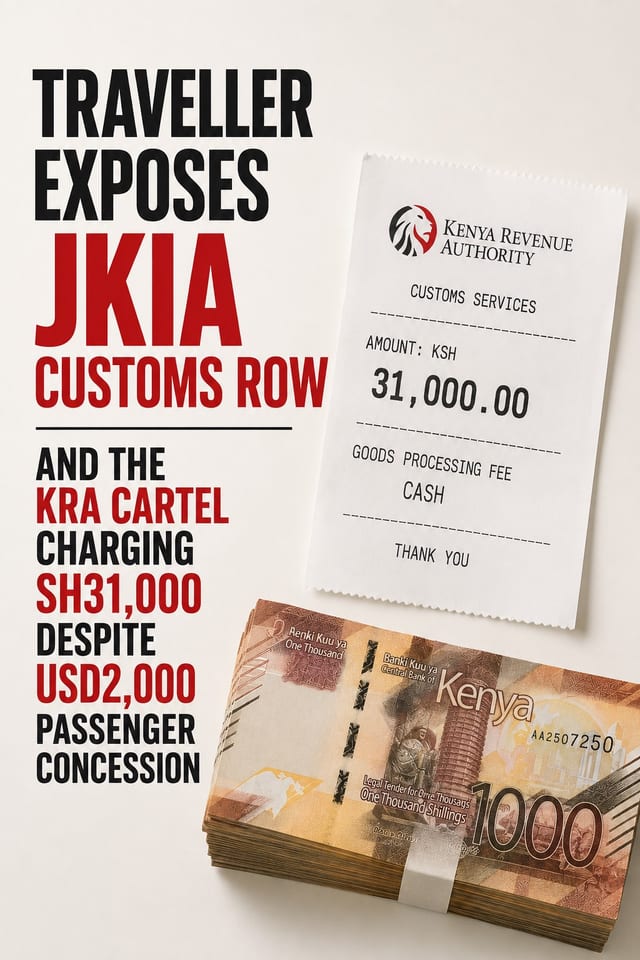
A fresh dispute at Jomo Kenyatta International Airport (JKIA) has put the Kenya Revenue Authority's passenger customs clearance procedures under scrutiny after a Kenyan traveller complains he was charged KSh31,000 in duties on a pair of motorcycle lights worth less than USD200, despite pointing customs officers to KRA's own guidance on the USD2,000 concession for new goods acquired abroad for personal or household use.
According to the complainant, KRA officers at JKIA had charged him duty on the motorcycle lights after classifying them as "spare parts" and therefore treating them as non exempt.
The dispute is particularly significant because KRA's current passenger clearance guidance states that passengers have a USD2,000 concession on goods for personal and/or household use.
In contrast, its published list of goods that are not exempt specifically identifies alcoholic beverages, fabrics in piece, motor vehicles, and trade goods or goods intended for sale or disposal. KRA's own guidance also states that passengers have the right to query customs duty assessed by an officer and receive an explanation of how the taxes were calculated.
This complaint is therefore not simply about the amount he was charged, but about how a customs officer interpreted the classification of the motorcycle lights and whether the USD2,000 concession was properly considered before the KSh31,000 bill was imposed.
In a very similar matter, another Kenyan had initially raised the matter on July 3, saying that KRA officers at JKIA had charged her duty on a pair of bike lights worth less than USD200, even though she understood KRA's passenger clearance guidance to allow a USD2,000 concession for personal and household goods.
She said the officers classified the lights as "spare parts", which they considered non exempt.
"Your officers at JKIA charged me duty on a pair of bike lights worth less than $200. KRA’s own passenger clearance guidance allows a USD 2,000 concession applicable to goods for personal and/or household use. They claimed they were 'spare parts' and therefore non-exempt."
The previous complainant then explained that he had initially been too tired to pursue the argument at the airport, but later returned to the issue after examining the relevant legal provisions and KRA's guidance more closely.
He argued that the guidance identifies categories that are excluded from the concession, including motor vehicles and trade goods, but does not expressly list motorcycle accessories or spare parts as a general excluded category.
"I was tired, didn't have the bandwidth to engage. Your guidance lists the non-exempt categories, including motor vehicles, trade goods, but not motorcycle accessories or spare parts as a general excluded category. Your staff should not make up their own rules or misuse discretion."
This goes directly to the heart of the dispute because the question is whether the officers were applying an established customs classification and exemption rule or whether the passenger was subjected to an interpretation that went beyond what the published passenger guidance provides.
The first complainant, later returned to the issue with what he described as the relevant legal and documentary material, including a copy of the East African Community Customs Management Act, KRA's guidance and the motorcycle's logbook, which he says was intended to demonstrate that the goods were connected to his personal motorcycle and were not being imported for commercial purposes.
According to his account, he was still told that the USD2,000 concession did not apply in the manner he had argued.
"This time I had time. I had a copy of the EACCMA section, the KRA guidance and even the log book for the motorcycle to show the goods were for personal use. Nothing doing. Simon told me they don’t know about the 2000usd and that as far as he knew it only applies to used goods."
That response is particularly striking when compared with KRA's currently published passenger clearance guidance, which says that new items valued at up to USD2,000 per traveller are exempt from import tax when declared to the Customs Officer, while separately stating that used personal effects are also exempt.
KRA's passenger terminal guidance also expressly states that the USD2,000 concession applies to goods for personal and/or household use, while listing categories that do not qualify, including motor vehicles and trade goods intended for sale or disposal.
That distinction is central to this complaint because his position is that a pair of motorcycle lights for his own motorcycle is not the same thing as importing a motorcycle or bringing commercial goods into the country for resale.
The law he cites provides for new items 
He subsequently published the provision he says supports his interpretation, beginning with the section on passengers' baggage and the treatment of personal effects and new or additional items.
He quoted the provision as follows:
"Passengers’ Baggage - Goods described in the following paragraphs entering the Partner States as accompanied or unaccompanied baggage of a passenger, subject to such conditions as the Commissioner may impose, are exempt from duty."
He then pointed to the provision dealing with personal effects and new items, which distinguishes between used personal and household effects and new or additional items purchased outside the Partner States for personal or household use.
"(1) Personal effects: All used personal and household effects of any kind which are intended for the passenger's own use or convenience and are not intended for sale, disposal, or commercial use. (2) New or additional items: Goods to the value of USD 2,000..."
The whistleblower further pointed out that the USD2,000 threshold was increased from USD500 by the EAC Council of Ministers, and that the provision concerns new items acquired outside the Partner States for the traveller's personal or household use.
The EAC itself confirms that the allowable amount for personal effects or baggage was increased from USD500 to USD2,000 through amendments to the EAC Customs Management framework.
KRA's current online guidance similarly confirms that passengers have a USD2,000 concession for goods intended for personal or household use, subject to the applicable conditions and exclusions.
So where does the dispute actually lie? 
The dispute is not whether KRA has a USD2,000 passenger concession because KRA itself currently publishes that concession.
The dispute is whether the particular motorcycle lights brought into the country fell within the category of goods covered by that concession, or whether customs law and the applicable tariff classification required the items to be treated differently because they were considered motorcycle spare parts.
KRA's published guidance says the customs officer assesses duty according to the customs value and applicable tariff classification, and it also states that passengers have a right to query the assessment and receive an explanation from the officer on how the amount was arrived at.
That means the authority should be able to explain precisely which provision, tariff classification or exemption rule was applied to the motorcycle lights, rather than simply telling a passenger that the items are "spare parts".
If the items were properly classified as taxable spare parts, KRA should be able to identify the legal and tariff basis for that decision.
If they qualified for the passenger concession, the assessment should equally be corrected.
The issue should ultimately be settled by the applicable customs law and documented classification, not by the personal interpretation of an individual officer.
After he attempted to have the issue addressed, he says he eventually paid KSh31,000 in duties.
His words were blunt:
"Long story short, I paid 31k in duties."
He then raised a much wider concern, alleging that revenue pressure could be encouraging some customs officers to interpret the passenger concession narrowly in order to maximise collections.
"It is rumored that because of revenue targets officers have cynically decided to not let Kenyans enjoy this benefit until a sufficiently triggered citizen takes the matter to the Tax Tribunal or High Court for proper interpretation."
However strong, it raises an important public interest issue because KRA's own published material says passengers have a right to challenge customs assessments, while the current guidance clearly recognises the USD2,000 concession.
Other travellers have raised questions about customs treatment 
This unfortunate experience has also triggered responses from other travellers who say they have encountered different treatment when bringing vehicle related items into Kenya.
One traveller claimed that he recently brought new car brake pads and discs worth £127.50, weighing approximately 10.5 kilograms, from the United Kingdom and said a customs officer allowed him through after examining his invoice.
Another social media user called on the authorities to ensure that customs officers follow the law and accused some officers of extortion, while urging the Katiba Institute to consider legal action over what the user described as problems at JKIA.
KRA itself says passengers can challenge customs assessments
Perhaps the most important part of KRA's own guidance for passengers is the recognition that a traveller does not have to silently accept a customs assessment.
KRA states that a passenger has the right to query the assessed customs duty, and that the Customs Officer is required to demonstrate the correctness of the assessment.
KRA also states that taxes are assessed using the customs value of the item and the applicable tariff classification under the EAC Common External Tariff and other relevant legislation.
The bigger issue is consistency at JKIA 
For ordinary Kenyans travelling through JKIA, customs clearance can already be intimidating because passengers are dealing with officials who have statutory powers to inspect baggage, determine customs value and assess taxes.
That makes consistency particularly important. A passenger who reads KRA's published guidance before travelling should reasonably expect the rules described on the authority's website to correspond with the rules applied at the airport.
It becomes a question of whether Kenyans travelling through the country's main international airport are receiving predictable and uniform treatment under the same customs framework.
What KRA should explain 
The matter now calls for a clear response from KRA Commissioner General Adan Abdulla Mohamed and the Customs and Border Control Department, particularly because this has publicly identified the nature of the goods, their approximate value, the purpose for which he says they were acquired and the legal provisions on which he relied.
This is not about allowing passengers to evade legitimate taxes. It is about ensuring that a tax authority applies its own published rules consistently, transparently and according to the law, especially when a traveller has taken the trouble to read the rules, produced supporting documentation and challenged an assessment he believes is inconsistent with those rules.