
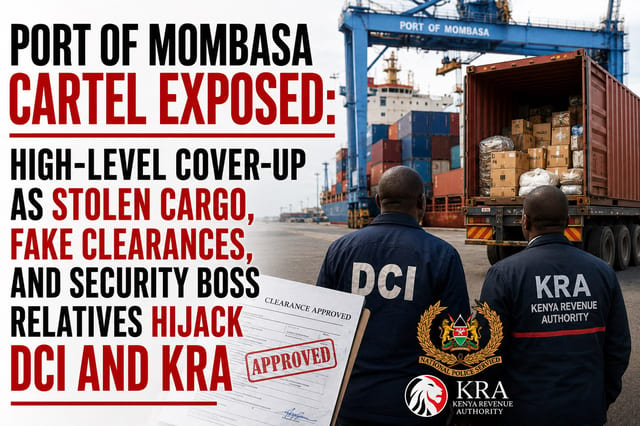
A whistleblower has exposed high-stakes cartel operation at the Port of Mombasa, detailing how a 20-foot container intercepted by security officers and taken to Port Police on Friday night, August 14, 2026, was abruptly subjected to top-down instructions for release.
The Directorate of Criminal Investigations (DCI) officers at Kilindini, Kenya Revenue Authority (KRA) officials, and Kenya Ports Authority (KPA) staff are operating in state of fear, facing intense pressure and intimidation from politically connected port operators and high-ranking security figures linked to the cargo.
The intercepted shipment—container CMAU0451462 under booking number PS2260837415, transported by vehicle registration KDT 056X/ZF 6338—has laid bare severe systemic vulnerabilities at Kenya’s primary trade gateway.
While official documentation identifies Africa Global Logistics Special on the Bill of Lading (No. GGZ3102113), KPA internal system records link the operation to Weber Logistics Limited.
According to the informant, customs officers are being pressured to retroactively fabricate clearance documents to cover up an illegal "exit-first, clear-later" scheme, leaving cargo owners terrified by direct threats and raising urgent questions about whether the Port of Mombasa has fallen under the control of untouchable port cartels.
The complaint received
“Good afternoon Cyprian hide my ID Friday 14/08/2026 around 9.00PM kuna gari ilishikwa Port na Security ikapelekwa Port Police gari enyewe ni ya Autoport Frieght Terminal na unajua hio ni ya akina nani (Autoports Freight Terminals Ltd is owned by the prominent Kenyan billionaire Abubakar "Abu" Joho and the influential Joho family). m/v registration ni KDT 056X/ZF 6338 ilikuwa imebeba container ni CMAU0451462 (20 ft) under booking number PS2260837415 mzigo ni wa Africa Global Logistics Special as per the Bill of Lading No. GGZ3102113 but company ilikuwa inaiba ni ya Weber Logistics Limited as per KPA system the company is related the relative of someone who has the highest position in the security sector from Garrissa the DCI Kilindini officers are being intimidated by so called owners of Mombasa and infact the owner of the Cargo has been called by one of them issuing threats to him he is now terrrified and cant make a report to any Police station because he has been told nothing will be done to them
The KRA officials have been directed to release the Container and issue documents to show that the container was procedurally cleared from the Port the question is do you remove the container from the Port and then come back and do the clearing the answer is NO documentation first then exit of the Container most recently containers have been missing from the port without paying taxes a good example is the 200 containers that were stolen from the Port where WERBER Company featured too if a whole DCI KRA, OCPD and KPA can be operate in fear what will happen to common mwananchi
The KRA officials have been directed to release the container claimining that procedures were followed please let the Kenyans know that Port of Mombasa is a crime scene if you dont have muscles you will be squeezed sisi kama clearing agents we are doomed.
The complaint raises issues that should not be settled through threats, phone calls or competing versions from interested parties.
Autoports has previously faced scrutiny over port operations 
The company mentioned in the complaint, Autoports Freight Terminals, has previously featured in public disputes and regulatory and legal proceedings concerning port and cargo operations.
A 2016 report by Nation Media Group said KRA and KPA suspended Autoport and Portside Freight Terminals over tax evasion and smuggling, while noting that the Joho family did not disown ownership of the companies and that company records showed interlinked shareholders.
In another matter, an Auditor General special audit reported that Autoports Freight Terminal Limited, a firm linked to the Joho family, received a concessionary deal to operate at the Nairobi Freight Terminal after what the audit described as forged board resolutions at Kenya Railways.
The historical record therefore makes it important for the current allegations to be examined through documents rather than political connections or assumptions about ownership.
There is already evidence that cargo can leave the port through irregular processes 
The concerns raised by the whistleblower also deserve attention because Kenya has previously recorded cases in which cargo was allegedly removed from the Port of Mombasa using improper documentation.
In a 2023 Employment and Labour Relations Court judgment involving KPA employees, the court recorded evidence concerning the theft of six coils from the Port of Mombasa, where two gate passes were issued using the wrong Bill of Lading and pick up order, after which the records were deleted from KPA's cargo information management system in an attempt to conceal the evacuation. The court upheld the dismissal of two employees found culpable after disciplinary proceedings.
KPA itself says it has electronic surveillance covering port areas, restricted access to container terminals, cargo scanning systems, centralised verification areas and security patrols designed to protect cargo and port users.
Those systems should make it possible for investigators to establish what happened to a particular container without relying solely on statements from individuals.
The port's clearance system must answer the questions 
KRA and KPA have been working on reforms aimed at improving cargo clearance and strengthening digital integration at the Port of Mombasa, including measures intended to reduce manual processes and improve the coordination of cargo exit procedures.
That makes the documentation surrounding CMAU0451462 particularly important.
Investigators should establish the container's declaration records, Bill of Lading, manifest information, customs entries, tax assessment, payment records, release instructions, gate pass, system logs and the precise time at which it was authorised to leave the port.
If something was irregular, the same records should reveal where the process broke down.
The intimidation allegations require an independent response 
The most disturbing part of the complaint is the state that officers investigating the matter were intimidated and that the cargo owner was threatened.
The Directorate of Criminal Investigations, particularly the DCI formation responsible for ports, has an explicit mandate to investigate crime involving cargo and irregularities within its areas of operation. DCI's Railways and Ports formation specifically lists investigations involving missing goods and irregularities connected to the conveyance of goods among its functions.
The Ethics and Anti Corruption Commission should also examine any credible allegations of abuse of office, interference with customs processes or improper influence over public officers.
The Kenya Revenue Authority should independently verify whether the container had been fully cleared and whether all applicable taxes and duties had been paid before any release was authorised.
The Port of Mombasa is not simply another commercial facility. It is one of the country's most important economic gateways, handling cargo destined for Kenya and several landlocked countries in the region, which means any weakness in its clearance and security systems has consequences far beyond individual clearing agents.