
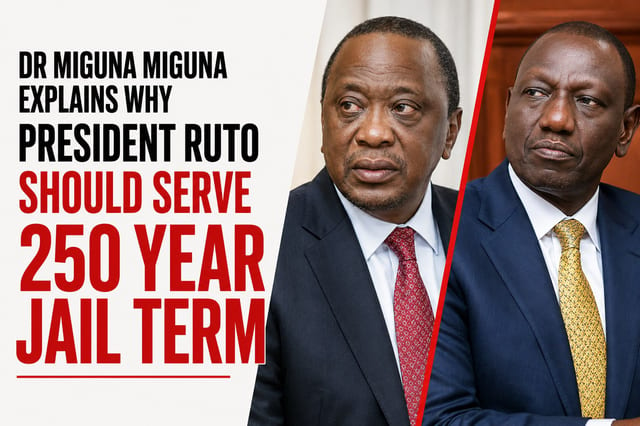
President William Ruto served as Uhuru Kenyatta’s Deputy President for 10 years, making him co-responsible for the government's actions.
As Deputy President from 2013 to 2022, President William Ruto was the co-captain of the Jubilee administration. He cannot detach himself from the multi-billion corruption scandals and the massive public debt that ruined Kenya's economy during Uhuru’s tenure.
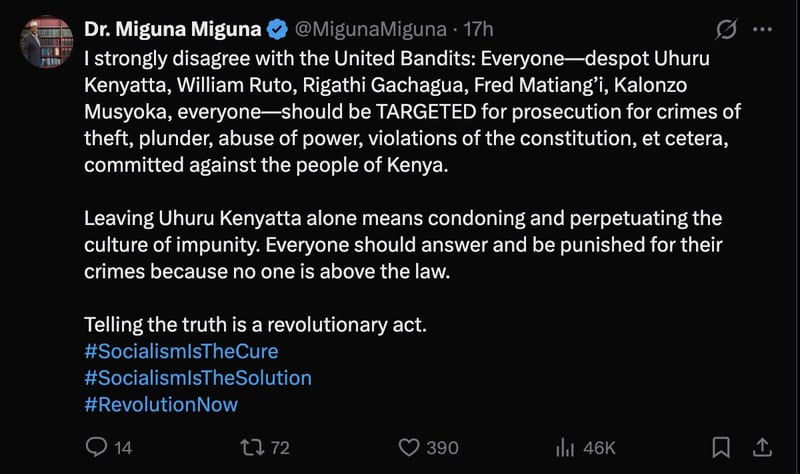
Miguna Miguna has launched another blistering attack on retired President Uhuru Kenyatta, arguing that the former Head of State and his Deputy should be serving a 250 year prison sentence over the plunder, mass murder, torture, constitutional violations, disobedience of court orders and abuse of office.
Miguna made the remarks in a social media post in which he directed readers to his previous books, articles and posts on the Kenyatta administration, insisting that he has documented his views extensively and dismissing those who, in his view, have failed to understand his arguments.
Miguna's intervention has reopened a much bigger question that Kenya has repeatedly struggled to answer since the end of the Kenyatta presidency in September 2022.
What happened to the billions of shillings lost, irregularly spent or placed under investigation during the decade Uhuruto was in power, and who was ultimately held accountable?
The Uhuru era was accompanied by a series of major corruption and procurement controversies.
The NYS scandals became one of the defining failures of the Jubilee era
In 2015, investigators revealed hundreds of billions of shillings at NYS was looted. , Reports put the disputed amount at approximately KSh791 million. But overal, more than Ksh 1.8 billion was looted.
Three years later, NYS was again at the centre of another massive corruption investigation.
In 2018, investigators uncovered a scandal involving approximately KSh9 billion in procurement transactions at the NYS, with dozens of suspects eventually facing charges.
The case involved the fraudulent procurement and payments, with former NYS Director General Richard Ndubai and former Youth Affairs Principal Secretary Lillian Omollo among those charged. Also, about 50 other suspects charged.
The matter became serious enough former Devolution and Planning Ministry Cabinet Secretary Anne Waiguru resigned amid the political pressure surrounding the scandal.
Arror and Kimwarer turned into a KSh21 billion political and legal battle 
The Arror and Kimwarer dams controversy became another defining financial scandal of the Kenyatta administration.
Former Treasury Cabinet Secretary Henry Rotich and other officials were prosecuted over theft of funds from the two dam projects, with court records describing allegations of losses running into approximately KSh21 billion.
Kenya's High Court records show that the contracts for the Arror and Kimwarer projects were worth hundreds of millions of US dollars and that substantial advance payments were made to the contractor.
Court documents specifically record advance payments of approximately US$41.6 million for Arror and US$33.7 million for Kimwarer, together amounting to several billion shillings.
KEMSA exposed another enormous hole in public procurement 
The COVID 19 pandemic produced another major procurement controversy through the Kenya Medical Supplies Authority.
The Ethics and Anti Corruption Commission investigated procurement of emergency COVID 19 commodities at KEMSA and identified irregular expenditure amounting to approximately KSh7.8 billion.
The EACC said its investigation established that procurement laws and public finance procedures had been breached, that KEMSA exceeded its available budget by approximately KSh3.2 billion and that some COVID 19 supplies were purchased at prices above prevailing market rates. The commission forwarded its findings to the Director of Public Prosecutions with recommendations for charges against several senior officials.
The Auditor General's special audit went even further, finding that KEMSA had irregularly procured COVID 19 related items worth approximately KSh7.63 billion, while excess stock worth more than KSh6.34 billion remained in warehouses. The audit also estimated a potential loss of approximately KSh2.34 billion if the stock had to be sold at prevailing market prices.
This was happening during a national emergency when Kenyans were dying from COVID 19 and the government was spending billions to protect the public.
The scandal therefore became not only a financial issue but also a question of public trust.
Then there is the Eurobond controversy 
Miguna's broader argument about the Kenyatta years also touches on one of the most politically explosive financial questions of that administration, the Eurobond.
Kenya's first sovereign Eurobond raised billions of shillings, and questions were subsequently raised over the accounting and utilisation of the proceeds.
A parliamentary report recorded concerns surrounding approximately KSh250 billion that varnished in the people's pockets.
The Eurobond controversy is legitimate material for scrutiny of the Kenyatta administration's financial management, but describing the entire KSh250 billion as stolen would go beyond what the cited official record establishes.
The Kenyatta family's offshore wealth created another uncomfortable question 
The corruption debate around Uhuru's presidency was not limited to government procurement.
The Pandora Papers, an investigation by the International Consortium of Investigative Journalists and hundreds of media organisations, revealed offshore companies and foundations linked to members of the Kenyatta family.
ICIJ reported that leaked records connected Uhuru Kenyatta and members of his family to offshore structures holding assets worth more than US$30 million, including companies and foundations registered in jurisdictions such as Panama and the British Virgin Islands.
The investigation also noted that some of the offshore structures predated Uhuru's presidency.
The Nairobi Expressway has added a newer layer to the debate 
More recently, questions surrounding the Nairobi Expressway have brought Kenyatta family business interests back into public discussion.
A 2025 Tax Appeals Tribunal dispute involving Edge Worth Properties and the Nairobi Expressway project generated documents concerning the company's ownership structure and its relationship with Enke Investments.
A separate High Court judgment confirms that Cale Infrastructure was subcontracted by Moja Expressway for work on the 27 kilometre Nairobi Expressway and that tax authorities subsequently pursued a KSh6.92 billion tax assessment arising from the project.
Reporting based on the tribunal proceedings has stated that Edge Worth Properties acted as a proxy for Enke Investments, associated with the Kenyatta family, and that the company declared approximately KSh1 billion in dividends in 2022.
The bigger question is accountability 
This is where Miguna's extraordinary statement intersects with a legitimate national debate.
Kenya has witnessed scandal after scandal involving public institutions, procurement systems, government projects and public funds.
The country has also witnessed investigations that produced dramatic headlines but sometimes ended without convictions, cases that collapsed, suspects who were acquitted, investigations that stalled and billions that remained difficult to trace.
That creates a much deeper accountability problem than simply asking whether one former President should spend 250 years behind bars.
How much public money was actually lost during the Kenyatta administration, what was recovered, who was convicted, who was acquitted, which cases remain pending and why have so many major corruption investigations failed to produce proportionate accountability?
Miguna's accusation is political, but the records are real 
Miguna's claim that Uhuru should spend 250 years in prison is his political position. The corruption controversies surrounding the Kenyatta years, however, are not imaginary.
There were actual investigations into NYS procurement. There were actual criminal cases arising from Arror and Kimwarer. There was an actual EACC investigation into KEMSA's KSh7.8 billion COVID 19 procurement.
There were actual parliamentary questions surrounding the Eurobond proceeds. There was an internationally reported Pandora Papers investigation into offshore structures linked to members of the Kenyatta family. And there are now court and tribunal records concerning tax disputes and corporate structures connected to the Nairobi Expressway.
Miguna may have chosen the language of 250 years in prison, but Kenya's real problem is not the length of a hypothetical sentence.
It is the fact that after decades of mega scandals, Kenyans still struggle to see a clear line connecting billions of shillings in alleged losses to investigations, convictions, recovery of stolen assets and final accountability.
That is the part of the Kenyatta legacy that deserves the most serious examination.