
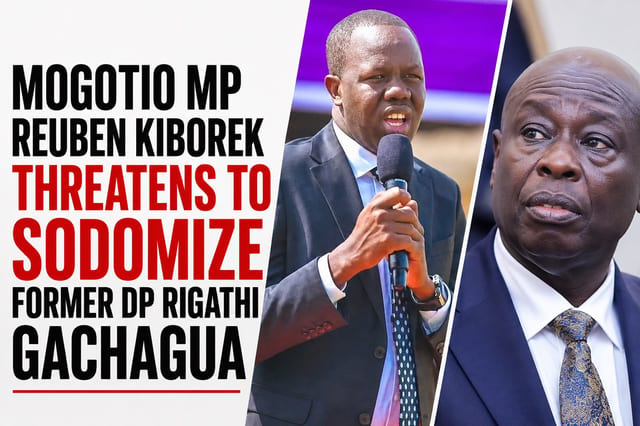
Mogotio MP Reuben Kiborek has come under scrutiny after telling police to arrest him alongside former Deputy President Rigathi Gachagua, adding that when Gachagua came out of custody, he would be singing “Tutam.”
The remark has attracted attention because of its sexualised wording and because of Kiborek's own history involving a 2018 defilement case, making the statement particularly uncomfortable in the current political environment.
There is a video of Kiborek asking Inspector General of Police Douglas Kanja to arrest him and lock him in the same cell with Gachagua.
Mogotio MP Reuben Kiborek is an already charged offender and this statements are not just political comments.
That is a serious matter, particularly when it comes from a sitting Member of Parliament who has been vindicated already in court.
Kiborek has a history that makes the remark more disturbing
In December 2018, Kiborek was arrested and charged in Nakuru after sexually assaulting a 16-year-old girl at Sarova Woodlands Hotel.
A charge sheet from the case, identifies the charge as defilement, contrary to Section 8(1) as read with Section 8(4) of the Sexual Offences Act.
The Standard reported in August 2022 that the case had been adjourned and that Kiborek had failed to appear in court on one occasion.
Kenya's Sexual Offences Act defines defilement as an act causing penetration with a child and provides different penalties depending on the child's age.
Why the latest remarks deserve scrutiny 
Political insults are common in Kenya. Politicians attack each other's policies, families, political records and alliances almost every day.
But there is a line between political criticism and language that appears to threaten sexual violence. That line should not be normalised.
The concern becomes even greater when the person making the statement is an elected representative who holds public office and has previously been the subject of a sexual offence prosecution.
Kiborek is entitled to criticise Gachagua. He is entitled to challenge his politics. He is entitled to demand his arrest if he believes a crime has been committed. But turning detention into a sexualised threat takes political rhetoric into territory that deserves examination.
Gachagua has previously reported threats to police 
In April 2025, Gachagua wrote to Inspector General Douglas Kanja that his life was in danger and citing incidents in which he said he had been targeted.
The DCI subsequently urged him to report such concerns through the police so they could be investigated. The agency said any report would be handled through the appropriate channels.
More recently, Gachagua has continued to publicly complain about threats and attacks against himself and his supporters. That background makes statements directed at him more sensitive than ordinary political banter.
This is not the first time political rhetoric has crossed into threats 
Kenya's political environment has increasingly seen threats and intimidation become part of political communication.
In 2025, MPs called for action against Gachagua after remarks they said could contribute to political violence ahead of the 2027 election. The disagreement demonstrated how quickly political statements can become matters of national security and public order.
In another case, human rights activists in Malindi accused a politician of hiring goons who attacked activists, including women, with claims that the attackers attempted to drag some of the women into bushes to sexually molest them. The activists called for police intervention.
Women in politics have already faced sexualised political attacks 
There is also a broader Kenyan pattern. Research on political violence in Kenya has documented the increasing use of sexualised attacks, gendered insults and threats against political figures.
A recent study on gendered attacks during Kenyan elections found that women politicians have increasingly been targeted through sexualised threats, online harassment and attacks on their bodies and families.
The problem therefore goes beyond one politician. When political actors normalise sexual violence as a form of intimidation, they contribute to a political culture in which violence becomes another language of political competition.
The Standard case cited in the debate also shows why sexual offences must be treated seriously 
The 2018 case involving Kiborek itself was reported by The Standard under the headline “Girl protests as MP aspirant's sexual assault case put off.” The report said the complainant had protested repeated delays in the proceedings and that the matter had been mentioned more than 12 times without proceeding to full hearing at that stage.
This explains why members of the public are likely to interpret the remark more seriously than they would an ordinary political insult.
Either way, an elected Member of Parliament should understand that words spoken from a political platform can carry consequences far beyond the applause of supporters.