
For years, Nation Media Group has faced criticism over its closeness to the political establishment, with critics questioning whether its journalism has remained sufficiently independent of government interests. As Cyprian Nyakundi has put it, “NMG has been part of the government.”
When you work for the Nation Media group you cant hate on Government . They will fire you
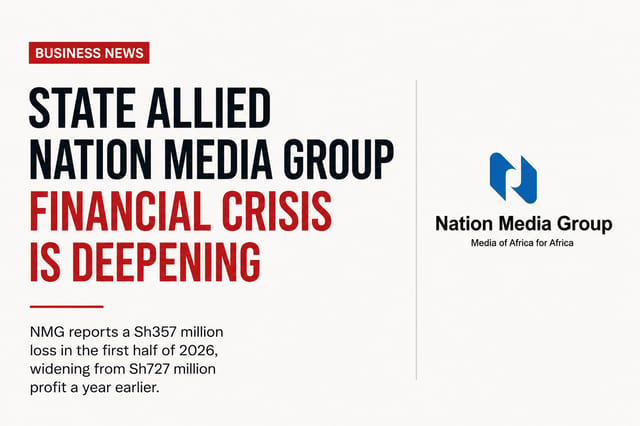
Now, with the company reporting a KSh357 million half year loss, questions about the cost of that relationship, editorial independence and declining public trust are likely to grow louder.
Nation Media Group (NMG) has recorded a KSh308.6 million net loss for the financial year ended December 2025, marking the company's third consecutive year in the red and raising fresh questions about the future of one of East Africa's biggest media organisations.
The figure is slightly different from the KSh357 million circulating in some reports. NMG's audited financial statements show a loss after tax of KSh308.6 million, compared with KSh254.4 million in 2024. The loss attributable to owners of the parent stood at KSh308.9 million.
The results point to continued pressure on the traditional media business, particularly print, even as NMG attempts to shift more aggressively towards digital platforms and broadcasting.
Revenue continues to fall 
NMG's group turnover declined by 3.1 percent to KSh6.04 billion, from KSh6.23 billion in 2024.
The company attributed the decline mainly to reduced print revenues.
That is significant because print has historically been one of the main pillars of the Nation Media business, supporting its newspapers and publications across East Africa.
At the same time, NMG reported some positive movement in other parts of the business.
Digital revenue increased by 5 percent, while broadcasting revenue also grew by 5 percent. The group's digital footprint expanded from 62.5 million users in 2024 to 64.7 million users in 2025.
The problem is that this growth has not yet been sufficient to compensate for the decline in the traditional business.
Three consecutive years of losses 
The latest results mean NMG has now recorded losses for three consecutive financial years.
The company's 2025 loss before income tax stood at KSh320.8 million, compared with KSh253.6 million the previous year.
The earnings per share also remained negative at KSh1.80, compared with negative KSh1.50 in 2024.
The board has also recommended no final dividend for the 2025 financial year, citing the prevailing economic environment and the group's investment plans.
This continues a trend that will concern shareholders who have historically relied on NMG as one of Kenya's major listed media companies.
The bigger problem is the collapse of the old media model 
The numbers tell a larger story about Kenya's media industry.
NMG is not simply dealing with a bad financial year. The company is attempting to transition from a business model heavily dependent on newspapers, print advertising and physical distribution towards one driven by digital audiences, online advertising, broadcasting and new forms of content monetisation.
That transition is proving expensive. NMG says it continues to invest in technology, content, talent and unified digital systems while attempting to improve the monetisation of its online audience.
But having millions of digital users does not automatically translate into equivalent advertising revenue. That is one of the biggest challenges facing traditional media companies globally.
The decline is stark compared with NMG's past 
The current financial position looks particularly striking when compared with the group's performance more than a decade ago.
NMG generated a net profit of about KSh2.53 billion in 2013, according to financial analysis of its historical results. By 2025, that position had swung to a KSh308.6 million loss.
Turnover has also fallen substantially over the same period. This demonstrates how dramatically the economics of news consumption have changed.
Readers have moved from buying newspapers every morning to consuming news through smartphones, social media platforms, search engines and direct publisher websites. Advertisers have followed the audience.
The half year numbers had offered some hope 
The full year loss also needs to be viewed against the improvement NMG had reported during the first half of 2025.
For the six months ended June 2025, the company reported a KSh41.7 million loss after tax, a significant improvement from the KSh260.2 million loss recorded in the corresponding period of 2024.
The company attributed the improvement partly to cost containment and digitisation, with operating expenses falling by 15.5 percent. But the full year results show that the improvement was not enough to return the group to profitability.
The ownership question adds another layer 
The financial results also come during a major transition in NMG's ownership.
In March 2026, the Aga Khan Fund for Economic Development announced the sale of its entire 54.08 percent stake in NMG to Taarifa Limited, controlled by Tanzanian businessman Rostam Aziz.
The transaction ended a 66 year association between the Aga Khan interests and the media group. The change in ownership comes at a particularly important moment.
The new ownership is inheriting a company with substantial brand recognition, a large audience and significant media assets, but also a business model under pressure.
NMG is not alone 
The problems facing Nation Media Group are part of a wider crisis affecting traditional media. Newspapers across the world have struggled as advertising has moved online and audiences have become accustomed to accessing information without paying directly for individual publications.
Kenya is no exception. The challenge for established media companies is that digital audiences can be enormous while digital advertising revenue remains highly competitive.
Technology companies capture a significant share of online advertising, while publishers compete against thousands of independent websites, influencers, social media creators and alternative news platforms.
Other media companies are facing the same battle 
NMG's situation can be compared with the challenges faced by other traditional media organisations that have had to restructure their businesses as audiences migrate online.
The Standard Group, another major Kenyan media company, has also undertaken cost cutting and restructuring measures in recent years as it deals with pressure on advertising and traditional media revenues.
Globally, major newspaper organisations including The Washington Post and The New York Times have also had to rethink their business models, with digital subscriptions, technology and diversified revenue streams becoming increasingly important.
The difference is that companies with strong digital subscription models have had greater opportunities to replace lost print revenue.
For Kenyan media houses, that transition remains difficult because consumers have historically expected much online news content to be free.
The real test for NMG is now monetisation 
NMG says its digital audience reached 64.7 million users during 2025. That is a huge audience. But the financial results raise a simple business issue: how much money is that audience generating?
Growing traffic without corresponding revenue growth can actually increase costs without solving the underlying financial problem.
NMG therefore needs to turn its digital reach into sustainable income through advertising, subscriptions, events, partnerships, technology and other commercial products.
The company says this is already part of its strategy. The latest results show, however, that the transformation is still incomplete.
No dividend for shareholders 
For investors, the decision not to recommend a final dividend is another important development. The board said the decision was influenced by the economic environment and the need to invest in the business.
That means shareholders are being asked to wait for the company's transformation to produce results. The strategy could work if the investments in digital and broadcasting eventually produce stronger revenue and profits. But the continued losses mean management has limited room for error.
What happens next 
The next phase of NMG's story will not simply be about whether newspapers survive. It will be about whether one of Kenya's oldest media companies can reinvent itself quickly enough to remain financially sustainable.
The company still owns powerful brands and has a massive audience across East Africa. But brand recognition alone cannot pay salaries, finance technology or satisfy shareholders.
The financial statements show a company caught between two worlds. The old print model is shrinking, while the new digital model has not yet generated enough revenue to replace it.
The KSh308.6 million loss is therefore more than another bad financial result. It is a warning that the economics of Kenyan media have changed permanently. And for Nation Media Group, the question now is whether its digital transformation will become a profitable new business before the old one becomes too expensive to sustain