
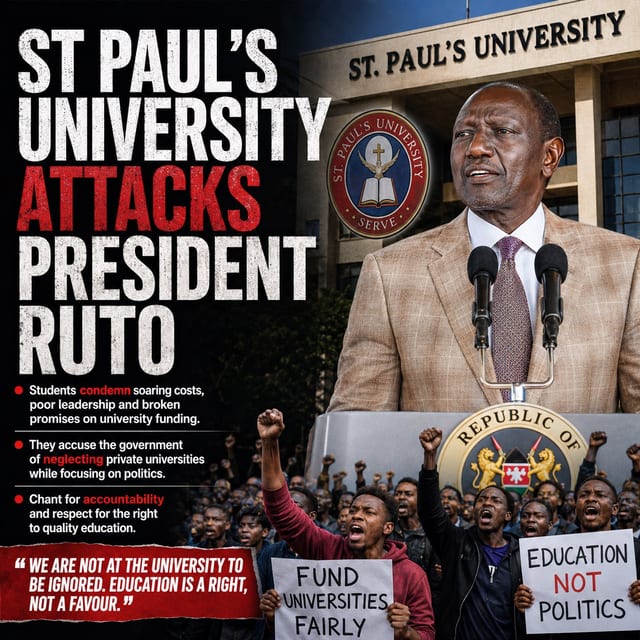
St Paul’s University has sparked a fresh online debate after posting what appears to be a sarcastic response to a student asking how long it takes to complete a certificate programme.
The university's verified X account responded with a deliberately repetitive line:
“By the next 6 months, In 6 months, before the end of 6 months, after 6 months.”
The post quickly attracted significant attention, with the screenshot showing more than 165,000 views, 1,900 reposts and 7,400 likes by the time it was captured.
While the university did not mention President William Ruto by name, the wording was immediately interpreted by many Kenyans as a reference to the President's frequently criticised use of six month timelines when announcing government projects and reforms.
The joke works because "six months" has become a familiar part of Kenya's political vocabulary.
Recent commentary has specifically described Ruto's use of the timeline as a recurring feature of his political messaging, with critics pointing to projects and government promises that have taken longer than initially indicated.
From presidential deadline to national punchline 
What makes the St Paul's University post notable is that the phrase has now moved beyond political commentary and into ordinary public conversation.
A student asked a straightforward question about the duration of a certificate programme.
Instead of giving a conventional academic answer, the university's social media team turned the question into a political joke.
The response essentially suggests that the answer is whatever "six months" means at a particular moment.
That is a sharp reference to the growing public perception that six months has become a standard political deadline for delivering major changes.
It is also a sign of how political language can eventually become part of popular culture.
Ruto has actually used six month timelines for major programmes 
The criticism is not based entirely on internet jokes.
In April 2026, Ruto promised that Nairobi would become "brighter, safer and more secure" within six months, outlining a programme involving street lighting, electricity connectivity, water and sanitation infrastructure.
Earlier this year, the Kenya Union of Special Needs Education Teachers complained that a presidential directive on an additional job group for teachers had remained unimplemented six months after it was announced at State House.
The issue has therefore become bigger than one speech.
It is now about whether government deadlines are being communicated realistically and whether ministries and agencies actually deliver within those timelines.
The university sector has its own reason to watch Ruto's promises 
The timing of the St Paul's University post is particularly interesting because higher education is itself at the centre of several major government promises.
Ruto recently announced plans for the government to fully fund tuition for students admitted to public universities, colleges and TVET institutions.
The proposal has since moved into Parliament, where lawmakers are reviewing legislation that would establish a new tertiary education funding authority and reorganise the way university and TVET students receive government support.
The announcement has attracted both hope and scepticism because universities are already facing serious financial challenges and questions remain over how such a large commitment will be financed.
For students, therefore, "six months" is not simply a joke.
They are watching whether government promises translate into actual changes in their fees, funding, accommodation and access to education.
There is another six month story involving education 
The government's own education reform process has also repeatedly operated around six month timelines.
In 2022, Ruto appointed the Presidential Working Party on Education Reform with a six month mandate, including periodic progress reports and a final report at the end of its term.
More recently, the government announced another six month education reform process to examine concerns surrounding the Competency Based Curriculum.
The latest task force is expected to examine the education system and provide recommendations over the six month period.
This means the phrase has become particularly relevant in the education sector.
Students, teachers and parents have repeatedly been asked to wait for reforms, reviews and new policies.
The public is therefore increasingly interested in what happens after the six months.
Six months can be enough time, but only if the deadline means something 
There is nothing inherently wrong with setting a six month deadline.
A government needs targets.
Institutions need timelines.
Projects cannot be allowed to run indefinitely without accountability.
The problem begins when deadlines become political slogans rather than measurable commitments.
A six month promise should ideally come with a clear starting date, responsible institution, budget, milestones and a publicly verifiable outcome.
That way, citizens can return six months later and determine whether the promise was delivered.
Without those details, "in six months" becomes difficult to distinguish from an open ended promise.
St Paul's joke has exposed something bigger 
The university's post is therefore funny because Kenyans already understand the reference.
It does not need to mention Ruto.
It does not need to mention a political party.
It does not even need to explain the joke.
The phrase "six months" has already acquired political meaning in the public imagination.
And that may be the most interesting part of the entire episode.
When a university can answer a student's question about a certificate programme by repeating a presidential style timeline and thousands of Kenyans immediately understand the joke, it shows how deeply that language has entered everyday political culture.
For the government, the lesson is simple.
Promises do not remain on podiums. Kenyans eventually turn them into measuring sticks.
And once a deadline becomes a joke, the administration has an even bigger job: delivering enough results to make people take the deadline seriously again.