
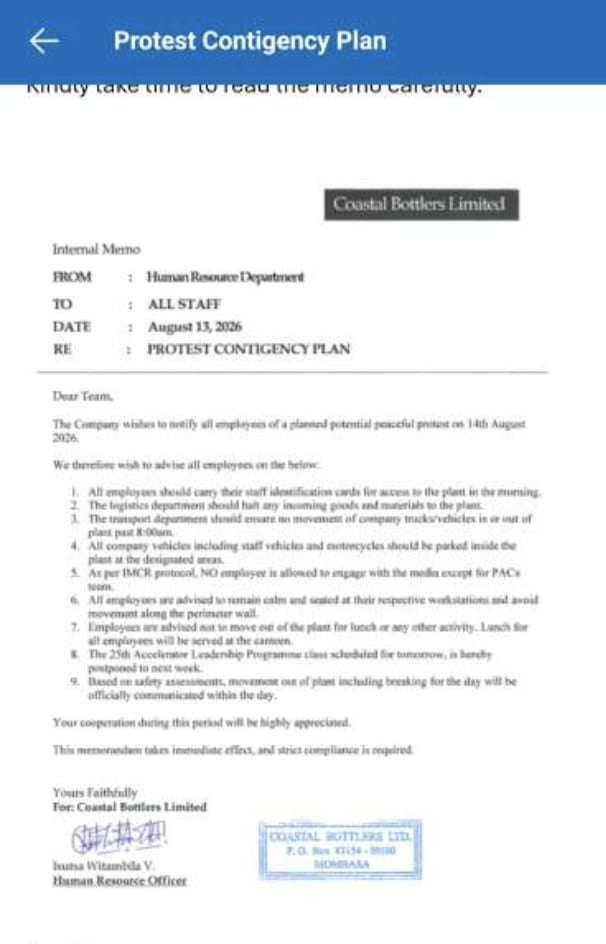
An internal memo from Coastal Bottlers Limited shows that the company has activated a contingency plan ahead of a planned peaceful protest scheduled for August 14, 2026, placing renewed attention on labour concerns that have recently surrounded the Coca Cola bottling business at the Coast.
The memo, issued by the Human Resource Department on August 13, 2026, is titled “Protest Contingency Plan” and was circulated to all staff.
The document instructs employees to carry their staff identification cards, directs the logistics department to secure company stock and materials, and asks the transport department to move company trucks and vehicles out of the plant.
It further directs employees to keep company vehicles and motorcycles in designated parking areas and tells staff not to engage with the media except through the designated PMC team.
Employees are also instructed to remain calm and seated at their workstations, avoid movement along the perimeter wall and remain within the plant for lunch and other activities.
The memo states that any movement out of the plant, including leaving for the day, would be communicated officially based on safety assessments.
It also postpones a Performance Management Committee class scheduled for August 14 and warns that the memo takes immediate effect, with strict compliance required.
Importantly, the document describes the demonstration as a “planned potential peaceful protest.” It does not identify the organisers or explain the specific grievances behind the planned action.
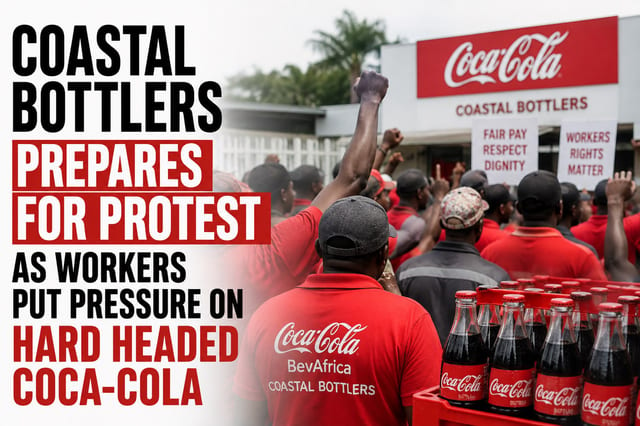
The memo comes after complaints over treatment of Coca Cola workers 
The latest development cannot be viewed entirely in isolation.
In July, labour rights activists and civil society groups publicly called for government intervention over allegations concerning workers at Coast Bottlers, with claims including harassment, intimidation, underpayment, delayed wages and unfair dismissals. The groups called for investigations by the Ministry of Labour and other government agencies.
Those allegations remain allegations and have not been established by a court.
The timing, however, means the August 14 protest deserves attention, particularly because the company has now formally acknowledged that it is preparing for a demonstration.
Nyakundi Report previously highlighted Coca Cola workplace complaints 
The current development also brings back an earlier investigation published by Nyakundi Report concerning complaints from Coca Cola employees.
That report, originally published in 2015 and updated in May 2026, carried allegations from current and former employees of Almasi Beverages, another Coca Cola bottling operation, who complained about alleged humiliation, excessive working hours and difficult treatment by management. The report cited attendance records that employees said showed some staff remaining at work until the early hours of the morning.
One particularly serious allegation in that report concerned an employee who was allegedly attacked and robbed while travelling home after leaving work late. The report said the employee subsequently lost his job after reporting the incident to management.
Those allegations relate to a different Coca Cola bottling company and historical events, and should not be presented as evidence of what is currently happening at Coastal Bottlers.
But they provide important context because complaints about workplace treatment within the wider Coca Cola bottling sector are not entirely new.
The Coastal Bottlers dispute has already attracted public demonstrations 
The situation at Coastal Bottlers also moved beyond internal complaints in July, when workers and Coast residents reportedly demonstrated and called for the removal of senior executives Seth Adu Baah and Joseph Yeboah Mensah.
Separate reports at the time said rights groups were demanding a government investigation into allegations of worker harassment, underpayment, intimidation and unfair dismissal.
Again, those are allegations raised by workers, activists and civil society groups, rather than findings against the company.
The company should therefore be given an opportunity to respond to the allegations and explain its position regarding the planned protest.
Questions over management and foreign executives 
The controversy has also included claims concerning the involvement of foreign nationals in senior management.
Nyakundi Report previously published allegations from employees concerning Seth Adu Baah and Joseph Yeboah Mensah, alongside questions about their work permits and employment status. The publication reported that the company was aware of the allegations and that its communications representative said the matter was being reviewed.
Those allegations should be distinguished from established facts.
The appropriate government agencies can determine whether the relevant employment and immigration requirements have been followed.
If there are genuine concerns regarding work permits, the Directorate of Immigration Services has the mandate to examine the status of foreign workers.
If there are complaints concerning employment conditions, the Ministry of Labour and Social Protection and the relevant labour officers should examine the employment records.
The Constitution protects fair labour practices 
Article 41 of the Constitution guarantees every worker the right to fair labour practices, including fair remuneration and reasonable working conditions.
That does not mean every employee complaint automatically proves an employer has violated the law.
It means complaints should have a proper mechanism for investigation.
If workers believe their pay, working hours, dismissals or treatment violate their rights, those complaints should be examined through the labour system rather than being left to simmer until employees feel compelled to protest.
The Central Organisation of Trade Unions and the relevant workers' union should also play their role where affected employees are represented.
A previous Coastal Bottlers court case provides another piece of context 
Coastal Bottlers has previously been involved in employment litigation.
In Kenya Union of Commercial and Allied Workers v Coastal Bottlers Limited, the Employment and Labour Relations Court dealt with a labour dispute involving the company. The existence of that case does not establish wrongdoing in the current dispute, but it demonstrates that disagreements between the company and employees have previously reached the labour courts.
That history makes it even more important for the company and workers to resolve the current dispute through documented procedures rather than allowing tensions to escalate.
The company has a responsibility to explain what is happening 
The August 13 memo is revealing because management clearly anticipates a protest serious enough to require operational planning.
Yet the document does not tell employees what the underlying dispute is.
It focuses on security, movement, company property, transport and communication with the media.
That may be a reasonable contingency response from management.
But contingency planning alone does not address the underlying grievances that may have triggered the demonstration.
If employees are protesting over wages, management should explain the applicable pay structure.
If the dispute concerns dismissals, the affected cases should be examined.
If workers are alleging intimidation or harassment, those complaints should be investigated.
If the protest concerns foreign employees occupying particular positions, the company and immigration authorities can clarify whether all legal requirements have been met.
The Ministry of Labour should not wait for the situation to deteriorate 
The planned protest provides an opportunity for the government to intervene before the dispute becomes more serious.
The Ministry of Labour and Social Protection should establish the grievances behind the protest and determine whether there are unresolved labour disputes.
The Directorate of Occupational Safety and Health Services should examine any complaints involving workplace safety and working conditions.
The Directorate of Immigration Services should verify any concerns relating to foreign employees and work permits.
If there are allegations of criminal conduct, intimidation or threats, the Directorate of Criminal Investigations can deal with those matters within its mandate.
And if there are claims involving financial misconduct or abuse of office, the appropriate investigative authorities should examine evidence rather than relying on competing accusations.
The protest itself should remain peaceful 
The company's memo describes the planned demonstration as peaceful.
That should remain the standard.
Workers have a right to raise grievances through lawful means, while the company has a responsibility to protect employees, property and its operations.
The police should facilitate lawful assembly while preventing violence or destruction of property.
The company should also avoid treating every protesting employee as a security threat simply because they have chosen to express a grievance.
The better outcome would be for management and workers' representatives to sit down with labour officials and establish what has gone wrong.
This is now a labour dispute that requires facts, not competing narratives 
The Coastal Bottlers memo does not prove that the company has mistreated its employees.
Nor does it establish that every allegation made by workers or activists is true.
What it does establish is that management is aware of a planned protest and has issued formal instructions to staff in response.
That development comes shortly after public allegations of underpayment, delayed wages, intimidation and unfair dismissals at the same company.
It also comes in a wider Coca Cola employment context where workers have previously raised serious complaints about management practices, including allegations documented by Nyakundi Report involving Almasi Beverages.
The next step should therefore be straightforward.
The workers should be heard. The company should respond. Labour officials should examine the records. And any allegations that amount to violations of Kenyan law should be investigated independently.
A protest contingency plan may protect a factory for a day.
It will not resolve the grievances that brought workers to the gates in the first place