
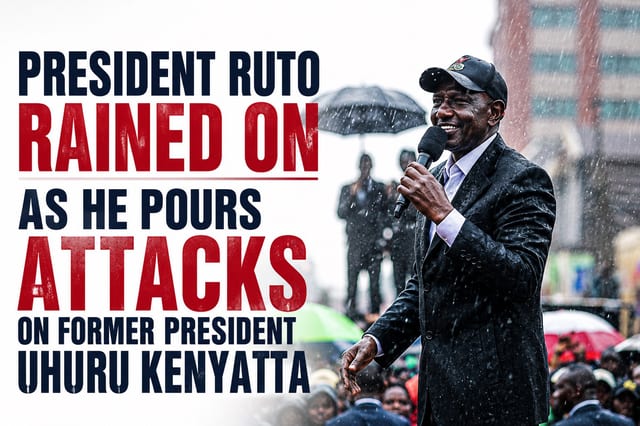
President William Ruto has renewed his political attacks on retired President Uhuru Kenyatta, accusing him of financing opposition politicians seeking to challenge his administration ahead of the 2027 General Election.
Speaking in Eldoret on August 13 after a Kenya Defence Forces recruits' parade, Ruto portrayed Uhuru as a behind the scenes sponsor of politicians he described as lacking a clear development agenda.
The President also criticised the former administration over its record on housing, healthcare and education, while presenting his own government's infrastructure programme as the basis for creating jobs and expanding economic opportunities.
Ruto's remarks came as he addressed residents in Eldoret under heavy rainfall, with images of the President continuing with his address without an umbrella quickly becoming part of the political conversation online.
Supporters portrayed the moment as evidence of Ruto's willingness to endure the same conditions as ordinary Kenyans.
But beyond the rain, the political message from Eldoret was unmistakable.
The 2027 contest is already shaping the President's public messaging.
Rather than focusing solely on his government's record, Ruto used the rally to place Uhuru Kenyatta and the opposition at the centre of his political argument.
Uhuru becomes a central figure in Ruto's opposition narrative 
Ruto's accusation that Uhuru is funding opposition figures is significant because it attempts to frame the emerging political contest as a continuation of the rivalry between the two former allies.
Ruto served as Uhuru's deputy for two terms before their relationship deteriorated towards the end of the Jubilee administration.
The political fallout between the two men eventually became one of the defining features of Kenya's 2022 election.
Ruto won the presidency after campaigning against what he described as the political establishment, while Uhuru supported Raila Odinga's presidential bid.
The latest remarks suggest that the old political battle remains relevant to Ruto's strategy as he prepares to seek another term.
However, the claim that Uhuru is funding particular opposition politicians remains an allegation from the President and would require evidence to establish.
Uhuru has not, based on the material provided, publicly confirmed the accusation.
Ruto also defended his development record 
The President did not limit his remarks to political opponents.
He used the Eldoret address to highlight infrastructure projects and promised that Kenya would continue experiencing major construction activity.
Ruto said his administration would keep the country as a "construction site" for years, presenting roads and other infrastructure projects as important sources of employment.
The message is consistent with one of the administration's central arguments: that large infrastructure programmes can create jobs while expanding the country's productive capacity.
But the political challenge for Ruto is that Kenyans will increasingly judge these promises against their daily experiences.
The cost of living, taxation, unemployment, housing costs and access to healthcare remain major issues for many households.
As the 2027 election approaches, development announcements will therefore face a more demanding test.
Kenyans will want to know not simply how many projects have been launched, but whether those projects have translated into better incomes, cheaper services and improved living standards.
The Uhuru question does not erase the Ruto question 
Ruto's decision to focus attention on Uhuru and the opposition also creates an obvious political challenge.
Uhuru is no longer the President.
Ruto is.
That means responsibility for the current state of government ultimately rests with the administration currently in office.
If the government has delivered on its promises, it can point to those achievements.
If programmes have failed, the administration must explain why.
Blaming the previous government may remain politically useful, but it becomes less persuasive as the current administration approaches the second half of its term.
The President has now been in office for nearly four years.
That gives voters enough time to assess his government's record independently of Uhuru's presidency.
A similar political pattern emerged during the 2022 campaign 
The current confrontation echoes the political environment that preceded the 2022 election.
Ruto spent much of that campaign presenting himself as an outsider challenging the political establishment despite having served as Deputy President for ten years.
Uhuru, meanwhile, backed Raila Odinga after their political relationship with Ruto collapsed.
The resulting contest produced one of the most consequential political realignments in recent Kenyan history.
Ruto's latest remarks suggest that the political consequences of that split are still shaping alliances.
The difference is that Ruto now speaks from the position of an incumbent President seeking re-election.
Ruto's attacks on former leaders are not new 
The President has repeatedly invoked the records of previous administrations when defending his government's policies.
He has particularly criticised what he describes as short term economic decisions and unsustainable borrowing under previous governments.
But the political environment has changed.
Ruto is no longer campaigning as a candidate promising to fix problems inherited from others.
He is the head of government responsible for decisions being made today.
That distinction will become increasingly important as the 2027 campaign takes shape.
The opposition now has an opportunity to answer with its own record 
Ruto's accusation that Uhuru is sponsoring his opponents will likely become part of the political debate.
But opposition politicians have an opportunity to shift the conversation away from personalities by explaining what they would do differently.
If they believe Ruto's economic policies have failed, they must explain what they would replace them with.
If they oppose the government's taxation policies, they should provide alternative revenue measures.
If they criticise infrastructure spending, they should explain which projects they would prioritise.
And if they accuse the government of corruption or waste, they should provide evidence and demonstrate how they would improve accountability.
That is ultimately the standard voters should apply to both sides.
The cost of politics is becoming another question 
Kenya's political class has already entered an early campaign cycle despite the 2027 General Election still being ahead.
Political tours, alliances, rallies and public exchanges are increasingly taking centre stage.
But millions of Kenyans are dealing with issues that have little to do with political personalities.
They are concerned about rent, food prices, school fees, healthcare, employment and household debt.
That creates a risk for every political camp.
If politics becomes dominated by accusations over who is funding whom, politicians may spend more time fighting each other than explaining how they intend to solve the problems facing citizens.
The Eldoret message was therefore bigger than the rain 
Ruto's decision to address residents in heavy rainfall created a powerful political image, but the more important development was what he said.
He has placed Uhuru Kenyatta and alleged opposition financing back at the centre of his political messaging.
That signals that the battle for 2027 is already influencing presidential rhetoric.
But the President will ultimately have to defend more than his ability to withstand a downpour.
He will have to defend his government's record.
The opposition will have to present a credible alternative.
And Uhuru, if he chooses to remain involved in politics, will have to account for whatever role he intends to play.
For voters, the most important question will be neither who stood in the rain nor who is financing whom.
It will be whether the people seeking their votes can demonstrate what they have done, what they intend to change and how their plans will improve the lives of ordinary Kenyans.