
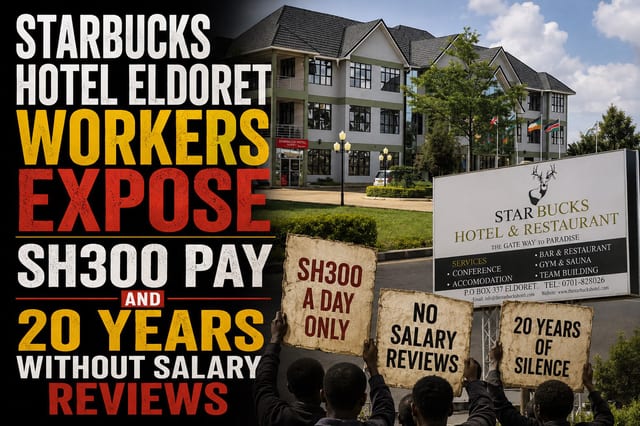
Workers at Starbucks Hotel along the Eldoret Kisumu Road have raised concerns over what they describe as years of low pay, limited salary progression and difficult working conditions at the hotel.
One employee, who requested complete anonymity for fear of victimisation, claims some workers have remained at the hotel for more than 20 years without a meaningful salary increment, despite the rising cost of living and periodic government adjustments to minimum wages.
The complainant alleges that some workers are still being paid as little as KSh300, raising serious questions about whether the hotel is complying with the minimum wage applicable to its employees and the nature of their employment arrangements.
The allegation has not been independently verified, and the hotel should be given an opportunity to explain its wage structure, employment terms and whether the reported KSh300 represents a daily wage, an hourly rate or another form of payment.
If it is a daily wage for a covered employee, however, the figure would require serious scrutiny. Kenya's Regulation of Wages (General) (Amendment) Order, 2024 came into force on November 1, 2024, and sets minimum wages by occupation and location. The legal framework also provides for minimum remuneration that employers cannot lawfully undercut.
For Eldoret, a city classified among the country's major urban areas, official government documents citing the 2024 wage order put the basic minimum monthly wage for a general labourer at KSh16,113.75, before the applicable housing allowance.
That makes the complaint particularly serious if the alleged KSh300 is indeed the amount being paid to an employee for a full day's work.
The complaint received 
Good evening Mr Nyakundi, There is a hotel in Eldoret that is overworking and under paying it's employees.. people have been working there for more than 20yrs but no salary increments even when the president increase the wage bill this hotel doesn't bother and it's managed by family members, people are paid 300bob till now besides Eldoret being a city kindly post this and hide my identity..... it's called Starbucks Hotel Eldoret along Eldoret Kisumu road
The complaint points to two separate issues that should be examined.
The first is whether workers are being paid in accordance with the applicable statutory minimum wage and their contractual terms.
The second is whether employees who have served the establishment for many years have been given proper reviews of their remuneration as their responsibilities, experience and the cost of living have changed.
A worker who has spent two decades at the same establishment deserves clarity about their employment terms, salary structure, statutory deductions and benefits.
The Labour Ministry should establish what workers are actually being paid 
The Ministry of Labour and Social Protection, through the relevant labour officers, has the mandate to enforce employment standards and investigate complaints involving wages and working conditions.
An inspection at the hotel would establish whether the allegations are accurate.
Investigators can examine employment contracts, payroll records, payslips, attendance registers and statutory remittance records. They can also establish the number of hours employees work and whether workers receive the applicable overtime payments where required.
The issue should therefore not be settled by competing claims.
The records should speak.
Kenyan courts have previously ordered employers to compensate workers for underpayment after establishing that employees were paid below the statutory minimum. In one Employment and Labour Relations Court case, the court held that underpaying an employee below the prescribed minimum wage violated the law and awarded the worker the applicable underpayments.
A similar complaint involved PADA Security 
The Starbucks complaint comes against the background of another case previously brought forward involving PADA Security, where guards alleged that they were being paid around KSh8,000 to KSh10,000 despite clients allegedly paying much higher amounts for security services.
The workers also alleged that statutory contributions including SHA and NSSF were not being remitted and that employees who complained risked dismissal.
That complaint, like the current one, raised the question of whether the amount paid to workers was consistent with Kenya's minimum wage requirements.
The appropriate response in such cases is not simply to dismiss workers' complaints.
Labour authorities should inspect records and establish whether employees are being paid legally.
Kitui Flour Mills workers also raised concerns over working conditions 
Workers at Kitui Flour Mills, part of the Dola Group, previously complained about conditions affecting casual workers in the loading and production sections.
They alleged that employees worked eight hour shifts with little opportunity for breaks, that sanitary facilities were unavailable during certain hours, and that workers lacked adequate water and personal protective equipment.
That complaint was different from the wage concerns at Starbucks Hotel, but it illustrates a wider problem facing low income workers.
Employment rights are not limited to the amount appearing on a payslip.
Working hours, rest periods, occupational safety, statutory contributions and basic workplace conditions also form part of an employer's obligations.
Artcaffe workers have previously raised another workplace complaint 
Workers at Artcaffe also previously complained of alleged harassment by senior employees, claiming that junior workers who raised grievances could face transfers, demotions or dismissal.
The workers further complained about salary reviews and the handling of internal complaints.
Again, the circumstances are different, but the underlying concern is similar.
Employees who depend entirely on their wages can be reluctant to challenge management when they fear losing their jobs.
That is why labour protections exist.
Workers should be able to raise legitimate employment concerns without being punished simply for asking questions about their wages or working conditions.
The issue of salary increases needs clarification 
The complainant refers to the President increasing the wage bill.
Strictly speaking, government announcements on minimum wages do not automatically mean every private employer is required to increase salaries by an arbitrary percentage.
What matters is whether the employer is complying with the applicable statutory minimum wage and the employee's contractual terms.
If the law changes the minimum applicable to a particular category of worker, an employer cannot simply continue paying an amount below the new legal threshold.
The employer should also provide workers with clear employment terms and proper records.
That is why an inspection would be more useful than relying on the complainant's allegation or the hotel's response alone.
Long service without meaningful pay progression 
The claim that some employees have worked at the hotel for more than 20 years without salary increments also deserves attention.
There is no general rule that automatically requires every private employer to increase an employee's salary every year simply because the employee has remained in employment.
However, the employer remains bound by statutory minimum wages, the employment contract and other applicable labour protections.
A worker's length of service can also be relevant when examining whether their responsibilities, job classification and remuneration have changed over time.
If someone has spent two decades working for an establishment, their employment history should be properly documented.
The hotel should respond 
Starbucks Hotel should clarify whether the reported KSh300 payment is accurate and, if so, explain:
- Which category of employees receives the amount.
- Whether it is a daily, hourly or other rate.
- How many hours those workers work.
- Whether workers receive house allowance or housing.
- Whether statutory deductions and contributions are made.
- Whether employees receive overtime pay where applicable.
- Whether the hotel has reviewed its wage structure following changes to Kenya's minimum wage regulations.
The hotel should also explain the allegation that some employees have remained for decades without salary reviews.
These are matters that can be verified through payroll and employment records.
Workers should not be forced to choose between silence and unemployment 
The most worrying aspect of the complaint is not simply the alleged low pay.
It is the possibility that workers may feel they have nowhere to turn.
A person earning a very low wage is unlikely to risk losing their only source of income by challenging an employer.
That is why the Labour Office in Uasin Gishu County should consider examining the complaint, particularly if affected workers are willing to provide employment records confidentially.
Where there are allegations of statutory non compliance, the National Social Security Fund and Social Health Authority should also establish whether workers are properly registered and whether the required contributions are being remitted.
The Directorate of Occupational Safety and Health Services can equally examine the workplace where employees raise concerns about unsafe or excessive working conditions.
The numbers should settle the dispute 
If Starbucks Hotel is complying with the law, its payroll records should demonstrate that.
If the KSh300 allegation is misunderstood or refers to something other than a full day's wage, the hotel can clarify it.
But if employees are genuinely working full shifts and receiving amounts substantially below the applicable statutory minimum, then the matter deserves immediate intervention.
Kenya's labour laws are meant to provide a floor below which remuneration should not fall.
A worker may accept a difficult job because opportunities are scarce, but that does not remove the employer's obligation to comply with the law.
The allegations against Starbucks Hotel remain unverified, but they are specific enough to warrant scrutiny by the relevant labour authorities.
The complainant has requested that their identity remain confidential for fear of victimisation.
The Ministry of Labour should investigate the records, establish what workers are actually earning and determine whether the hotel is complying with Kenya's employment laws.