
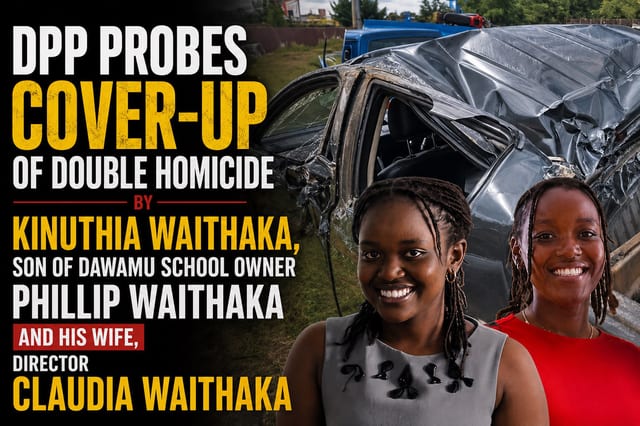
Serious questions are emerging over the handling of the fatal Peponi School road crash after the Director of Public Prosecutions moved to have alleged interference with the investigation examined.
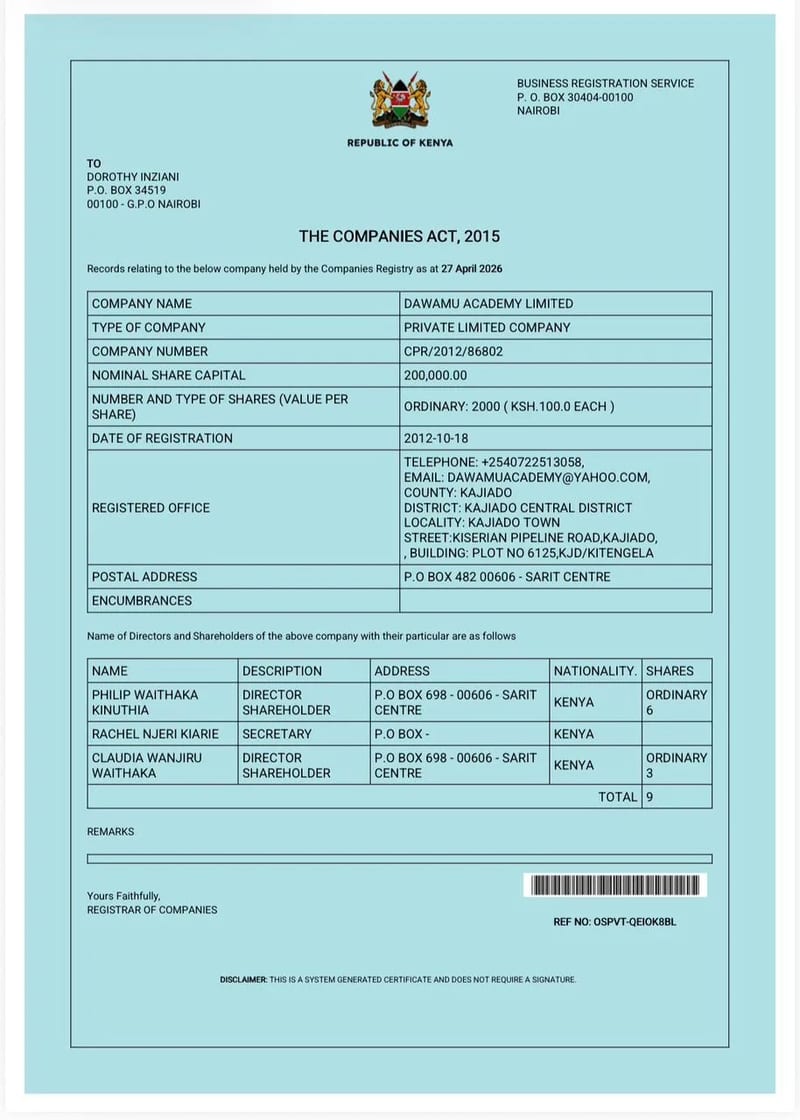
The case concerns the deaths of two Peponi School students in a crash involving vehicle KCQ 222X, which has been reported as belonging to Dawamu School, associated with Philip and Claudia Waithaka.
The crash occurred along Ngong Road near Lenana School on April 25, 2026, and claimed the lives of Yzeera Ssebunya and Danielle Mirembe Kembabazi Kavuma, two recent graduates of Peponi International School
What makes the matter particularly troubling is the conflicting account of who was behind the wheel at the time of the crash.
According to the information surrounding the case, witnesses have reportedly disputed the version that a 34 year old relative was driving the vehicle. Allegations have instead emerged that Kinuthia Waithaka, the son of Philip Waithaka and Claudia Waithaka, was allegedly driving before he was removed from the scene and another person was subsequently presented as the driver.
The fact that the DPP is now seeking a probe into possible interference makes the questions too serious to ignore.
The central question is simple: who was driving? 
In any fatal road crash, establishing who was operating the vehicle is one of the most basic parts of an investigation.
Police would ordinarily be expected to establish the driver's identity through witness accounts, physical evidence, vehicle positioning, forensic examination and other available evidence.
That makes conflicting accounts particularly concerning.
If investigators initially identified one person as the driver and witnesses are saying something different, the matter cannot simply be brushed aside.
The families of the two students who died deserve to know exactly what happened.
They deserve to know who was driving.
They deserve to know whether anyone was removed from the scene.
And they deserve to know whether another person was subsequently presented to investigators as the driver.
According to police records, the matter was entered under OB 03/25/04/2026 and U/C OB 05/25/04/2026, confirming that the incident was formally reported and remains part of an official investigative process.
The Isuzu double-cabin pickup reportedly lost control and rolled multiple times along Ngong Road. Two young women lost their lives instantly while other occupants suffered injuries of varying severity.
As reported, the vehicle, KCQ 222X, belongs to Dawamu School, owned by Phillip Waithaka and his wife Claudia Waithaka. Their son, Kinuthia Waithaka was driving. Allegedly they came to the accident scene and took their child, left the rest. They allegedly have tried to say that a 34 year old relative was driving but witnesses from that night have refuted that claim.
Why is the DPP now asking questions about a possible cover up? 
The involvement of the DPP is significant because it suggests that the prosecution authorities are not satisfied with simply proceeding on the existing version of events.
The allegations of interference must now be independently examined.
Who was at the scene immediately after the crash?
Who first identified the driver?
Who transported the alleged driver away?
Who gave investigators the name of the person eventually presented as the driver?
Were witness statements consistent?
Were CCTV recordings, phone records or other evidence examined?
And most importantly, was anyone attempting to alter the account of what happened?
These are not questions that should be answered through speculation on social media.
They require evidence.
The families should not have to fight competing versions 
The tragedy involves two young people whose lives were cut short.
For their families, this is not simply another court file.
Every unanswered question prolongs the pain.
If the original account is accurate, investigators should be able to demonstrate it through evidence.
If the account was manipulated, those responsible should equally be identified and held accountable.
The justice system cannot operate on the basis of who has greater influence, wealth or connections.
A traffic death involving schoolchildren should receive the same seriousness regardless of the social standing of those involved.
Why has this received so little public attention? 
Another uncomfortable issue is the apparent lack of sustained public attention surrounding the allegations.
The crash involves two schoolchildren, conflicting accounts over the driver's identity and now a request by the DPP for a probe into possible interference.
That should ordinarily attract serious public scrutiny.
Instead, the matter has largely remained outside the national conversation.
The question therefore becomes:
Who has been allowed to control the narrative surrounding this crash?
That does not mean there was necessarily a deliberate attempt to suppress the story.
But when allegations of a cover up emerge, transparency becomes even more important.
The public should not have to rely on rumours, conflicting witness accounts or social media posts to understand what happened.
A similar case: the Shakahola investigations 
Kenya has seen how allegations of institutional failure can become much bigger when early warnings or evidence are not properly handled.
The Shakahola massacre eventually resulted in extensive investigations after hundreds of people were found dead in connection with the activities of pastor Paul Mackenzie and his followers.
The case raised difficult questions about whether authorities had received warnings and whether institutions had acted quickly enough.
The lesson is relevant here for a different reason.
When there are conflicting accounts, investigators must follow every available lead instead of settling for the easiest version of events.
The Albert Ojwang case also showed the danger of accepting one version too quickly 
The death of blogger Albert Ojwang in police custody provides another important example.
The initial account surrounding his death was later challenged by post mortem findings and subsequent investigations. The case eventually resulted in murder charges against several people.
The lesson was clear.
The first version of events is not automatically the final truth.
Evidence must be allowed to determine what happened.
The same principle should apply to the Peponi School crash.
If witnesses dispute the identity of the driver, their evidence must be properly recorded and tested.
If there is evidence suggesting someone was removed from the scene, investigators should establish who authorised it and why.
If another person was presented as the driver, authorities should establish exactly how and when that happened.
A third comparison: the case of the Kware killings 
The investigations into the Kware bodies case also demonstrated the importance of forensic evidence in establishing what happened to victims rather than relying solely on early narratives.
The discovery of bodies triggered intense public concern and competing theories, forcing investigators to rely on identification, post mortem examinations and other evidence to establish the circumstances surrounding the deaths.
Again, the principle is the same.
Serious allegations require serious evidence.
The Peponi case should be treated in the same manner.
The institutions now under the spotlight 
The Office of the Director of Public Prosecutions has already raised concerns serious enough to seek further investigation.
The Directorate of Criminal Investigations should therefore establish the complete chain of events surrounding the crash.
The Independent Policing Oversight Authority, where there are allegations of police interference or misconduct, should examine whether officers followed proper procedures.
The National Police Service should also account for the handling of the crash scene and any decisions made regarding the identification and custody of the alleged driver.
And if the investigation establishes that someone deliberately interfered with the case, the Ethics and Anti Corruption Commission and other relevant authorities should consider whether any abuse of office or other offence occurred.
This is bigger than one driver 
The real issue is not simply whether one person was driving a vehicle.
It is whether the justice system can be trusted to establish the truth when powerful or well connected individuals may be involved.
If Kinuthia Waithaka was not driving, investigators should establish that through evidence.
If he was driving, the evidence should equally demonstrate it.
If another person was genuinely behind the wheel, that person should be properly identified and held accountable if the evidence supports criminal responsibility.
Nobody should be convicted in the court of public opinion.
But nobody should be protected from investigation because of their family name, connections or social position either.
The two Peponi School students who died cannot speak for themselves.
Their families can only rely on investigators, prosecutors and the courts to reconstruct what happened.
The DPP's request for a probe should therefore be treated as an opportunity to settle the competing accounts once and for all. The public does not need another version of the story. The families need the truth, backed by evidence.