
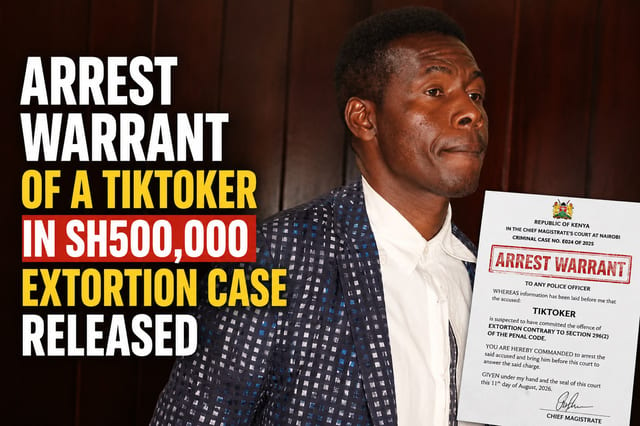
A Nairobi court has ordered the arrest of blogger and TikToker Joseph Gitonga Kihanya, popularly known as Gitonga Archives, after he failed to appear for proceedings in a case in which he is accused of demanding Sh500,000 in connection with social media content.
The case dates back to July 2025, when Kihanya was charged with demanding property with menaces, contrary to Section 302 of the Penal Code. He denied the allegations and was released on a Sh50,000 cash bail.
According to the prosecution's case, Kihanya allegedly demanded Sh500,000 through another person from Amos Hunja Mwangi, with the money allegedly being sought in exchange for taking down a TikTok post and stopping further posts targeting Co-operative Bank and its staff.
The allegations remain allegations and have not been proved in court.
The original case 
The prosecution alleged that between July 20 and July 27, 2025, Kihanya and another person demanded the money from Hunja.
The court was told that Kihanya had published claims on TikTok alleging that approximately Sh1.6 billion had been stolen from Co-operative Bank customer accounts.
The complainant allegedly became involved in discussions over the removal of the content, with the prosecution claiming that the Sh500,000 demand was made in that context.
Kihanya denied the charge.
At the time of his arraignment, his lawyers asked the court to release him on reasonable terms, arguing that he had limited financial means.
The court subsequently granted him Sh50,000 cash bail and also issued an order restricting him from publishing allegedly defamatory statements concerning Co-operative Bank or its employees pending the case.
The latest arrest order now brings the matter back into the spotlight.
A case that raises difficult questions about social media and money 
The case goes beyond one TikToker and one bank.
It raises a bigger question about what happens when social media activism, allegations of wrongdoing and demands for money become intertwined.
There is an important difference between publishing allegations against a powerful institution and allegedly demanding payment in exchange for removing content.
The court will ultimately determine which version of events is supported by evidence.
That distinction is particularly important in Kenya, where bloggers, TikTokers and other online commentators increasingly play a role in exposing complaints that traditional media may not immediately pursue.
But influence on social media also comes with responsibility.
If someone publishes an allegation, the subject has legal avenues to challenge it.
If someone believes a company has committed wrongdoing, there are also investigative and regulatory channels through which evidence can be presented.
The criminal allegation in this case is therefore not simply about what appeared on TikTok. It is about what allegedly happened around the content and the money demand.
A similar case involved a bank and a much larger alleged takedown payment 
Kenya has previously seen another unusual dispute involving a blogger, a bank and alleged payment to remove online publications.
In Cyprian Nyakundi and another v Director of Criminal Investigations and others, the High Court dealt with a case involving allegations surrounding negotiations for the removal of blog articles concerning Victoria Commercial Bank.
A legal publication discussing the case records that negotiations involving the blogger and representatives linked to the bank culminated in an agreement involving Sh17.5 million, with the meeting being recorded by DCI officers. The court proceedings subsequently considered whether the evidence had been obtained through entrapment.
That case is important because it demonstrates how complicated these disputes can become when law enforcement becomes involved in negotiations over online publications.
It also shows why courts must carefully examine how evidence was obtained, rather than simply looking at the final recording or transaction.
The Gitonga Archives case is different and must be determined on its own evidence, but the similarity lies in the uncomfortable intersection between online publishing, alleged demands for money and criminal investigations.
Another warning from Kenya's online space 
Kenya has also witnessed cases where social media personalities have faced criminal investigations over content published online.
The arrest and prosecution of bloggers and online activists has repeatedly generated debate over where legitimate criticism ends and criminal conduct begins.
In 2021, for example, human rights defender Mutemi Wa Kiama was arrested and charged after posting content concerning IMF loans. His social media accounts were suspended by court order and he was required to report to investigators, although he was eventually released without charges.
The case was fundamentally different from the Gitonga Archives matter because it involved political expression rather than an alleged demand for money.
But it illustrates the increasingly important role courts play in determining the boundaries between online speech, public interest activism and conduct that may attract criminal liability.
The question now is whether Gitonga will appear 
The immediate issue before the authorities is straightforward.
The court has ordered that Kihanya be arrested after his failure to appear.
Once he is brought before the court, the proceedings can continue and the reasons for his absence can be addressed through the proper legal process.
The arrest order does not establish that he committed the alleged extortion offence.
He remains entitled to due process and the presumption of innocence until the case is determined.
At the same time, a person facing criminal proceedings is expected to comply with court directions and attend when required.
The bigger lesson for Kenya's digital creators 
The case should also serve as a warning to Kenya's rapidly expanding online media ecosystem.
TikTok, Facebook, YouTube and blogs have given ordinary citizens the ability to reach thousands or even millions of people without owning a television station or newspaper.
That power can expose genuine wrongdoing.
But it can also create opportunities for abuse.
The answer cannot be to silence legitimate criticism.
Neither can the answer be to allow people to use damaging allegations as leverage for private payments.
Where allegations concern corruption, fraud or abuse, the strongest protection for the public is evidence, documentation and proper investigation.
The Directorate of Criminal Investigations, the Office of the Director of Public Prosecutions and the courts must therefore allow the evidence to determine what happened in this case.
And if the allegations against Kihanya are eventually proved, accountability should follow.
If they are not proved, the court process must equally protect him from being punished for an offence the prosecution cannot establish.
For now, the immediate development is that a court has ordered his arrest after he failed to attend the Sh500,000 extortion proceedings.
The next chapter will begin when he is brought before the court and the matter proceeds on its evidence.