
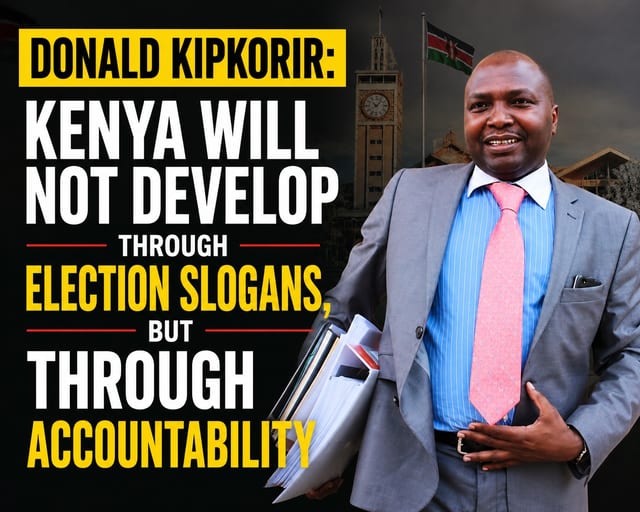
Lawyer Donald B. Kipkorir has laid out eight conditions he believes Kenya must address if the country is to move from political promises to genuine development.
His argument starts with the issue that continues to drain public resources: corruption.
Kipkorir says no Kenyan should have to pay a bribe to win a government tender, secure payment for work already completed or gain access to a public official. He argues that public service should not become a marketplace where citizens are forced to pay before accessing services or government leaders.
He also proposes that wealth declarations by public officials be made publicly accessible online, including information showing how declared assets were acquired. His argument is that the wealth of public officials should be capable of being reconciled with their legitimate public salaries.
Another proposal targets conflicts of interest.
According to Kipkorir, the President, Deputy President, Cabinet Secretaries, Principal Secretaries, CEOs, MPs, Senators, Governors, MCAs and other senior officials should not be allowed to trade with the government in any form.
His fourth proposal focuses on the people who keep the country running.
He argues that police officers, teachers and doctors should have a minimum starting salary of KSh150,000, saying Kenya must make these professions attractive enough to draw some of the country's brightest minds.
Kipkorir also argues that public officials must be held to higher standards of personal conduct.
His position is that leadership should come with moral responsibility and that serious scandals involving those entrusted with public office should not simply be brushed aside because the individual holds political power.
Education should produce thinkers, not voters 
Kipkorir's proposals also extend to education.
He wants Kenya's education system, from kindergarten through university, to focus more heavily on curiosity, invention, creativity, patriotism, knowledge and integrity.
He argues that hard work and intellectual ability should be rewarded rather than allowing political connections, corruption or other forms of favouritism to determine who succeeds.
That proposal touches a problem Kenya has repeatedly faced.
A country cannot build a competitive economy if its education system produces graduates who are trained to pass examinations but struggle to find opportunities to apply their knowledge.
Development should not depend on voting patterns 
On infrastructure, Kipkorir argues that roads, railways, ports and electricity networks should connect the entire country without political favouritism.
His argument is simple.
Development should not be a reward for voting for the government of the day.
A road should be built because an area needs the road.
Electricity should reach a community because the community needs electricity.
A railway, hospital, water project or other public investment should be based on economic and social need rather than the political calculations of leaders.
Food security must come before political rhetoric 
Kipkorir also places food security among his priorities.
He argues that Kenya should become self sufficient in food and eventually produce enough surplus for export.
His reasoning is that a population struggling to afford food will naturally focus on immediate survival rather than long term national development.
That argument places food production at the centre of economic policy rather than treating agriculture as an issue reserved for rural communities.
The warning about 2027 
The final part of Kipkorir's argument is political.
He says proposals outside these fundamental issues can easily become tools for exciting voters ahead of the next General Election.
That is an important distinction.
Kenya has no shortage of political speeches, launches, rallies and ambitious promises. The harder question is whether leaders are prepared to address the systems that allow public money to disappear, government contracts to be manipulated, public officials to accumulate unexplained wealth and citizens to remain dependent on political goodwill.
The eight points therefore raise a broader question for Kenyans ahead of the next election:
Are politicians offering policies that can change how government works, or are they simply offering Kenyans another set of promises designed to secure votes?
For Kipkorir, development begins with clean government, accountable leadership, competitive public institutions, better paid essential workers, quality education, equal infrastructure development and food security.
Anything less, he argues, risks becoming another election season promise rather than a plan for transforming Kenya