
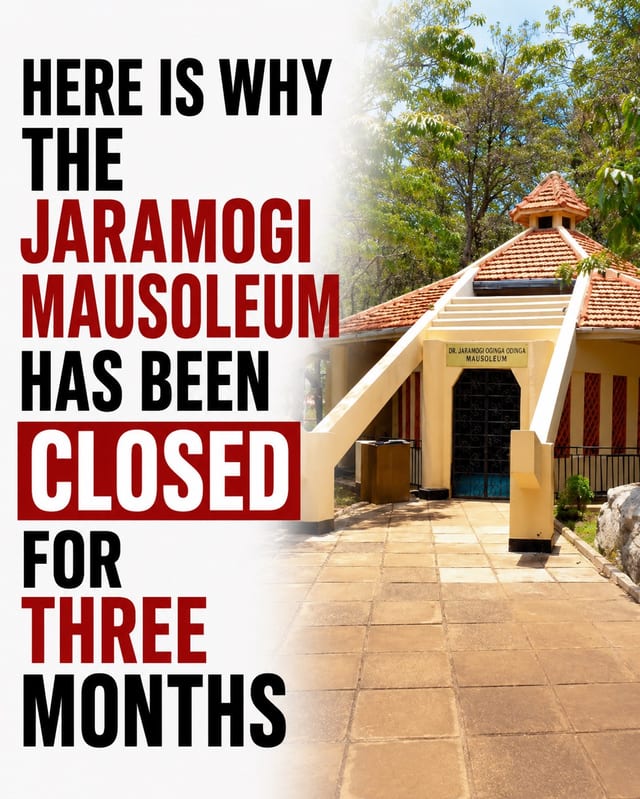
The Jaramogi Oginga Odinga Mausoleum in Bondo, Siaya County, has been shut to the public for three months, temporarily cutting off visitors from one of Kenya's important political heritage sites.
The National Museums of Kenya says the closure took effect on July 20, 2026, and the site will remain inaccessible until October 30, 2026, because of construction works taking place at the site.
The closure is linked to a much larger redevelopment of the Kang'o Ka Jaramogi site, where the government is putting up a new mausoleum for the late former Prime Minister Raila Odinga while also undertaking alterations to Jaramogi Oginga Odinga's existing mausoleum. The National Museums of Kenya had earlier advertised a tender covering both the proposed Raila mausoleum and alterations to the existing Jaramogi facility.
This means the three month closure is not simply about shutting the doors of a museum.
It comes at a major moment for a site that carries decades of Kenya's political history.
Visitors told to stay away 
The National Museums of Kenya has warned visitors and tourists not to travel to the mausoleum during the closure period because they will not be allowed access while construction continues.
For residents and visitors who regularly use the site as a place to learn about Jaramogi's life and Kenya's political history, the announcement means a temporary break from access to the memorial.
The mausoleum has long served as more than a burial site.
It has preserved material connected to Jaramogi's political career, Kenya's independence struggle and Luo cultural heritage.
The collections include photographs, personal belongings and cultural artefacts, alongside material connected to other major figures in Kenya's political history.
That makes the ongoing construction particularly significant.
Raila's memorial is being built next door 
The closure comes as construction of the new Raila Odinga Mausoleum gets underway at the same compound.
The government and Raila's family formally handed over the site on July 20, marking the transition from planning to construction. The National Museums of Kenya is overseeing the wider development, while the Kenya Defence Forces is spearheading construction of the new memorial.
The new facility is expected to form part of a broader heritage complex.
Plans previously published by the National Museums of Kenya included a research centre, library, digital archives and an amphitheatre as part of the proposed Raila memorial.
The wider project also includes improvements to the existing Jaramogi mausoleum.
That explains why visitors are being kept away from the area while construction is taking place.
A site carrying two generations of political history 
The redevelopment will bring together the memorials of father and son at the same historic location.
Jaramogi Oginga Odinga was one of the central figures in Kenya's independence struggle and later became the country's first Vice President.
Raila Odinga went on to become Kenya's second Prime Minister and remained one of the country's most influential opposition figures for decades.
The decision to develop a memorial for Raila beside his father's mausoleum therefore creates a site that will bring together two generations of Kenya's political history.
It also means the government is effectively reshaping one of the country's most politically significant heritage locations.
The project has been in the works for months 
The construction did not begin suddenly.
In June, the National Museums of Kenya published tender documents for the construction of the proposed Raila Amolo Odinga Mausoleum and alterations to the Jaramogi Oginga Odinga Mausoleum in Bondo.
The tender was part of preparations for the redevelopment of the site.
By July 20, the project had moved into the construction phase, with officials saying the new Raila mausoleum could be completed within about two months.
The three month closure of the existing mausoleum therefore gives contractors time to carry out the works without exposing visitors to an active construction site.
The public money question will follow the project 
Because the National Museums of Kenya is a state institution and the project involves a public heritage site, the redevelopment will inevitably attract questions about cost, procurement and oversight.
The tender documents should be available for public scrutiny.
The contractor should be known.
The awarded amount should be known.
The scope of work should be clear.
And once the project is complete, Kenyans should be able to establish whether the work delivered matches what taxpayers were promised.
This is particularly important because the project involves both construction of a new memorial and alterations to an existing public heritage facility.
The National Museums of Kenya, the Public Procurement Regulatory Authority, the Auditor General and other relevant oversight bodies have a role in ensuring that the project is implemented according to procurement and financial management requirements.
A similar heritage project shows why oversight matters 
Kenya has previously spent public money rehabilitating historic sites.
The Jaramogi mausoleum itself underwent rehabilitation works in earlier years, with the National Museums of Kenya undertaking a facelift of the facility.
The lesson from such projects is that preservation of historical sites requires more than putting up new buildings.
The state must also protect the historical material already held at these locations.
That means construction should not compromise artefacts, archives or the integrity of the existing memorial.
Another major memorial project is also raising public interest 
The new Raila memorial is being presented as a facility that will preserve his history and provide space for research and exhibitions.
The proposed design includes digital archives and a research centre, meaning the project could eventually become more than a burial site.
But the real measure will be what eventually happens after construction.
Will the archives be accessible?
Will researchers be able to use the facility?
Will schoolchildren be able to learn about Kenya's political history there?
Will the site preserve historical records rather than simply becoming another political monument?
Those are questions that should be answered once the project is complete.
Three months will change the site 
For now, the immediate reality is that the gates of the Jaramogi Oginga Odinga Mausoleum are closed.
Visitors have until October 30 before the National Museums of Kenya expects access to resume.
By then, the landscape around Kang'o Ka Jaramogi is expected to look different.
A new memorial will stand beside Jaramogi's.
The existing mausoleum will have undergone alterations.
And the site will carry an even larger part of the Odinga family's political history.
The closure may therefore be temporary, but what is being built during those three months could permanently change one of Kenya's most recognisable political heritage sites.
For now, visitors will have to wait. The real test will be whether the redevelopment preserves the history of the place while delivering value for the public money being spent on it.