
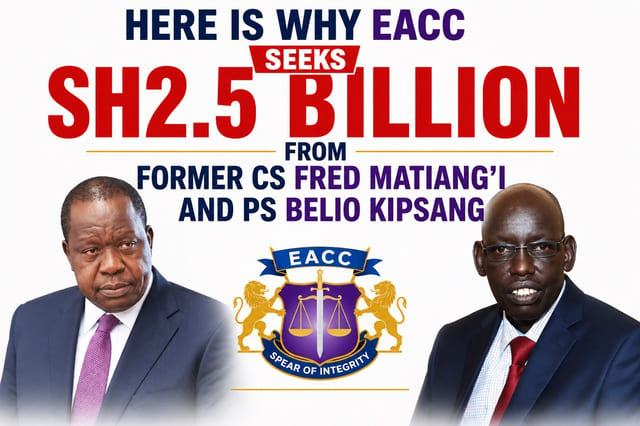
The controversial Ruaraka land compensation saga is back in the spotlight, with the Ethics and Anti-Corruption Commission (EACC) now demanding nearly Sh2.5 billion from 25 individuals and companies over the payment made for 13.77 acres of land in Ruaraka.
Among those targeted are former Interior Cabinet Secretary Fred Matiang’i and former Education Principal Secretary Belio Kipsang, with the anti-graft agency seeking recovery of the money together with interest.
The latest move brings back one of Kenya's most controversial land compensation cases and raises a simple question: how did taxpayers end up paying billions for land that courts and government investigations had questioned?
The land at the centre of the dispute was associated with public schools in Ruaraka, including Ruaraka High School and Drive Inn Primary School. The government paid Sh1.5 billion as compensation to businessman Francis Mburu, a payment that was subsequently challenged in court.
The controversy became even more serious after the High Court found the compensation payment unlawful and ordered recovery of the money.
The EACC's latest demand shows that the matter has not disappeared.
Matiang’i and Belio now face the recovery question 
The inclusion of Matiang’i and Kipsang in the latest recovery demand places renewed focus on the government officials involved in the process that led to the payment.
The EACC is not simply asking questions anymore.
It is seeking money.
The agency has written demand letters to the individuals and entities it considers liable, with the total amount reportedly reaching almost Sh2.5 billion once interest and other amounts are factored in.
That creates a serious accountability test.
If public officials participated in decisions that resulted in an unlawful payment, who should ultimately carry the financial responsibility?
Should taxpayers absorb the loss?
Should the individuals involved be required to refund the money?
And if there was no wrongdoing by particular officials, why were they included in the recovery process?
Those questions will have to be answered through the legal process.
The money was public money 
The most disturbing part of the Ruaraka saga is that the dispute was never simply about a piece of land.
It was about public money.
Sh1.5 billion was paid out in compensation.
That is money that could have financed classrooms, hospitals, roads, water projects or other public services.
Instead, the payment became the subject of years of litigation and investigations.
The latest EACC action means the state is now attempting to recover the money rather than simply allowing the matter to disappear into the long list of Kenyan corruption scandals.
A similar land scandal shows why recovery matters 
The Ruaraka case is not happening in isolation.
Kenya has repeatedly seen public land disputes in which property worth billions ends up being contested years after irregular allocations or transactions take place.
One recent example involves Karura Forest land, where the EACC announced recovery of land valued at approximately Sh2.8 billion after litigation established that the property had been illegally acquired.
That case demonstrates why recovery of public assets matters.
A corruption investigation that ends with headlines but no recovery does little to repair the damage.
The public loses the land.
The public loses the money.
Then nobody takes responsibility.
Recovery proceedings at least create the possibility that taxpayers can get back what was lost.
The bigger question is why the payment happened 
The public should not only be interested in getting the money back.
Kenyans should want to know how the payment was approved in the first place.
What advice did government officials receive?
Who authorised the compensation?
What documents were relied upon?
Were warnings raised before the payment?
Were those warnings ignored?
Who signed the approvals?
Why did the government proceed with the payment despite concerns surrounding ownership of the land?
These are more important questions than simply asking where the money went.
Because if the same weaknesses remain inside government procurement, valuation and compensation systems, another Ruaraka can happen tomorrow.
Matiang’i should answer the questions 
Former CS Fred Matiang’i has previously been a powerful figure within government, serving in several senior positions before leaving office.
The latest EACC action puts his name back into a controversy involving billions of shillings in public funds.
Matiang’i deserves the opportunity to respond to the recovery demand and explain his role in the transaction.
The same applies to Belio Kipsang and every other individual named by the anti-graft agency.
Being named in a recovery demand does not by itself establish criminal liability or personal wrongdoing.
But it does mean the allegations and financial claims are serious enough to require answers.
This is where accountability should begin 
For years, Kenyans have watched corruption cases become political arguments.
One government blames another.
Former officials accuse investigators of political persecution.
Investigators insist they are pursuing public interest.
Politicians trade accusations.
Meanwhile, the money remains missing.
The Ruaraka case now presents an opportunity to test whether Kenya's recovery system can actually work.
If the courts ultimately establish that individuals or companies are legally liable for the loss, the money should be recovered.
If they are not liable, the courts should clear them.
But the process should not be allowed to become another endless political theatre.
The public deserves the facts.
Who received the money?
Who approved it?
Who benefited?
Who was warned?
Who ignored the warnings?
And who will ultimately pay it back?
The Ruaraka land saga has already consumed years.
The latest EACC demand means the story is entering another phase.
This time, the question is no longer simply who got Sh1.5 billion.
It is whether Kenya can finally make those responsible for questionable public expenditure account for every shilling.