
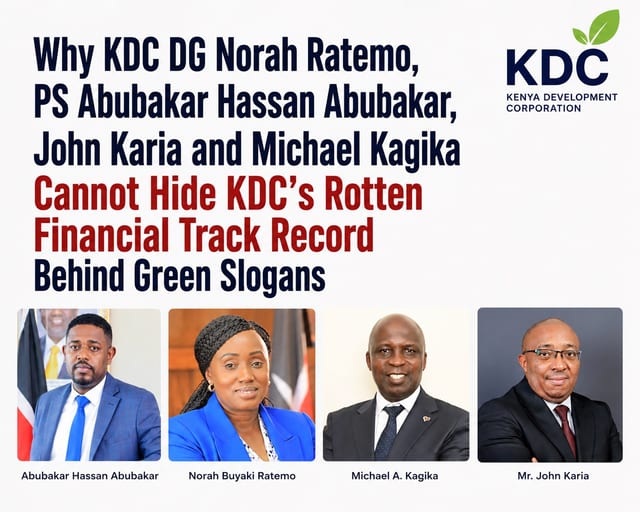
The Kenya Development Corporation has unveiled new products and a sustainability plan that it says will support green financing and investment across the country.
The public messaging is predictable. Green innovation. Sustainable financing. Low carbon economy. Environmental protection.
But there is another story Kenyans need to read.
Before KDC starts presenting itself as the answer to Kenya's green financing needs, Kenyans should be asking how the corporation has handled public money, investments, loans and assets already under its control.
KDC is a state owned development finance institution created from the merger of ICDC, Tourism Finance Corporation and IDB Capital. Its current strategic plan says its mission is to provide financial and technical support to medium and large scale enterprises for sustainable socio economic development.
That mandate gives the corporation enormous responsibility.
It is dealing with public resources.
It is financing businesses.
It is taking security over property.
It is making investment decisions.
And now it wants to expand its role in green finance.
The question is simple:
Can Kenyans trust the institution with even more money before the old questions surrounding its operations are fully answered?
Start with the people running KDC 
The corporation's own website currently lists Norah Buyaki Ratemo as Director General. It lists Kennedy M. Wanderi as Acting Director Corporate Services and Deputy Director, Finance and Accounts, John Karia as Acting Corporation Secretary and Director Legal Services, Faith Nene as Director Strategy, Research, Policy and Innovation, Dominic Ndewa as Deputy Director Strategy, Planning and Performance Management, Carolyne Misoi as Deputy Director Human Resource and Administration, and Judith Omachar as Deputy Director Business Development and Advisory.
These are the people Kenyans should be asking questions of when KDC launches another financing programme.
Norah Buyaki Ratemo, as Director General, carries the biggest responsibility for the corporation's day to day management. KDC says she was appointed Director General on July 4, 2023, after previously serving as Director of Investments.
Kennedy M. Wanderi, who currently combines Acting Director Corporate Services with Deputy Director Finance and Accounts, sits directly in an area where questions about expenditure, financial controls and reporting matter.
John Karia, as Acting Corporation Secretary and Director Legal Services, occupies the office expected to safeguard the corporation's legal and governance processes.
Faith Nene, heading Strategy, Research, Policy and Innovation, is part of the leadership responsible for translating the corporation's plans into measurable results.
Dominic Ndewa, responsible for Strategy, Planning and Performance Management, is connected to the systems through which those results should be measured.
Carolyne Misoi, in charge of Human Resource and Administration, oversees the people and internal administration of the corporation.
Judith Omachar, heading Business Development and Advisory, sits on the side of KDC responsible for dealing with businesses seeking support.
These names matter because a public corporation is not an abstract building.
People make the decisions. People approve processes. People sign documents. People answer for failures.
And if KDC is now asking Kenyans to trust it with more financing, Kenyans have every right to examine the record of the institution and the leadership currently running it.
The Auditor General has already raised issues around KDC's assets 
This is where the glossy green financing story starts becoming uncomfortable.
The Auditor General's report on KDC for the year ended June 30, 2023 raised concerns about investment property held by the corporation.
The audit noted that KDC had unsold apartments in the Zamia Heights and Oceania Apartments projects years after completion.
As of June 30, 2023, 11 of 28 Zamia Heights apartments and 24 of 36 Oceania apartments remained unsold. The report said the unsold units had a combined recognised value of KSh490.5 million. KDC was still paying service charges on the unsold units.
That is not a small amount of idle property.
It raises a basic development finance question.
Why is a state development corporation sitting on hundreds of millions of shillings in apartments that remained unsold for years?
And what lessons were learnt from those investments before KDC started announcing new products?
The Auditor General noted the possibility of impairment because of the slow uptake.
This is precisely the kind of information that should be discussed alongside any new sustainability plan.
Not hidden behind a green financing hashtag.
Then there is the question of KDC's lending business 
KDC is a lender.
That means some businesses borrow money from the corporation and provide assets as security.
When borrowers fail to repay, KDC can move to recover its money.
That has already produced a number of court battles.
In February 2025, Business Daily reported that a food processing company was facing the possible loss of its prime estate over a KSh276 million loan from KDC. The High Court declined to stop the bank from exercising its statutory power of sale, with the court saying KDC should be allowed to realise its security.
In another case, Aberdare Mountain Fresh Limited and another v Kenya Development Corporation, the High Court granted the borrowers 90 days to settle their loan arrears, failing which KDC could proceed with the statutory sale of the properties.
And in Steel Formers Limited and another v Kenya Development Corporation, the High Court granted an interim injunction stopping the sale of two properties pending the hearing of the case, subject to conditions imposed by the court.
These cases do not mean KDC did anything wrong.
They show something else.
KDC's decisions affect real businesses, real properties and real livelihoods.
That makes financial accountability even more important.
KDC has also been the subject of an Auditor General special audit 
The corporation's record also includes a special audit concerning the use of emergency funding for Covid 19 socio economic support in the tourism sector.
The Auditor General's report specifically examined transparency, accountability and inclusiveness in the use of those funds by KDC.
That should be part of the public conversation whenever KDC talks about managing new pools of money.
The question should not be:
"How attractive is the new sustainability plan?"
It should be:
"What controls will prevent the problems of yesterday from being repeated with tomorrow's money?"
And now KDC wants to handle green money 
The green financing strategy did not simply appear out of nowhere.
National Treasury and the World Bank backed SAFER Project engaged KDC to develop a green financing strategy and pursue sustainability accreditation.
The terms of reference specifically called for governance structures, green and sustainable finance frameworks, innovative financial instruments such as green bonds and sustainability linked loans, climate and ESG risk assessment systems and frameworks for tracking and reporting climate performance.
That sounds impressive.
But it creates another accountability question.
Who will independently verify that money labelled "green" actually finances green projects?
If KDC gives a company KSh500 million under a green financing product, who checks what happens to that money?
Who checks whether the environmental targets were achieved?
Who checks whether the project polluted a river?
Who checks whether workers were properly treated?
Who checks whether the company simply used the money for an ordinary business activity and attached a green label to it?
And who publishes the findings?
The PR machine will focus on the launch 
That is the easy part.
There will be photographs.
There will be speeches.
There will be hashtags.
There will be LinkedIn posts about sustainability.
There will be messages describing KDC as a leader in green development finance.
But Kenyans do not need another beautifully packaged government programme.
They need numbers.
How much money will be available?
Where did the money come from?
Who will qualify?
Who will approve applications?
Who will monitor the beneficiaries?
How much will be given to each beneficiary?
What collateral will be required?
What interest will be charged?
How many Kenyan businesses will receive the money?
How many businesses outside Nairobi will benefit?
How many loans will eventually become non performing?
And perhaps the most important question:
Who will be held personally responsible when public money is lost?
A development corporation should not become a debt collection machine 
There is another uncomfortable side to development finance.
When KDC finances a business that later collapses, it can move to recover its money through the security provided.
That is commercially understandable.
But the purpose of a development finance institution is different from that of an ordinary commercial bank.
Its job is to help build productive businesses.
That means KDC should be judged by more than the amount of money it lends.
It should be judged by the number of businesses that survive.
The jobs created.
The industries built.
The businesses that expand.
The regional spread of investment.
The tax revenue generated.
And the public value created.
If businesses keep collapsing and properties keep ending up in court battles, then somebody needs to ask whether the institution's lending decisions are working as intended.
KDC needs to open its books to public scrutiny 
The corporation's strategic plan has ambitious targets, including deployment of green climate financing and increased investments in special projects.
Those targets should come with public reporting.
KDC should publish a clear list of green financing beneficiaries once disbursements begin.
It should publish the amounts.
It should publish the sectors.
It should publish the counties.
It should publish repayment performance.
It should publish the environmental results.
It should disclose projects that fail.
And it should publish independent assessments of whether projects actually met the green criteria.
That is how public confidence is built.
Not through hashtags.
Kenyans should ask what happened to the old money before celebrating the new money 
The people being asked to trust KDC with new financing are the same taxpayers whose money ultimately supports the public institutions behind the corporation.
They have every right to ask difficult questions.
Why were hundreds of millions tied up in unsold apartments?
Why have borrowers repeatedly ended up in court with KDC over loan recovery?
What did previous audits reveal?
What happened to the recommendations?
What lessons were implemented?
Who was held accountable where weaknesses were identified?
And why should Kenyans simply accept another financing programme without demanding answers?
This is not an attack on green financing.
It is an attack on blind trust.
Kenya needs development finance.
Kenya needs investment.
Kenya needs manufacturing.
Kenya needs clean energy.
Kenya needs businesses that create jobs.
But Kenya does not need another public institution where the language of development becomes more impressive than the actual results.
The current KDC leadership, led by Norah Buyaki Ratemo, now has an opportunity to prove that this new programme will be different.
And the other managers listed by KDC, including Kennedy M. Wanderi, John Karia, Faith Nene, Dominic Ndewa, Carolyne Misoi and Judith Omachar, should be prepared to answer questions within their respective areas of responsibility.
Because when the cameras leave and the hashtags disappear, the only thing that will matter is where the money went, who received it, what was achieved and who answers when it is lost.
KDC can call it green finance. Kenyans are entitled to call it public money and demand answers.