
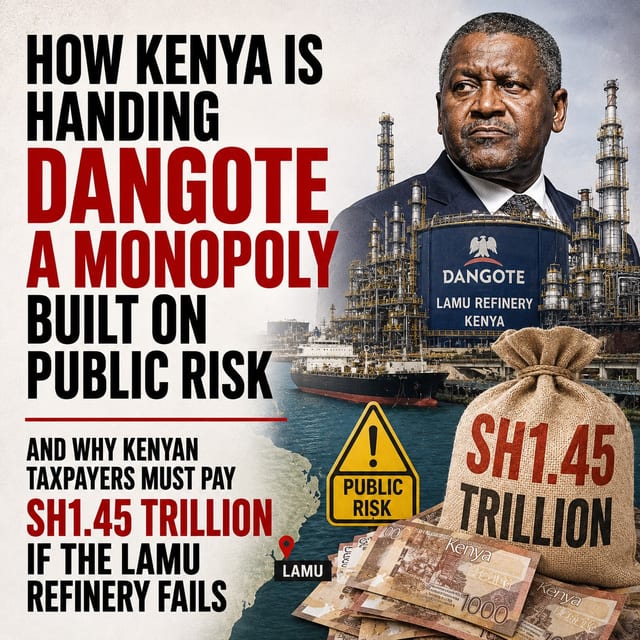
Aliko Dangote is planning one of the biggest private industrial projects ever proposed in Kenya, but the financing structure behind the planned Lamu oil refinery deserves as much attention as the refinery itself.
The project has now been put at about $16 billion, down from the earlier estimate of $17 billion. Dangote plans to finance roughly 70 percent through debt, meaning about $11.2 billion, while the remaining 30 percent would come through equity. Business Daily puts the debt requirement at about Sh1.45 trillion.
Construction is expected to begin in October 2026, with the proposed refinery designed to process about 700,000 barrels of crude oil per day. The facility is being presented as a regional project intended to supply refined petroleum products beyond Kenya.
That is where Kenyans need to stop and ask some uncomfortable questions.
If Dangote is borrowing Sh1.45 trillion for the refinery, who ultimately carries the risk if the project struggles to repay the debt?
That question becomes even more important because the project is not being discussed as an ordinary private factory.
President William Ruto has expressed support for the refinery, and Dangote has said government support will be important, including access to land and measures that protect the refinery from competing imports.
Government support for a major industrial investment is not automatically a bad thing.
But Kenyans must know exactly what they are being asked to support.
Sh1.45 trillion is not small money 
The proposed debt alone is enormous.
It is roughly the kind of figure that immediately raises questions about financing costs, repayment periods, guarantees, tax treatment, land arrangements, infrastructure support and possible government commitments.
The critical issue is whether the debt remains entirely a private-sector liability or whether any part of the financing structure could eventually expose Kenyan taxpayers to losses.
That must be made clear before public resources are committed.
There should be no vague promises.
There should be no hidden guarantees.
There should be no situation where a project is presented as privately financed at the beginning only for taxpayers to be called upon later when things become difficult.
Kenya has seen enough large projects where the public is left asking who approved what and who will pay when the numbers stop working.
The Dangote refinery in Nigeria offers another lesson 
Dangote is not attempting something small.
His Lagos refinery is one of the largest refining projects in Africa. It involved an investment of more than $19 billion and has a capacity of about 650,000 barrels per day. The refinery has since moved into commercial operations and has become a major supplier of refined petroleum products.
That experience will clearly be important in Kenya.
But it should not be used as a substitute for proper scrutiny of the Lamu project.
The fact that a billionaire has successfully built a refinery elsewhere does not automatically mean that the Kenyan project will have the same economics.
Lamu is a different market.
Kenya has a different tax regime.
East Africa has different fuel consumption patterns.
The project will face different logistics costs, different political conditions and different regulatory requirements.
And the global oil market is constantly changing.
What happens if oil demand changes? 
The proposed refinery would process 700,000 barrels of crude every day.
That is an enormous capacity.
The question is whether Kenya and the wider East African market can absorb the products at prices that allow the refinery to comfortably service more than $11 billion in debt.
The project is being positioned as a regional refinery, meaning its success will depend heavily on markets outside Kenya.
That creates another risk.
If Uganda, Tanzania, Rwanda, South Sudan, Ethiopia and other regional markets continue sourcing petroleum products from competing suppliers, the refinery will have to compete for those markets.
Kenya therefore needs to see the actual business case.
Not political speeches.
Not promises of thousands of jobs.
Not headlines about Africa's richest man.
The numbers.
How much crude will be processed?
At what cost?
Where will the crude come from?
What will the refining margin be?
Who will buy the products?
What percentage will be sold locally?
What percentage will be exported?
What happens when global refining margins fall?
And how much will the refinery need to earn every year just to service its debt?
Those are the questions that matter.
Government support must come with conditions 
Dangote has indicated that government assistance will be important, including land and import protection.
This is where Kenyans should pay close attention.
Import protection can have consequences for consumers.
If the government restricts competing petroleum imports to protect a local refinery, Kenyan consumers could end up with fewer choices and potentially higher prices if the local refinery cannot produce competitively.
The government must therefore explain what "protection" means.
Will Kenya impose tariffs?
Will it restrict competing imports?
Will government agencies be required to purchase from the refinery?
Will neighbouring countries receive incentives to buy from Lamu?
Will Kenya guarantee a market?
Will taxpayers compensate the company if the market does not perform?
These details cannot be left to future negotiations.
Lamu residents also deserve answers 
A project of this size will completely change the economic picture around Lamu.
There will be demand for land, roads, housing, security, water, electricity, transport and other infrastructure.
There will be employment opportunities.
There will also be environmental and social concerns that cannot be ignored.
Lamu is not an empty piece of land waiting for an industrial project.
People live there.
Communities depend on fishing, tourism and other economic activities.
The refinery must therefore go through the required environmental and social processes before construction.
The rush to build should never become an excuse for cutting corners.
There is another Kenyan project that should serve as a warning 
Kenya has previously pursued major energy projects with big promises about investment, jobs and economic transformation.
The Mombasa Petroleum Refinery, once an important part of Kenya's petroleum infrastructure, eventually stopped refining crude and was converted into a storage facility.
That history should remind policymakers that having a refinery is not enough.
The economics have to work.
A refinery can be expensive to build and expensive to operate.
If the market changes, a giant facility can quickly become a financial burden.
That is why the Lamu project must be tested against multiple scenarios before the first major construction contract is signed.
Kenya should not become the silent partner 
This is the biggest issue.
Dangote is a private investor.
He has every right to seek financing for a project he believes will make money.
But Kenya must protect its own interests.
If the businessman wants land, infrastructure, tax incentives, import protection or other government assistance, Kenyans deserve to know exactly what they are giving and what they are receiving in return.
How many permanent jobs?
How many Kenyan contractors?
How much local procurement?
How much tax revenue?
What percentage of the ownership will eventually be Kenyan?
Will Kenyans have an opportunity to invest?
Will the refinery eventually be listed on a local exchange?
What happens if the project fails?
What happens to the land?
What happens to government infrastructure built specifically for the refinery?
These questions should be answered before construction starts.
The Sh1.45 trillion debt deserves public scrutiny 
The most important figure in this entire story may not be the 700,000 barrels per day.
It may be the Sh1.45 trillion debt.
Debt can build great businesses.
It can also destroy businesses when revenue projections fail.
Research on corporate financing has repeatedly shown why companies must carefully balance debt and equity when financing major investments. The cost of borrowing, repayment obligations and business performance can have a major effect on the financial health of an enterprise.
That is why Kenya should not simply celebrate the size of the proposed investment.
It should interrogate the financing.
Who lends the money?
At what interest rate?
For how many years?
Who guarantees the debt?
What happens if the refinery does not generate enough revenue?
What exactly will the Kenyan government provide?
And most importantly:
Can Kenyans be certain that not one shilling of public money will be used to rescue a privately financed project if things go wrong?
This could be a major opportunity, but scrutiny must come first 
There is no doubt that a functioning large scale refinery could change Kenya's petroleum industry.
It could create jobs, support local suppliers, generate taxes and reduce reliance on imported refined petroleum products.
But none of those benefits should blind Kenya to the financial risks.
The country should welcome serious investment while demanding serious accountability.
Dangote is putting up the money and taking on debt because he believes the project can work.
Kenya should therefore make sure that its own deal works for Kenyans too.
Before the ground is broken in October, the public deserves to see the numbers.
A Sh1.45 trillion borrowing plan is too big to be treated as just another business announcement.
If the project succeeds, Dangote will make money.
If the project struggles, Kenyans must not be the ones left holding the bill