
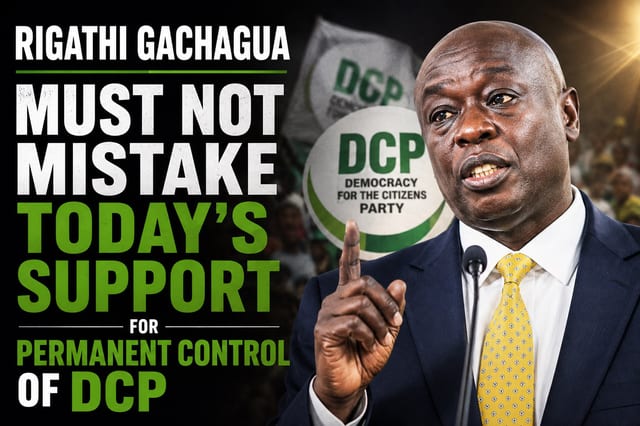
Rigathi Gachagua should be very careful not to convince himself that the support he enjoys today means he will remain in total control of DCP after the next election, because Kenyan politics has a brutal habit of changing once power, money and new ambitions enter the room.
Right now, Gachagua is benefiting from anger against President William Ruto, resentment over his impeachment and a strong feeling across parts of Mt Kenya that he was humiliated and unfairly removed from power.
That gives him enormous political energy, but energy created by anger against somebody else is not necessarily the same thing as permanent loyalty to the person leading the rebellion.
This is where comparisons with Raila Odinga become dangerous for Gachagua, because Raila built something very different over decades, where large numbers of supporters were emotionally attached to him before elections, after elections and even when supporting him came with no immediate political reward.
Raila could tell his supporters to back a candidate they had never heard of and many would do it, withdraw from a political arrangement and carry his base with him, or enter a coalition with someone they had spent years attacking and still retain substantial control.
That kind of political authority did not appear because Raila formed a party and became its leader, since it came from decades of detention, opposition politics, constitutional struggles, elections, betrayals, defeats and a deeply personal bond with his supporters.
Gachagua cannot simply manufacture that relationship because he wants to become the Raila of Mt Kenya, and modern Mt Kenya politics is much more fragmented, transactional and competitive than the political environment Raila dominated for years.
The same voters cheering Gachagua today can disagree with him tomorrow, particularly once the immediate objective of removing Ruto disappears and politics returns to questions of governors, MPs, succession, Cabinet positions, business interests and control of local power.
That is when DCP could become much harder to control.
Some politicians currently joining Gachagua are not necessarily joining because they believe in Rigathi Gachagua as a permanent political commander, since many are joining because they believe he currently represents the strongest vehicle against Ruto in the region.
Those are two very different things.
After an election, especially if DCP becomes successful, everybody will suddenly have their own constituency, money, supporters, ambitions and claims about who contributed most to the victory.
Governors will want independence, MPs will resist instructions that threaten their seats, wealthy financiers will demand influence and younger politicians will begin asking why one man should permanently control a movement they helped build.
Gachagua should therefore avoid the temptation to humiliate smaller parties, dictate who should dissolve, decide who can speak for Mt Kenya or treat every disagreement as disloyalty, because those habits can create enemies inside his own coalition long before they become visible publicly.
The strongest political leader is not always the one who controls everybody, but the one who creates a structure capable of surviving disagreement without collapsing.
Mt Kenya has repeatedly shown that its electorate can move very quickly when the political mood changes, and politicians who once appeared untouchable have discovered that popularity in the region can disappear within one election cycle.
Uhuru Kenyatta once commanded overwhelming support there, then large parts of the same electorate moved towards Ruto when the political circumstances changed.
Ruto later enjoyed extraordinary support across the region, yet only a few years into his presidency he has faced open hostility in areas that overwhelmingly backed him.
That alone should warn Gachagua against believing any political support in Mt Kenya comes with permanent ownership papers.
The region can support you intensely without surrendering itself to you forever.
Gachagua’s real test will therefore come after Ruto, not before Ruto, because opposing an unpopular president gives everyone a common enemy and temporarily hides the differences among people standing on the same side.
Once that common enemy disappears, all those differences return.
That is when Gachagua will find out whether DCP is genuinely an institution or simply a temporary vehicle held together by anger against William Ruto.
Raila survived those moments repeatedly because his political base often treated his word almost as final, but expecting the same relationship in modern Mt Kenya would be a serious misreading of both the region and the current generation of voters.
Rigathi can become extremely influential, perhaps even the dominant political figure in Mt Kenya for a period, but he cannot assume he will become Raila Odinga simply by controlling the biggest opposition vehicle in the region.
The wiser path would be building DCP around rules, internal elections, competing centres of influence and leaders strong enough to disagree with him without immediately becoming enemies.
Otherwise, Gachagua could help build a very powerful party, win the battle he is currently fighting, then discover after the election that the people inside the vehicle no longer believe he alone should hold the steering wheel.
Source: Editor in Chief