
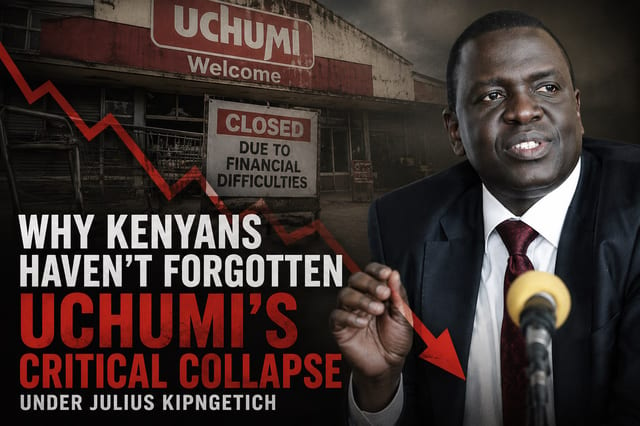
Former Uchumi Supermarkets Chief Executive Officer Julius Kipngetich has called for urgent action to address education inequalities in Northern Kenya, warning that thousands of children continue to miss out on quality education because of historical marginalisation.
His remarks have sparked debate online, with some Kenyans arguing that before he lectures the country on leadership and equity, questions surrounding his own record at Uchumi have never completely faded from public memory.
For many younger Kenyans, Julius Kipngetich is best known today for his conservation and public service roles. What many Gen Zs may not know is that he also served as the Chief Executive Officer of Uchumi Supermarkets during one of the retailer's most difficult periods.
Kipngetich took over the struggling retailer in 2015 with a mandate to rescue what was once Kenya's largest supermarket chain. At the time, Uchumi was already weighed down by debt, supplier complaints, empty shelves and mounting financial losses.
His appointment was welcomed by many who believed his previous success at the Kenya Wildlife Service and the Kenya Tourism Board could help revive the retailer. That turnaround never materialised.
During his tenure, Uchumi continued to struggle with liquidity problems, suppliers repeatedly complained about delayed payments, branches continued closing and confidence among customers and creditors kept declining.
Kipngetich resigned in 2017 after about two years at the helm.
While Uchumi's problems predated his appointment and continued after his departure, many Kenyans still view the leadership of that era as part of the story behind one of the country's biggest corporate collapses. The collapse of Uchumi remains one of Kenya's most significant corporate failures.
Thousands of workers lost their jobs. Suppliers were left chasing billions of shillings in unpaid invoices. Landlords, transporters and small businesses that depended on the supermarket also suffered major financial losses.
The debate resurfaced after Kipngetich warned that marginalising parts of the country through poor access to education could have long term consequences for national development.
Critics argue that public leaders should be prepared to answer questions about their own leadership records before positioning themselves as voices on national governance issues.
Uchumi is not the only once dominant retailer whose collapse left lasting scars.
Nakumatt Supermarkets also collapsed under the weight of debt, leaving suppliers, employees and landlords counting billions in losses. Years later, many creditors are still pursuing payment through the courts, making the retailer another example of how poor corporate governance can devastate businesses and livelihoods.
Another comparable case is Tuskys Supermarket, whose collapse triggered years of legal battles between directors, creditors and employees. Staff went for months without salaries, suppliers remained unpaid and customers lost confidence before the chain eventually disappeared from the market.
More recently, governance failures have continued to attract scrutiny in Kenya's corporate sector. Courts have increasingly emphasised that company directors and senior executives have a duty to exercise sound financial oversight, particularly where businesses hold public trust, employ thousands of people or manage large sums owed to suppliers and creditors.
Kipngetich's comments on education are likely to continue generating discussion. For some Kenyans, the message stands on its own merit. For others, the messenger's corporate record remains part of the conversation.
As debate over leadership and accountability continues, many believe the lessons from Uchumi should never be forgotten, especially by a generation that may only know the supermarket chain through history books and abandoned buildings.