
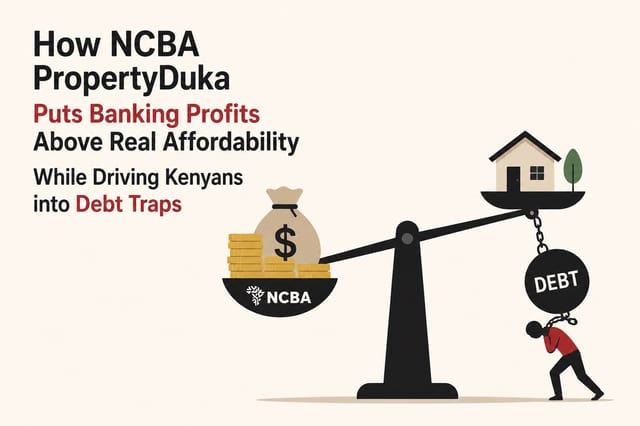
NCBA Bank wants Kenyans to believe the biggest obstacle to owning a home is a complicated buying process.
That is the message behind PropertyDuka, the bank's newly launched platform that promises to bring property search, financing, construction, furnishing and insurance under one roof.
But many Kenyans are asking a different question. Is NCBA solving the country's housing crisis or simply creating another pipeline to sell more loans?
Yet beneath the polished marketing lies a much bigger question that deserves public scrutiny. Has Kenya's housing crisis really been caused by disconnected property services, or is the banking industry deliberately overlooking the far more difficult conversation about affordability, debt and the financial risks that ordinary families face after signing mortgage agreements?
The statistics quoted by NCBA itself reveal the scale of the problem. Kenya's property market is estimated to be worth more than KSh1 trillion every year, yet the country has only about 30,000 active mortgages despite a population exceeding 60 million people. Nearly 79 percent of urban residents continue to live in rented housing. These numbers have remained stubbornly low despite decades of mortgage campaigns, property exhibitions and financial products designed to encourage home ownership.
That reality suggests the problem has never been a lack of houses to choose from or insufficient digital platforms to search for them. The real obstacle has always been the financial ability to own them.
For many Kenyans, purchasing a home is no longer determined by ambition but by economic survival. Household incomes have come under increasing pressure from higher taxes, rising electricity bills, expensive food, costly transport, healthcare expenses and declining purchasing power. Formal employment has slowed, businesses continue to close and thousands of workers have experienced layoffs or salary reductions over the past few years. In such an environment, committing to a mortgage that may run for twenty or twenty five years is no longer simply a financial decision. It is a long term gamble on the future stability of one's income.
This is where NCBA's campaign appears disconnected from the reality facing many households. PropertyDuka promises to simplify the process of buying property, but it says very little about the financial burden that begins after the paperwork is complete. Searching for a house has never been the most difficult part of home ownership. Meeting monthly repayments for two decades while navigating an unpredictable economy is where the real challenge begins.
The banking industry has often presented mortgages as pathways to wealth creation and financial security. Yet Kenya's recent economic history tells another story. As interest rates rose and the cost of living increased, many borrowers struggled to keep up with repayments. Loan restructuring became more common, distressed property sales increased and auction notices became a familiar sight in newspapers and online platforms. Behind every repossessed property is usually a family whose financial circumstances changed long after the mortgage agreement was signed.
Against that backdrop, it is reasonable to ask whether PropertyDuka is genuinely solving the country's housing problem or simply creating another channel through which banks can acquire mortgage customers.
The platform may streamline customer experience, but it does not reduce the cost of borrowing. It does not lower property prices, guarantee stable employment or shield borrowers from economic shocks. More importantly, it does not explain what support exists for customers whose financial circumstances change after taking on long term debt.
These are not theoretical concerns. They reflect the everyday experiences of many Kenyans who entered the property market with optimism only to find themselves overwhelmed by changing economic conditions that were beyond their control.
The conversation becomes even more important when viewed alongside the wider challenges that have plagued Kenya's property sector. Over the years, buyers have lost billions of shillings through fraudulent land transactions, double allocation of titles, delayed title deeds, incomplete developments and projects that stalled after purchasers had already paid substantial deposits. Court cases involving developers, financiers and property owners have become increasingly common, exposing weaknesses in due diligence and consumer protection across the industry.
NCBA says PropertyDuka brings the entire property ecosystem together under one roof. That claim naturally raises further questions. What level of due diligence has the bank undertaken on the projects listed on the platform? How are developers vetted before being introduced to customers? What protections exist if a project stalls, ownership documents become disputed or buyers discover legal defects after making payments? If PropertyDuka is intended to become a trusted marketplace, transparency around these safeguards is just as important as the technology itself.
The bank has chosen to measure success by helping customers move from aspiration to action. Yet action alone is not a meaningful measure of success in the mortgage market. A successful mortgage is one that a borrower completes without financial distress. A successful property investment is one that creates wealth rather than becoming the reason a family loses its home. Those are the outcomes that matter most, yet they receive very little attention in the promotional campaign.
NCBA could strengthen public confidence by providing greater transparency around its own mortgage portfolio. How many mortgages issued over the past decade remain fully performing? How many customers have sought loan restructuring after economic hardship? How many financed properties have entered recovery proceedings or been auctioned? These figures would provide a clearer picture of the realities facing Kenyan homeowners than promotional messages centred on aspiration.
Innovation in banking is welcome, and there is no doubt that digital tools can simplify transactions and improve customer experience. The difficulty is that technology cannot solve structural economic problems. A well designed platform cannot replace affordable housing policy, stable employment, lower borrowing costs or stronger consumer protections. It cannot change the fact that millions of Kenyans remain priced out of the property market, not because they cannot find houses online, but because they cannot afford the long term financial obligations that come with buying one.
Viewed through that lens, PropertyDuka appears less like a solution to Kenya's housing crisis and more like a sophisticated customer acquisition strategy built around an aspiration that remains financially unattainable for most households. Before inviting more Kenyans into long term mortgage commitments, NCBA should first demonstrate how its approach addresses the affordability challenges that have kept home ownership beyond the reach of the majority for decades.