
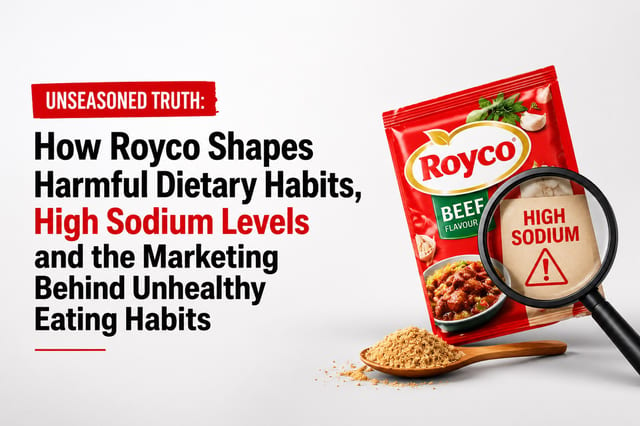
Millions of Kenyan families sprinkle Royco into their meals every day without ever asking a simple question. What exactly are they consuming, and how much of it is too much?
For years, Royco has been sold as an essential ingredient for tasty food. Yet independent research is raising uncomfortable questions about how consumers are persuaded to buy the product, whether enough attention is paid to its nutritional profile, and whether aggressive marketing has normalised the daily use of processed seasoning products without adequate public education.
Academic researchers who analysed Royco's television advertising concluded that the commercials are carefully designed to influence consumer behaviour through emotional appeals, celebrity endorsements and persuasive imagery. The study argues that viewers often absorb these marketing messages without critically examining how they shape purchasing decisions.
At the same time, public health experts continue to warn that excessive sodium intake remains one of the leading contributors to hypertension and cardiovascular disease. Seasoning mixes are among the processed foods that contribute to daily sodium intake, making transparency and consumer awareness matters of legitimate public concern.
Turn on the television during prime time or scroll through social media and you'll likely come across celebrity chefs, influencers or entertainers promoting the product.
But as Royco cements itself as a kitchen staple, researchers are beginning to ask an important question.
Are Kenyans buying Royco because they genuinely need it, or because years of carefully crafted marketing have convinced them they cannot cook without it?
A recent academic study examining Royco television advertisements found that the brand's marketing strategy goes far beyond simply introducing a seasoning product.
Researchers concluded that Royco advertisements deliberately combine emotional appeal, visual imagery, celebrity endorsements and persuasive language to influence consumer behaviour and purchasing decisions.
According to the study, many viewers focus on the attractive meals, smiling families and trusted public figures featured in the advertisements without recognizing the psychological persuasion techniques being used.
The researchers observed that the advertisements create the impression that adding Royco automatically results in tastier meals and happier families, making the seasoning appear almost indispensable in everyday cooking.
That raises an important public interest question.
At what point does successful marketing begin shaping dietary habits instead of simply informing consumers about a product?
Nutrition experts have for years warned that excessive sodium consumption is a growing public health concern across the world.
Processed foods, seasoning mixes and ready made flavour enhancers contribute to daily sodium intake, often without consumers realizing how much salt they are consuming.
The World Health Organization recommends limiting sodium intake because excessive consumption increases the risk of high blood pressure, heart disease and stroke.
Many consumers add table salt during cooking and then add seasoning products without considering the combined sodium content of the meal.
Royco vs. WHO Limits
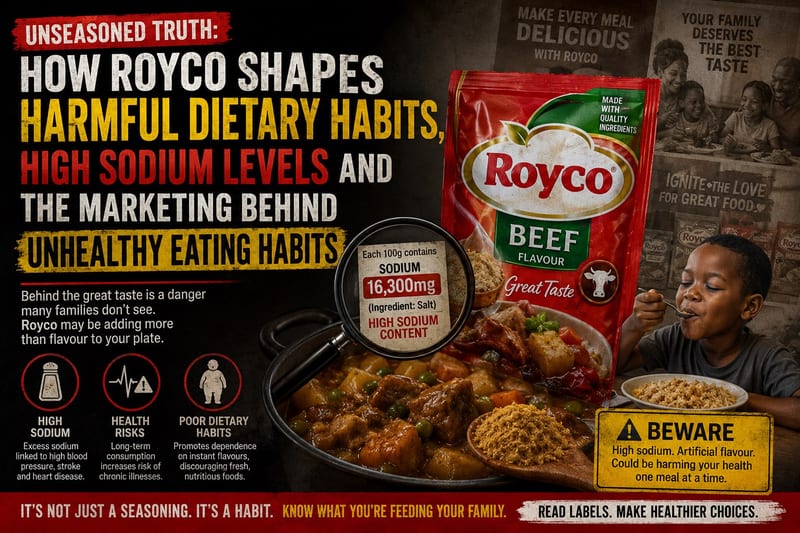
One of the biggest nutritional concerns surrounding Royco is its sodium content. Based on the product's published nutritional information, a single 2-gram Royco cube contains approximately 455 milligrams of sodium.
That means one cube alone accounts for nearly 23 percent of the World Health Organization's recommended maximum daily sodium intake of 2,000 milligrams for an adult. The numbers become more concerning when multiple cubes are used, as is common in many Kenyan households.
Two cubes provide about 910 milligrams of sodium, or nearly 46 percent of the WHO's daily limit, while three cubes contribute approximately 1,365 milligrams, consuming more than 68 percent of the recommended daily maximum before any ordinary table salt is added during cooking.
Royco's bulk seasoning formulations have also been reported to contain up to 25 grams of salt per 100 grams of product, making roughly a quarter of the product's weight salt.
Nutrition experts point out that the total sodium intake may be even higher because flavour enhancers such as monosodium glutamate (MSG), disodium inosinate, and disodium guanylate also contribute sodium to the final meal. This raises legitimate public health questions about whether consumers fully understand how quickly seasoning products can push meals toward or beyond the WHO's recommended sodium limits, particularly when several cubes are used in one pot alongside additional table salt.
The issue is whether consumers are receiving enough information to understand how much sodium they consume every day.
Royco's marketing strategy has attracted growing scrutiny because it does more than simply advertise a seasoning product. By consistently portraying Royco as the "secret ingredient" behind delicious, home cooked family meals, the campaigns may encourage consumers to view the product as an essential part of everyday cooking rather than an occasional flavouring.
Researchers who analysed Royco's television advertisements found that the commercials rely heavily on emotional storytelling, attractive food imagery and messages centred on natural ingredients such as turmeric, garlic and coriander. Critics argue that this emphasis on "natural" ingredients can create a health halo around the product, drawing consumers' attention to selected spices while paying less attention to its sodium content
Another academic paper analysing Royco's advertising found that the company's campaigns rely heavily on persuasive communication strategies that create strong emotional connections between the product and family life.
According to the researchers, these advertisements use carefully selected language, colour, music and storytelling to influence purchasing behaviour.
The study argues that consumers rarely stop to analyse these techniques because the advertisements are designed to feel natural and relatable.
That has renewed debate about whether celebrity endorsements should be accompanied by stronger public education on healthy eating and balanced diets.
Royco has also expanded its marketing beyond traditional television advertising.
The brand now works with digital creators, chefs and influencers who demonstrate recipes using the product across social media platforms.
Critics argue that the constant visibility reinforces the perception that every meal requires processed seasoning.
Researchers say consumers should distinguish between advertising claims and nutritional information.
A product can be legally marketed while consumers still deserve clear information about how it fits into a healthy diet.
Another study frequently cited in discussions about packaged seasonings examined microbial contamination in spices and spice products sold in East Africa.
The researchers found contamination in several spice products available in the market at the time, highlighting the importance of quality control throughout food production and storage.
However, the study did not conclude that Royco products are inherently unsafe for consumption, nor can findings from products sampled years ago in another country automatically be applied to products currently sold in Kenya.
The research instead reinforces a broader point.
Food manufacturers must maintain strict quality assurance systems, and regulators must continue routine testing of processed food products sold to consumers.
The bigger issue facing Kenya today may not be whether Royco is legal or whether people should stop using it.
It is whether consumers are being given enough balanced information to make informed dietary choices.
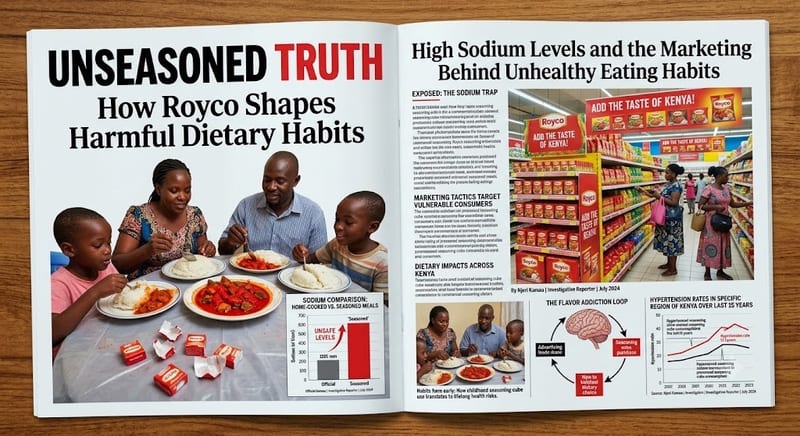
Should front of pack nutrition labels be more prominent?
Should advertisements for processed food products include stronger nutritional messaging?
Should celebrity endorsements be balanced with public health campaigns encouraging moderation in sodium intake?
These are questions that deserve serious public discussion.
Food companies have every right to market their products within the law.
Consumers equally have the right to understand what they are buying, how often they should consume it and how it contributes to their overall diet.
As Kenya continues to battle rising cases of hypertension, diabetes and other non communicable diseases, conversations about everyday food choices cannot be ignored.
Royco remains one of the country's biggest food brands.
That success also comes with responsibility.
When millions of households use a product every day, transparency, responsible marketing and consumer education become just as important as sales.
The conversation should not be about banning Royco.
It should be about giving Kenyans enough information to decide whether the seasoning belongs in every meal, or simply as one ingredient among many in a balanced diet.