
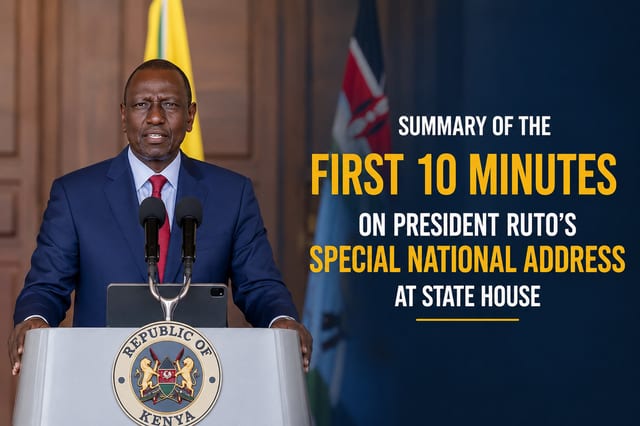
President William Ruto used the opening of his address to lay the foundation for Vision 2060, arguing that Kenya has reached a defining moment in its history. He said Vision 2030 is nearing its end and called for a new long-term national development charter that reflects the aspirations of the 2010 Constitution.
He urged Kenyans to move beyond politics and focus on building the country's future. To support his argument, he compared Kenya with countries such as South Korea, China, Vietnam, Singapore, Taiwan and Bangladesh, saying Kenya missed several global waves of industrialisation while those nations transformed their economies and lifted millions out of poverty.
The President acknowledged that Kenya failed to take advantage of those opportunities but did not spend much time explaining why. He instead shifted the focus to what he described as a new opportunity for the country to get it right.
He argued that his administration has already laid the foundation for that future by restoring macroeconomic stability. He pointed to a stronger Kenya shilling, higher foreign exchange reserves, lower inflation, lower borrowing costs, increased investor confidence and record foreign direct investment. He also cited Kenya's ranking as Africa's most competitive economy as evidence that economic reforms are beginning to bear fruit.
The central message of the first ten minutes is that Kenya has moved past its economic difficulties and is now ready to begin planning for the next generation through Vision 2060.
Reality on the Ground 
The speech relies heavily on national economic indicators, but many Kenyans continue to judge the economy by their daily lives. While inflation has eased and the shilling has stabilised, households still face high food prices, expensive electricity bills, rising school fees, costly transport and limited job opportunities. Small businesses continue to complain about high taxes and the cost of doing business.
The President correctly points out that Kenya fell behind countries like South Korea, China and Vietnam. What the speech leaves largely unanswered is why Kenya repeatedly missed those opportunities. Issues such as corruption, policy inconsistency, expensive power, weak industrial growth, governance failures and frequent policy changes receive little attention.
Hot Take 
The first ten minutes are less about announcing new policies and more about convincing Kenyans that the economy has recovered enough to begin talking about Vision 2060.
The President's macroeconomic argument is supported by improvements in several key indicators, but the speech does not fully address the gap between those statistics and the lived experience of many Kenyans.
For many citizens, the question is not whether the economy looks better on paper. It is whether life has become more affordable.
That gap between government data and everyday reality is likely to determine how the rest of the President's message is received.