
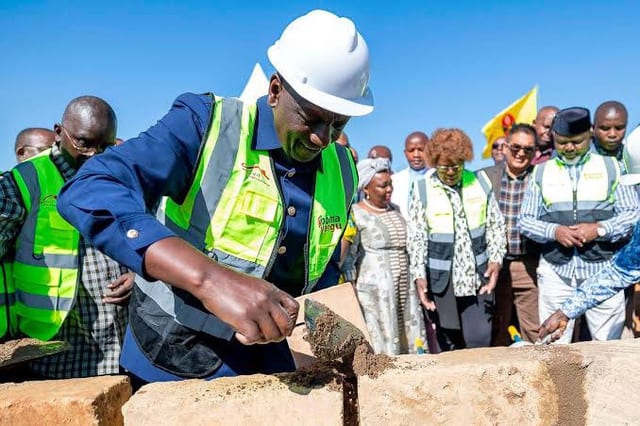
When President William Ruto launched the Affordable Housing Programme, Kenyans were told they were buying into a dream.
A chance to own decent homes. A chance to build wealth.
A chance to secure their future.
Today, thousands appear to be asking for something much simpler.
Their money back.
The latest figures tell a story the government cannot ignore.
According to official data, savers under the Boma Yangu housing scheme have withdrawn more than KSh2.7 billion, nearly half of the KSh5.4 billion that had been saved.
That is not just a financial statistic. It is a vote of no confidence.
People do not withdraw money from a programme they trust. They withdraw because confidence has been shaken.
The government says withdrawals have been driven by delays in house allocations and concerns over project delivery.
That explanation raises even bigger questions.
If Kenyans are paying into a housing scheme every month through deductions and voluntary savings, why are so many still waiting for homes?
Why are contributors withdrawing instead of waiting?
Why has confidence fallen so sharply in one of the government's biggest promises?
These questions do not stop with the Ministry of Housing.
They go all the way to the top.
President William Ruto made affordable housing one of the defining promises of his administration.
He defended the Housing Levy in public rallies, in Parliament and in court.
He repeatedly told Kenyans that the programme would create jobs, reduce the housing deficit and give ordinary families a path to home ownership.
If confidence in that programme is now weakening, the President cannot simply leave the explanation to junior officials.
He owes Kenyans answers.
Housing Cabinet Secretary Alice Wahome also has questions to answer.
Her ministry oversees implementation of the programme.
Kenyans deserve a detailed account of how many housing units have actually been completed, how many have been allocated, how many contributors have received homes and how many are still waiting.
The State Department for Housing and Urban Development should equally explain why contributors are withdrawing such significant amounts and what steps are being taken to restore confidence.
The Boma Yangu management should provide greater transparency about waiting lists, allocation criteria and project timelines.
People who have entrusted the programme with their savings deserve regular, detailed updates.
The issue goes beyond houses.
It is about trust.
Every month, millions of Kenyan workers contribute to public programmes with the expectation that government promises will be honoured.
When confidence begins to collapse, rebuilding it becomes far more difficult than collecting the money in the first place.
The government has repeatedly described affordable housing as a cornerstone of Kenya's economic agenda.
If that is true, transparency cannot be optional.
Kenyans deserve to know how much money has been collected through the Housing Levy.
How much has been spent?
Which projects are complete?
Which contractors have been paid.
How many units have been allocated.
How many contributors remain on waiting lists.
Without those answers, suspicion will continue to grow.
No flagship government programme should rely on public relations to maintain credibility.
It should rely on results.
The withdrawal of KSh2.7 billion should serve as a warning.
Confidence is far easier to lose than it is to rebuild.
President Ruto, Housing CS Alice Wahome and the officials responsible for implementing the Affordable Housing Programme now face the task of convincing Kenyans that the programme is still delivering what it promised.
Until they do, every new withdrawal will speak louder than every new government announcement.