
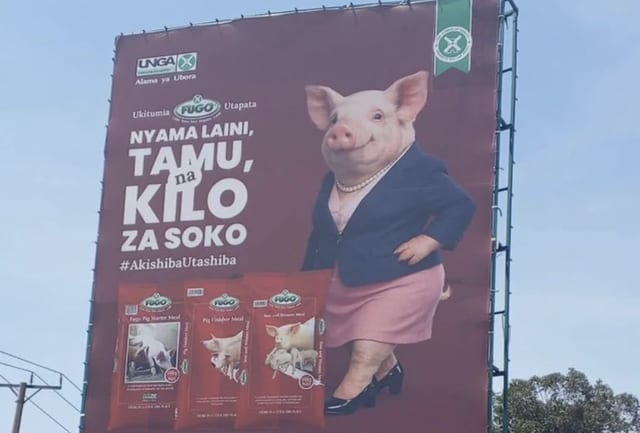
One of Kenya's oldest food and animal nutrition companies, Unga Group PLC, is facing criticism over a roadside billboard in Nyeri that some residents have described as degrading to women.
The advertisement, installed near the YMCA junction at the entrance to Nyeri Town, promotes Unga Farm Care's pig feed using the slogan "Nyama Laini, Tamu, na Kilo za Soko." The billboard features a pig standing upright and dressed in attire commonly associated with a professional woman, including a blazer, skirt, high heels, necklace and makeup.
While the campaign appears intended to portray healthy, market-ready pigs in a creative and memorable way, a section of the public says the artistic direction crossed the line by presenting a pig with distinctly feminine characteristics. They argue that the imagery is disrespectful and risks normalizing offensive stereotypes against women.
The controversy now places the spotlight on Unga Group PLC's leadership and marketing team, who bear responsibility for ensuring the company's advertising reflects not only creativity but also sensitivity to diverse audiences.
Like all advertisers in Kenya, marketing campaigns are expected to comply with the Code of Advertising Practice administered by the Advertising Standards Board of Kenya (ASBK), which promotes truthful, decent and socially responsible advertising.
Complaints relating to potentially offensive advertisements may also attract scrutiny from the Kenya Film Classification Board (KFCB) where applicable, depending on the nature and placement of the content.
Critics say the issue is not the promotion of pig farming itself, but rather the decision to anthropomorphize the animal using features traditionally associated with women.
They argue that marketers should have anticipated how such imagery could be interpreted by members of the public, particularly in a country where public advertising reaches audiences of all ages and backgrounds.
Others, however, have defended the campaign, saying the advert simply uses humour and human-like characters to market livestock products, a technique commonly employed in advertising around the world. To them, the pig is a fictional mascot rather than a representation of women, and any resemblance is incidental to the creative concept.
Whether the billboard is ultimately considered offensive is a matter of public interpretation. Nevertheless, the reaction illustrates how modern advertising campaigns can quickly become subjects of public debate when audiences perceive messaging differently from what advertisers intended. The discussion also underscores the importance of cultural sensitivity and consumer engagement in corporate marketing.
Below is the complaint received from a Nyeri resident.
Hello Nyakundi,
There is an advertisement put up by Unga Group as you enter Nyeri Town at YMCA. It is a total insult to women. A pig is depicted as a woman! Quite offensive.
I will not buy Unga Group products for the next five years unless they withdraw the advert and apologise.
See that advert for yourself. They need to be called out.
Thank you for your good work.