

Fresh questions are now being raised about labour practices at Simbisa Brands Kenya after workers accused the company of mistreatment, unexplained deductions and discriminatory implementation of the latest government-mandated wage increment.
At the centre of the complaint is a simple but disturbing question: how does an allowance suddenly become a “company advance” one month later, only for the employer to deduct it from workers’ salaries as though it was a debt? That is the issue employees say Simbisa Brands Kenya must answer.
According to the complaint, the company issued what was understood to be an allowance, then in the following month deducted the same money under the label of a “company advance.” To the affected employees, that does not look like payroll clarification. It looks like an unlawful recovery disguised as accounting language.
And that is only one part of the anger.
Workers are also questioning why the company allegedly implemented the latest government-announced salary increment selectively, giving it only to a few employees while leaving others out, and then failing to backdate it to 1st May as required by the gazetted wage order. If that account is accurate, then the issue at Simbisa is no longer just about deductions. It becomes a broader labour rights problem involving selective pay treatment, non-compliance with wage directives and a workplace culture where some employees appear to be treated as disposable.
This is the kind of complaint that should concern not only the affected staff, but also the Ministry of Labour, labour officers and any regulator serious about enforcement of wage laws in Kenya. Because once an employer starts playing games with what counts as an allowance, what counts as an advance and who qualifies for a government wage increment, the line between payroll administration and worker exploitation becomes dangerously thin.
How does an allowance become a debt overnight?
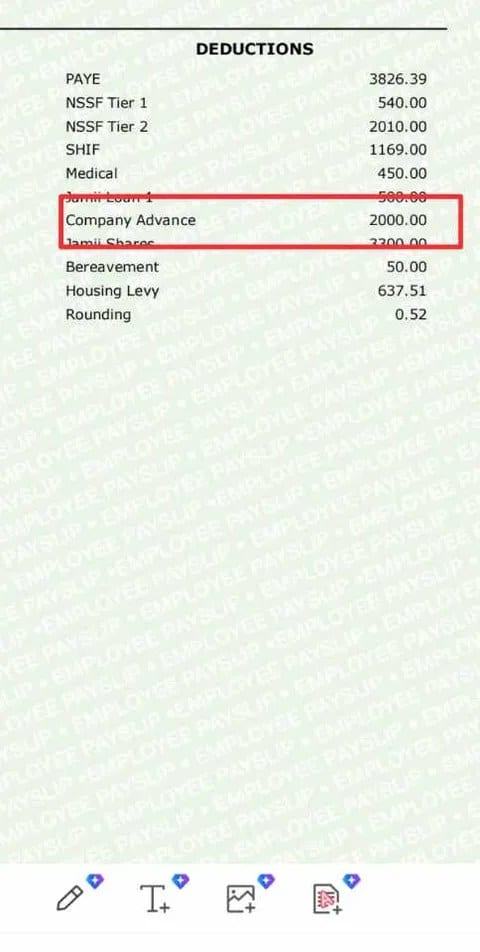
That is the first question Simbisa Brands Kenya needs to answer without corporate doublespeak.
If a payment was communicated to employees as an allowance, on what basis did the company later convert it into a company advance and recover it from staff salaries? Allowances and advances are not the same thing. An allowance is ordinarily an employer-provided payment meant to support work-related needs or compensate staff under certain circumstances. A company advance, on the other hand, is money recoverable from the employee, usually issued with a clear understanding that it will be repaid or offset.
So workers are right to ask: which one was it?
If it was truly an advance, why was it not communicated as an advance from the start? Why was it apparently paid out as an allowance only to be clawed back later? Was there written consent from the employees? Was there a payroll explanation issued before the deduction? Did staff sign any acknowledgment that the money would be recovered? Or did the company simply decide, after the fact, to rename the payment and dip into workers’ already stretched salaries?
That matters because employers do not get to play shell games with workers’ income. You cannot tell employees one month that you are giving them an allowance, then in the next payroll quietly relabel it as a recoverable debt. That is exactly the kind of conduct that leaves workers feeling cheated, cornered and powerless, especially in a labour market where many people fear speaking up because they know how easily employers can retaliate.
For workers already living month to month, a deduction like that is not a technical payroll adjustment. It is rent money. It is transport money. It is school fees. It is food. It is the difference between surviving the month and sinking into debt.
Selective wage increments raise an even bigger problem
The second complaint may be even more serious because it goes to the heart of fairness and compliance with the law.
Employees say that after the government announced a salary increment, only a few workers at Simbisa Brands Kenya received the adjustment. Others were allegedly left out completely. On top of that, the increment was reportedly not backdated to 1st May, despite the gazetted wage order requiring the new minimums to take effect from that date.
If true, then the company must explain two things.
First, why were only some employees given the increment? On what basis were others excluded? Was the wage order applied selectively depending on outlet, department, job category or management preference? If the increment was tied to statutory minimum wage adjustments, then it is not a reward scheme that management can distribute to favourites while sidelining everyone else. It is a legal wage obligation.
Second, why was the increment not backdated to 1st May? Wage orders do not become optional because a company finds them inconvenient. If the law says the revised wage floor took effect on a particular date, then employers are expected to comply from that date, including arrears where applicable. Anything less raises the obvious suspicion that workers are being shortchanged through delay, selective implementation or outright disregard of the law.
And this is where Simbisa’s labour practices deserve closer scrutiny. Because when you place the “allowance turned company advance” complaint next to the “only a few employees got the increment” complaint, a pattern begins to emerge. One complaint suggests money being taken away through questionable payroll labelling. The other suggests money being withheld through selective or incomplete application of a legal wage increase. Put the two together and workers are left with a reasonable fear that the company is not merely disorganised, but is operating a system in which payroll ambiguity and unequal treatment work against employees rather than for them.
This is bigger than one payroll dispute
What makes the complaint especially serious is that it is not being framed as a one-off error. It is being framed as part of a wider problem of employee mistreatment.
That phrase matters. Because unlawful deductions and discriminatory pay practices rarely exist in isolation. They thrive in workplaces where employees feel they cannot question management, where HR explanations are vague or dismissive, where labour rights are treated as inconveniences, and where staff are expected to absorb unfair treatment in silence because jobs are scarce and speaking up is risky.
In such workplaces, the payroll system becomes one more tool of control. A deduction appears and nobody properly explains it. A government wage increase is announced and only some people see it in their payslip. Workers ask questions and are met with indifference, hostility or bureaucratic jargon. By the time the month ends, the employee is the one left trying to decode their own salary while management behaves as though the burden of proof lies with the worker.
That is exactly why complaints like this matter. They expose not just a payroll issue, but the power imbalance at the centre of many low-wage workplaces. Employees in the food and hospitality sector are often among the most vulnerable when it comes to labour abuse. They work long hours, depend heavily on every shilling in their salary, and are frequently made to feel replaceable. Once an employer knows its workers are desperate, it becomes easier to normalise deductions, delay compliance with wage orders or quietly apply benefits to some people while denying others.
That is why Simbisa Brands Kenya cannot be allowed to brush this off as a misunderstanding. If the company wants to call itself a serious employer, it must answer clearly and publicly.
Simbisa Brands Kenya needs to explain itself
The company should be answering a straightforward list of questions.
If an allowance was paid to employees, what exactly was the nature of that allowance and why was it later treated as a company advance?
Was the payment originally described in writing as an allowance, and if so, who authorised the later deduction?
Did employees consent to the recovery of that money, and where is that consent?
If the company believed the payment was made in error, why was the burden shifted onto workers rather than addressed transparently through proper payroll communication?
On the salary increment, which categories of employees received the government-announced raise and which ones did not?
Why were some workers allegedly excluded?
Why was the increment not backdated to 1st May if that was the effective date under the gazetted wage order?
Has the company conducted a payroll audit to confirm that every eligible employee was paid the correct amount, including arrears?
These are not hostile questions. They are the minimum questions any lawful employer should be able to answer if workers are accusing it of unlawful deductions and discriminatory pay treatment.
Labour authorities should not wait to be embarrassed publicly
This is also the kind of matter that should not require workers to beg for attention online before the law moves. If there are allegations that an employer has deducted money under a questionable “company advance” label and failed to properly implement a gazetted wage increase across the board, then the Ministry of Labour, labour officers and relevant labour inspectors should be paying attention.
Kenyan labour law is not supposed to exist only on paper or in speeches during Labour Day celebrations. It is supposed to mean something in actual workplaces where salaries are processed, deductions are made and workers live with the consequences. If employers can decide that an allowance is suddenly recoverable, or that only selected employees deserve a government wage increment, then the entire point of wage protection laws begins to collapse.
And that is the bigger danger here. If this complaint is accurate and nothing happens, it sends a message to other employers that compliance is optional, that wage orders can be trimmed, delayed or selectively applied, and that workers will simply absorb the loss because they are too afraid to challenge it.
The complaint from the employees
Hello Nyakundi. Please address the issues of employees mistreatment and unlawful deduction at Simbisa Brands Kenya. Going by the memo, how does the allowance qualify as a company advance? Why did the company deduct the same as a company advance in the subsequent month? Again, only a few employees were given the salary increment announced by the government and it wasn’t backdated to May 1st as gazetted. Why does the company discriminate against other employees?
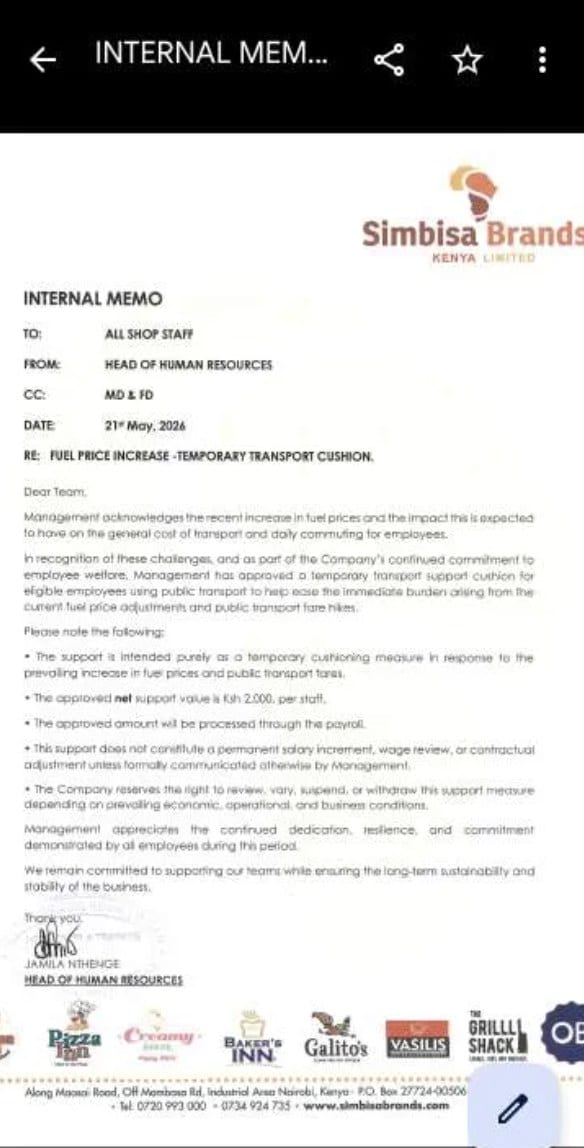
That is the complaint, and it is not a small one.
If Simbisa Brands Kenya has a lawful explanation, then it should produce it clearly: the memo, the payroll basis for the deduction, the legal justification for classifying the allowance as a recoverable advance, the criteria used in implementing the wage increment, and proof that all eligible workers received what the law required from 1st May.
But if workers were indeed given an allowance only for it to be clawed back later as a “company advance,” and if the wage increment was selectively applied while others were denied their lawful entitlement, then this is not just bad HR practice.
It is worker exploitation dressed up as payroll management.