
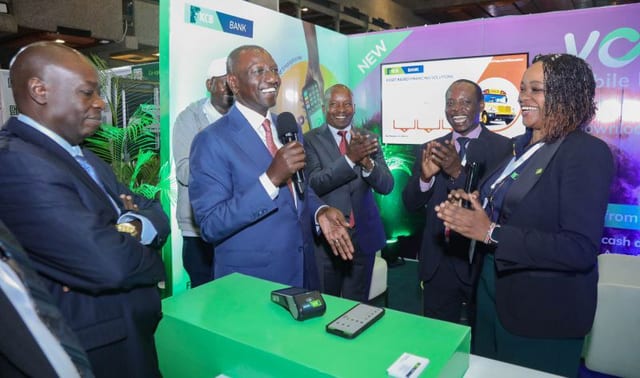
Prominent lawyer Donald Kipkorir has raised concerns over Kenya's newly introduced instant traffic fines system after a payment made for a legitimate speeding offence reflected a private individual's name instead of a government entity.
The revelation has sparked fresh questions about transparency in the collection of public revenue and whether motorists are adequately protected from fraud.
Kipkorir disclosed that his younger brother was issued with an instant traffic fine after allegedly exceeding the speed limit along the A2 road on June 17.
According to the lawyer, the offence was verified through the National Transport and Safety Authority (NTSA) portal before the payment was made at a Kenya Commercial Bank (KCB) branch, as required under the new system.
However, what happened next left him baffled.
Although the payment was processed at a KCB branch and an official receipt was issued, the M-Pesa confirmation message reportedly indicated that the money had been sent to an individual bearing the name Catherine Jerono, rather than to NTSA, the National Treasury or another government account.
The transaction has ignited debate online, with many Kenyans questioning why money collected on behalf of the government would appear to be received by a private individual.
Kipkorir has maintained that his concern is not the validity of the speeding offence itself. According to him, his brother accepted the fine after the offence appeared on the NTSA system, visited a KCB branch where the teller confirmed the fine, made the payment and received an official receipt. The issue, he argues, is why the payment confirmation identified what appeared to be a personal account holder instead of a clearly designated government collection account.
KCB's Deeper Role in the NTSA System 
KCB's role in NTSA's enforcement architecture extends far beyond receiving payments for instant traffic fines.
The bank inherited key responsibilities in NTSA's Smart Driving Licence programme after acquiring National Bank of Kenya, which had originally participated in the public-private partnership (PPP). Following Nigeria's Access Bank's acquisition of NBK, a Deed of Novation executed in February 2026 transferred NBK's obligations to KCB.
Under the revised arrangement, KCB became a commercial partner alongside the Pesa Print Consortium in a PPP that covers not only the production of Smart Driving Licences but also the infrastructure supporting NTSA's instant traffic fines programme. The National Treasury is listed as the government entity overseeing the fiscal structuring of the partnership.
That broader commercial relationship is relevant context. It does not, on its own, suggest any wrongdoing by either NTSA or KCB. However, it means KCB participates in the enforcement ecosystem as more than a neutral banking agent. As a structured commercial partner with responsibilities within the programme, questions surrounding how public money is collected, held and reconciled become matters of significant public interest.
The controversy therefore goes beyond a single M-Pesa notification. It raises broader questions about whether sufficient transparency exists in a system that millions of Kenyan motorists may eventually interact with.
Questions That Demand Public Answers 
Kenya's public finance framework generally requires that revenue collected by or on behalf of government institutions be deposited into authorised and auditable government collection accounts.
Against that backdrop, several questions remain unanswered.
If the account that appeared in Kipkorir's transaction is an authorised collection point under the NTSA-KCB arrangement, why does it display an individual's name instead of clearly identifying NTSA, KCB or the Pesa Print Consortium?
What internal controls ensure that payments received through such accounts are fully reconciled with official government revenue records?
How many instant traffic fines have been processed through similarly structured accounts since the nationwide rollout resumed on June 1?
Given that KCB is already a participant in the broader PPP underpinning the instant fines infrastructure, what safeguards exist to assure the public that every payment is fully traceable from the motorist to the government's revenue accounts?
The concerns have become even more significant as Kenya continues implementing an automated traffic enforcement system backed by more than 1,000 speed cameras across major highways.
Growing Public Anxiety 
The incident comes at a time when fraudsters have increasingly targeted motorists using fake traffic fine messages, cloned payment links and fraudulent M-Pesa requests.
Against that background, the appearance of a private name in an otherwise legitimate payment confirmation has heightened public anxiety. Many motorists say they now face an uncomfortable dilemma. Ignoring an NTSA fine notice risks additional penalties and restrictions on access to NTSA digital services, while paying requires confidence in a payment chain that has now raised questions in the public domain.
Several Kenyans have since called for Parliament, the Auditor-General and other oversight agencies to examine the payment architecture supporting the instant fines programme and determine whether existing safeguards are sufficient to protect public revenue and public confidence.
For now, neither NTSA nor KCB has publicly provided a detailed explanation addressing why an official payment generated a confirmation bearing what appeared to be an individual's name, or how such transactions are structured within the instant fines collection system.
This publication has sought comment from both NTSA and KCB Bank Kenya and will update this report should either institution respond. Motorists who have received instant traffic fines and have payment confirmations showing similar account details are encouraged to share their documentation for verification, as additional verified cases would help determine whether the incident was isolated or indicative of a broader payment architecture that warrants independent scrutiny.