
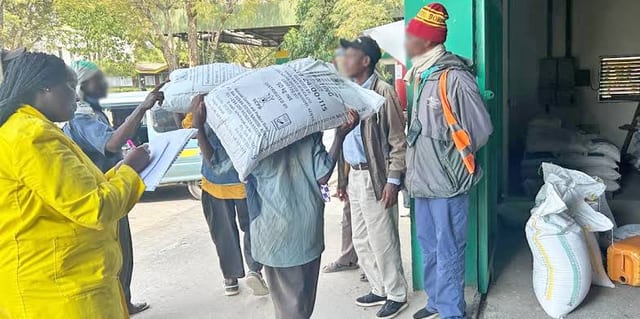
Agriculture remains the backbone of the economy in many parts of Western Kenya, with thousands of families depending on maize farming as their primary source of income. To support food production and cushion farmers against rising input costs, the government has invested heavily in fertilizer subsidy programmes aimed at ensuring affordable access to farm inputs during critical stages of crop production.
However, the success of any subsidy programme depends not only on the availability of the inputs but also on fair and transparent distribution. Whenever farmers are unable to access subsidized fertilizer while the same products allegedly appear in private hands and are resold at inflated prices, questions inevitably arise about whether the intended beneficiaries are actually receiving support.
The issue becomes particularly serious during the top-dressing season, when maize farmers require fertilizer to support crop growth and maximize yields. Delays or shortages during this period can significantly affect production, leaving farmers with lower harvests despite having invested heavily in land preparation, planting, and other inputs.
Hello Nyakundi,
Kindly hide my identity.
I would like to raise concerns about what is happening at the National Cereals and Produce Board (NCPB) depot in Bungoma.
Since late April, many of us farmers have been struggling to access top-dressing fertiliser despite repeatedly being informed that the government has continued releasing fertiliser under the subsidy programme.
What is puzzling is that whenever we visit the cereals board, we are often told that the fertilizer has not arrived yet or that we should wait for fresh stocks.
The common response is usually, "hajafika" or "subiri kidogo."
However, what many of us have observed is that the same government-branded fertilizer somehow becomes available almost immediately outside the cereals board through brokers and middlemen.
In fact, it is becoming common to find people openly selling fertilizer just outside the depot while genuine farmers are being turned away at the official distribution point.
As farmers, we find this very difficult to understand.
How can fertilizer allegedly be unavailable inside the cereals board but readily available outside through brokers?
Where are these brokers obtaining the fertilizer from?
And why are ordinary farmers being forced to buy the same subsidized fertilizer at much higher prices?
The most frustrating part is the cost.
The fertilizer being sold outside is often significantly more expensive than the subsidized government price. Many farmers end up paying as much as one-and-a-half times more simply because they have no alternative and cannot afford to wait while their crops require urgent top-dressing.
For small-scale farmers, these additional costs are devastating.
Many of us already struggle with high production costs, unpredictable weather patterns, expensive farm labour, and fluctuating market prices.
The subsidy programme was supposed to ease that burden, but what we are witnessing appears to benefit brokers more than farmers.
I have personally seen desperate farmers leave the cereals board empty-handed and then proceed to purchase what appears to be the same government-branded fertilizer from individuals operating nearby.
This has created a widespread perception among farmers that there may be collusion between certain individuals and brokers who profit from fertilizer meant for ordinary farmers.
Whether that is true or not, the authorities need to investigate and provide answers.
We are therefore appealing to the Ministry of Agriculture, the National Cereals and Produce Board, county agricultural officials, and relevant anti-corruption agencies to investigate the distribution of subsidised fertiliser at the Bungoma depot.
Farmers deserve transparency.
We deserve to know how much fertiliser has been delivered, how much has been distributed, who has received it, and why genuine farmers continue being told that stocks are unavailable while the same fertilizer allegedly appears in private hands for resale.
The subsidy programme was created to help farmers, not enrich brokers.
If these allegations are true, then the people responsible are undermining food production and exploiting hardworking farmers who are simply trying to feed their families and contribute to the country's food security.
Concerned Farmer.