
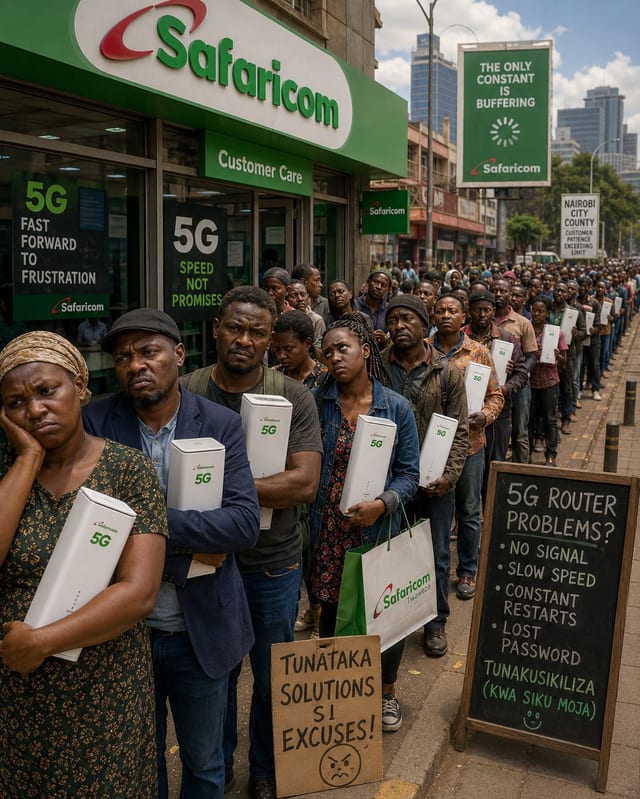
Safaricom's ambitious push into the 5G internet market is facing growing scrutiny as increasing numbers of customers complain about persistent problems affecting the company's widely marketed 5G routers.
On Monday, images circulating online showed large numbers of customers reportedly queuing outside a Safaricom outlet seeking assistance with malfunctioning Baicells-branded 5G routers, adding to a growing wave of frustration that has been building for months across social media platforms and consumer forums.
The routers, which have been heavily promoted as a fast and reliable solution for homes and businesses seeking high-speed internet connectivity, are now at the centre of mounting complaints involving signal failures, slow internet speeds, unexpected reboots, lost passwords, and repeated connectivity disruptions.
The situation has become so widespread that some customers have begun openly questioning whether the devices were adequately tested before being rolled out to the market.
"Stress Disguised as Internet" 
Popular blogger Cyprian Nyakundi amplified the complaints after sharing a photograph showing customers allegedly seeking assistance over the routers.
In one of his posts, he described the devices as "stress disguised as internet" and argued that affected customers deserved compensation for the repeated inconveniences they have experienced.
The hashtag #SafaricomMustCompensate quickly gained traction among dissatisfied users who shared their own experiences with the devices.
According to customers, the frustration extends far beyond occasional technical glitches.
Many users claim the routers repeatedly lose signal, disconnect from the network, or require frequent restarts to function properly. Others report being forced to reset passwords multiple times or make repeated visits to Safaricom customer care centres in search of solutions.
For some, what was sold as a premium internet experience has become a recurring source of stress.
The Premium Price, The Premium Expectations 
Safaricom has built its reputation over decades as Kenya's leading telecommunications provider.
As the country's largest telecom company with approximately 65 percent market share, the company enjoys a dominant position in the industry and has traditionally marketed itself as the benchmark for quality, reliability, and innovation.
That reputation is precisely why customer frustrations are attracting so much attention.
Consumers who purchase Safaricom products often do so because they expect superior service compared to competitors.
When those expectations are not met, disappointment quickly turns into anger.
Many customers argue that they are paying premium prices for products and services that no longer consistently deliver premium performance.
The 5G routers have become the latest symbol of what some users view as a broader decline in service quality.
Endless Trips to Safaricom Shops 
Among the most common complaints is the need for repeated visits to Safaricom customer care centres.
Users say they have spent considerable time travelling to outlets, waiting in queues, explaining the same issues repeatedly, and undergoing troubleshooting processes that often provide only temporary relief.
Some customers claim they have visited customer care centres multiple times for the same device without achieving a permanent solution.
Critics argue that the growing number of complaints suggests the issue may be more widespread than isolated cases of defective hardware.
Several online users have questioned why the company continues to treat the problem as individual customer issues rather than acknowledging what appears to be a recurring pattern.
Customer Care Under Pressure 
The growing backlash has also reignited criticism of Safaricom's customer support systems.
Many users claim that obtaining effective assistance has become increasingly difficult, with customers often being directed between helplines, mobile applications, websites, and physical service centres.
While Safaricom continues to encourage customers to seek support through its official customer care channels, critics argue that the company's response has not matched the scale of the complaints being raised.
For affected customers, the issue is not simply about a router.
It is about trust.
A telecommunications provider is expected to deliver reliable connectivity, particularly at a time when internet access has become essential for work, education, business, entertainment, and communication.
When that reliability disappears, the consequences are immediate.
Remote workers miss meetings.
Businesses experience disruptions.
Students struggle with online learning.
Families lose access to essential digital services.
Competitors Sensing an Opportunity
As frustrations grow, some customers have begun publicly comparing Safaricom's service to alternatives offered by competitors, particularly Airtel.
Several online users have claimed they switched providers after repeated problems with their 5G routers, while others have openly encouraged fellow consumers to explore competing options.
Although Safaricom remains Kenya's dominant telecom operator by a significant margin, growing dissatisfaction presents an opportunity for rivals seeking to capture market share.
History has shown that customer loyalty can erode quickly when consumers feel ignored or underserved.
A PR Problem Becoming a Service Problem 
Perhaps the most damaging aspect of the controversy is the perception that Safaricom's public messaging increasingly differs from customers' lived experiences.
The company frequently highlights innovation, digital transformation, network expansion, and technological leadership.
Yet many customers argue that such achievements mean little if basic service quality continues to decline.
Critics contend that no amount of corporate storytelling can compensate for unreliable products and poor customer experiences.
For years, Safaricom enjoyed a reputation for dependability that helped distinguish it from competitors.
Today, some customers believe that reputation is under threat.
The growing volume of complaints surrounding the 5G routers has become a test of whether the company is willing to acknowledge customer frustrations and implement lasting solutions.
The Demand for Accountability 
As complaints continue to spread online, affected users are increasingly calling for Safaricom to provide clear explanations regarding the recurring problems.
Many want the company to publicly address concerns about the Baicells routers, explain the cause of the reported failures, and outline the steps being taken to resolve the issues.
Others are demanding compensation for customers who have spent months struggling with devices that they say have failed to deliver the promised experience.
Ultimately, the controversy surrounding Safaricom's 5G routers goes beyond hardware failures.
It touches on customer trust, corporate accountability, and whether Kenya's largest telecommunications company is listening to the people who built its success.
Because while marketing campaigns may attract customers, it is consistent service delivery that keeps them.
And for many frustrated users currently queuing at Safaricom outlets, that is the issue that remains unresolved.